The Complete Guide to British Royal Protocol
Britain’s monarchy has long understood a truth that many modern institutions struggle to accept: power rarely survives on authority alone. It survives through atmosphere, ritual and the careful management of symbolism.
That may explain why royal protocol continues to fascinate audiences far beyond the United Kingdom itself. In an age dominated by political volatility, algorithmic outrage and relentless informality, the British Crown still operates within a world where gestures retain meaning, clothing communicates hierarchy and silence itself may carry ceremonial weight.
To dismiss royal protocol as mere etiquette would therefore be to misunderstand its purpose entirely.
Royal protocol functions as the invisible grammar of monarchy. It structures appearances, preserves continuity and transforms ordinary public acts into carefully choreographed expressions of statehood. A royal procession, a state banquet or even the placement of guests inside Buckingham Palace all belong to a broader language designed to project permanence in a century increasingly defined by instability.
The remarkable aspect is not that these traditions exist. It is that they continue to command attention in societies that supposedly abandoned rigid ceremonial culture long ago.
Yet the monarchy has always relied less upon coercion than upon performance. Its influence emerges through spectacle disciplined by tradition — an institution sustained as much by emotional imagination as by constitutional reality.
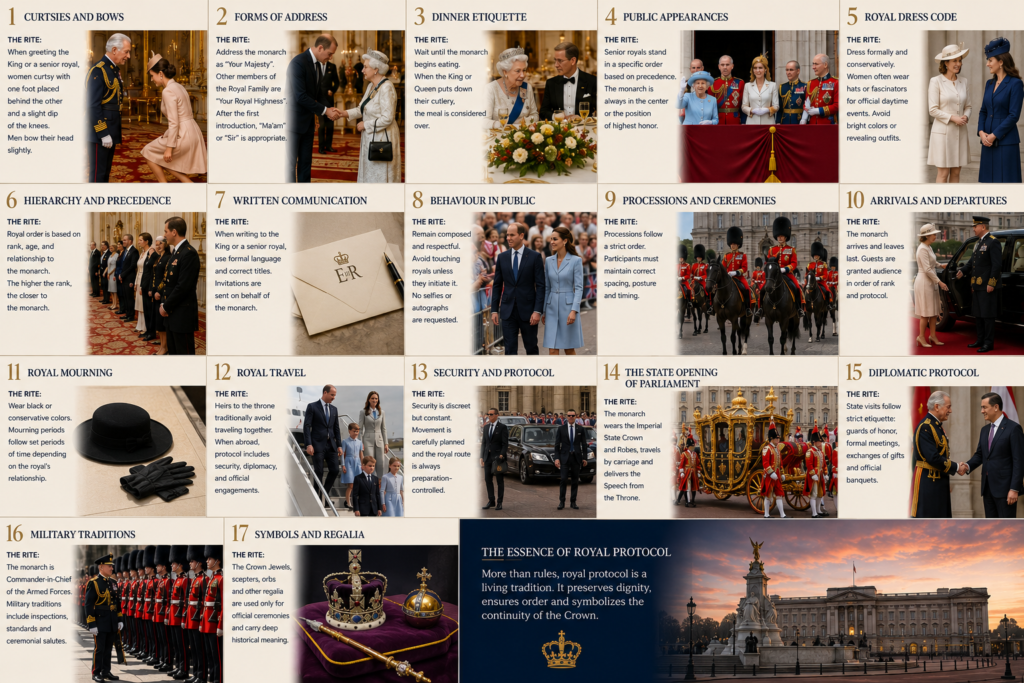
Protocol as the Architecture of Continuity
Royal protocol developed gradually across centuries of dynastic conflict, imperial expansion and constitutional evolution. Some customs trace their origins to medieval courts, where physical proximity to the sovereign could determine political fortune. Others emerged later, particularly during the Victorian era, when the monarchy increasingly reinvented itself as a symbol of national stability and moral order.
Over time, protocol became less about aristocratic vanity and more about institutional preservation.
That distinction matters.
Modern monarchies cannot rely upon political dominance in the manner of earlier centuries. Their legitimacy now depends heavily upon symbolic authority. Ceremony, therefore, becomes strategic rather than ornamental.
Why Continuity Matters
The monarchy must appear continuous even when the nation around it changes profoundly. This explains why royal institutions place extraordinary emphasis upon repetition.
Annual ceremonies, balcony appearances, military processions and formal rituals create a sense of permanence capable of surviving political transitions and generational change.
Protocol transforms continuity into something visible.
The Curious Persistence of Royal Formality
Contemporary Britain often presents itself as informal, pragmatic and socially fluid. Everyday life bears little resemblance to the rigid ceremonial world associated with palace culture.
Yet royal ritual continues to exert unusual emotional power over the national imagination.
Coronations still attract global audiences. Royal funerals suspend ordinary political rhythms. Weddings inside Westminster Abbey or St George’s Chapel generate levels of fascination that extend far beyond celebrity culture.
Why These Rituals Still Fascinate
Part of that attraction lies in contrast itself.
The monarchy offers modern audiences access to a world governed by structure and symbolism at a moment when many institutions appear increasingly transient. Protocol reassures precisely because it resists improvisation.
During moments of uncertainty, ritual creates the impression that some forms of order still endure.
Titles and the Language of Hierarchy
Few aspects of royal culture reveal the monarchy’s relationship with symbolism more clearly than titles.
Within royal institutions, titles function almost as constitutional artefacts. “Prince of Wales,” “Princess Royal” or “Duke of Edinburgh” each carry historical memory accumulated across generations.
These designations rarely concern status alone. They reflect continuity, succession and dynastic narrative.
The Symbolic Weight of Royal Titles
When Catherine became Princess of Wales, the transition immediately revived associations with Diana, public expectations surrounding the future monarchy and broader discussions about institutional evolution under King Charles III.
The monarchy understands that language itself shapes perception.
Titles therefore operate not simply as forms of address, but as instruments of historical continuity.
Curtsies, Bows and the Performance of Respect
Perhaps no tradition better illustrates the ceremonial logic of monarchy than the persistence of bows and curtsies.
No legal requirement compels individuals to perform these gestures when greeting members of the Royal Family. Yet many continue to do so voluntarily during formal encounters.
More Than Simple Etiquette
The significance lies less in submission than in participation.
Royal protocol invites individuals into a symbolic theatre where continuity momentarily becomes tangible. A slight bow of the head or carefully executed curtsy acknowledges not merely a person, but an institution positioned within centuries of national history.
The gesture survives because it creates emotional connection through ritual.
Modern politics rarely achieves the same effect.
Buckingham Palace and the Choreography of Power
Royal appearances often project effortless elegance. In reality, they depend upon extraordinary levels of planning.
Every public engagement involves carefully coordinated logistics:
- diplomatic considerations,
- security arrangements,
- visual composition,
- media positioning,
- ceremonial sequencing.
Even seemingly spontaneous interactions generally unfold within tightly controlled frameworks.
Buckingham Palace as a Symbolic Stage
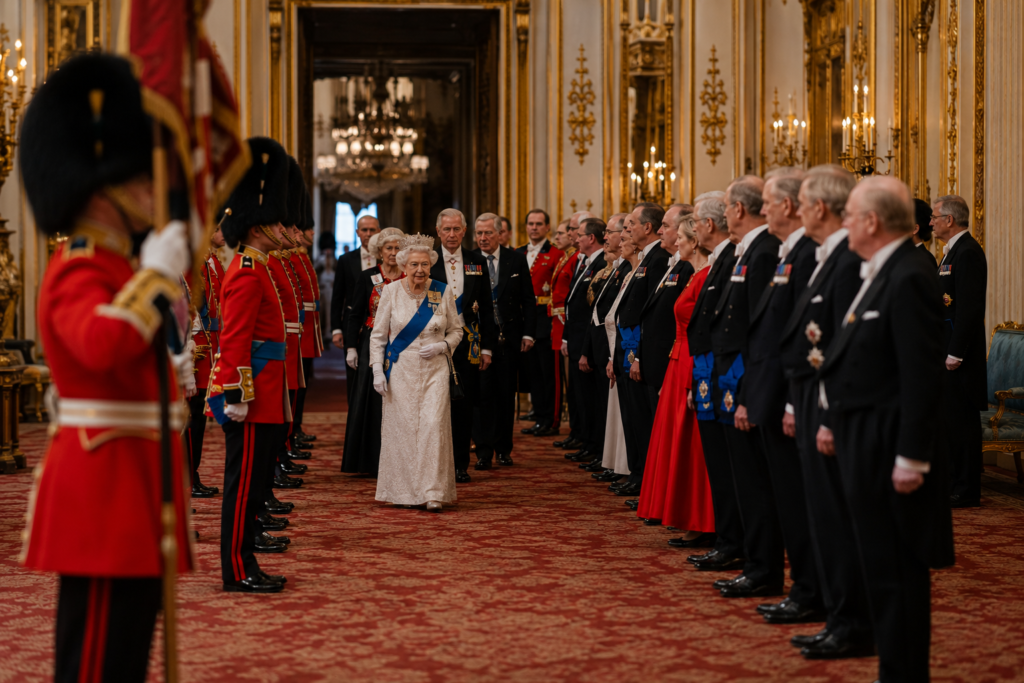
Buckingham Palace operates partly as a residence, though perhaps more importantly as a symbolic stage designed for the performance of monarchy itself.
Balcony appearances, state receptions and military ceremonies all contribute to a visual language instantly recognizable across the world.
The institution’s survival depends heavily upon maintaining that atmosphere.
Monarchy without ceremony would risk becoming administrative rather than mythic.
Royal Fashion as Diplomatic Language
Royal clothing occupies a curious place within contemporary public life. It generates endless commentary while simultaneously functioning as subtle political communication.
Queen Elizabeth II understood this dynamic instinctively. Her brightly colored coats and hats ensured visibility within large crowds while reinforcing the visual authority of the sovereign.
Catherine, Princess of Wales, has modernized the same principle through a more contemporary aesthetic blending accessibility with ceremonial elegance.
The Hidden Meaning Behind Royal Fashion
Within royal circles, clothing frequently carries layered meaning:
- diplomatic respect toward host nations,
- references to historical continuity,
- support for British designers,
- signals of mourning or celebration.
Fashion inside the monarchy rarely concerns aesthetics alone.
It functions as controlled symbolism.
The Ritual Discipline of Royal Dining
State banquets remain among the monarchy’s most revealing ceremonial environments.
At first glance, these occasions appear devoted to elegance and diplomatic hospitality. Yet beneath the polished silver and candlelit grandeur lies an invisible architecture of hierarchy.
The Invisible Rules of Royal Banquets
Seating arrangements follow precise diplomatic logic. Conversation patterns are often structured deliberately. Timing itself carries ceremonial significance.
One famous custom continues to fascinate observers: once the monarch finishes eating, the meal traditionally concludes for everyone else.
The rule may sound archaic, even theatrical. Yet monarchy depends precisely upon transforming ordinary actions into symbolic acts.
Protocol elevates dinner into performance.
Neutrality and the Constitutional Survival of the Crown
Among all royal conventions, political neutrality remains perhaps the most essential.
The monarchy’s authority depends heavily upon its ability to appear above partisan conflict. Senior royals therefore avoid explicit political commentary with extraordinary discipline.
Why Political Neutrality Protects the Monarchy
This restraint occasionally creates tension in an era increasingly shaped by public activism and instant reaction. Yet constitutional monarchy survives precisely because it occupies symbolic rather than ideological territory.
Protocol protects that ambiguity.
Once monarchy becomes politically divisive, its broader national function weakens considerably.
Mourning and the Management of National Emotion
Royal mourning reveals the monarchy at its most disciplined.
The death of Queen Elizabeth II demonstrated the extraordinary precision underlying ceremonial grief within the British state. Every detail — from public announcements and military processions to clothing expectations and ceremonial timing — unfolded according to plans refined over decades.
Ritual as Stability During Grief
The institution seeks to project continuity even in moments of emotional rupture.
This capacity partly explains why royal funerals often transcend ordinary state ceremonies. They combine personal grief, constitutional symbolism and national theatre within a single carefully managed framework.
The monarchy understands that public emotion itself may require ritual structure.
Why Royal Protocol Continues to Fascinate the World
The enduring appeal of British royal etiquette reflects something larger than curiosity about aristocratic life.
Modern societies increasingly experience politics as fragmented, temporary and emotionally exhausting. Monarchies, by contrast, project continuity through ritualized stability.
The Emotional Power of Ceremony
Their ceremonies create the impression that certain institutions remain capable of outlasting historical turbulence.
Royal protocol therefore satisfies a deeper cultural desire for permanence.
That explains why audiences continue to scrutinize:
- royal weddings,
- balcony appearances,
- coronations,
- body language,
- wardrobe symbolism,
- state ceremonies,
- succession rituals.
These events transform political continuity into visual narrative.
And human societies remain irresistibly drawn toward narrative.
The Monarchy Between Tradition and Adaptation
The contemporary Royal Family now faces a delicate balancing act.
Excessive rigidity risks making the institution appear disconnected from modern Britain. Excessive informality risks dissolving the mystique upon which ceremonial monarchy partly depends.
King Charles III and the Evolution of Royal Protocol
King Charles III appears increasingly aware of this tension. Meanwhile, Prince William and Catherine embody a more modern royal image — emotionally accessible yet still disciplined by institutional expectation.
The monarchy’s future may ultimately depend upon preserving ceremony without allowing it to harden into irrelevance.
That challenge is not uniquely British. It reflects a broader question confronting many historical institutions in the twenty-first century: how does one modernize without losing symbolic depth?
The Crown continues attempting to answer that question through protocol itself.
More Than Etiquette
British royal protocol has never merely concerned manners.
At its core, it functions as a sophisticated system for transforming abstract constitutional ideas into emotionally resonant public rituals.
Through hierarchy, repetition and symbolism, the monarchy creates the impression of continuity across generations separated by political upheaval, cultural transformation and technological revolution.
The Last Great Ceremonial Monarchy
That illusion remains extraordinarily powerful.
Long after the decline of imperial Britain and the erosion of traditional aristocratic society, the Crown still commands global fascination through the disciplined performance of ceremony.
Inside Buckingham Palace, protocol continues to serve its oldest purpose.
It makes permanence visible.
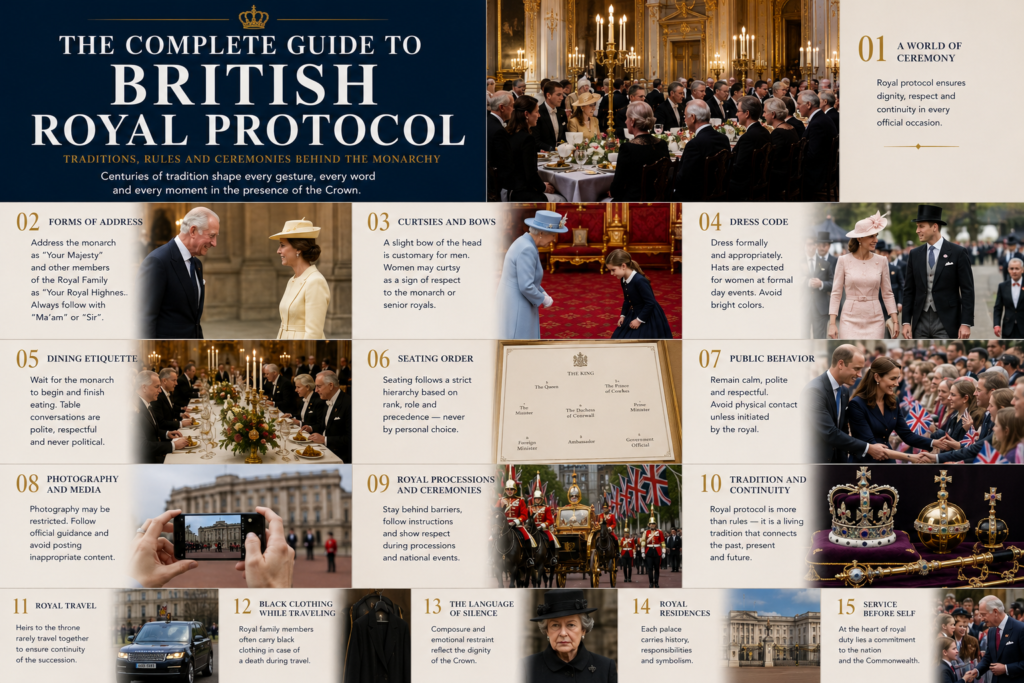
Protocol as the Architecture of Continuity
Buckingham Palace and the Language of Ceremony
The Gold State Coach
The Moving Symbol of Britain’s Royal Ceremony
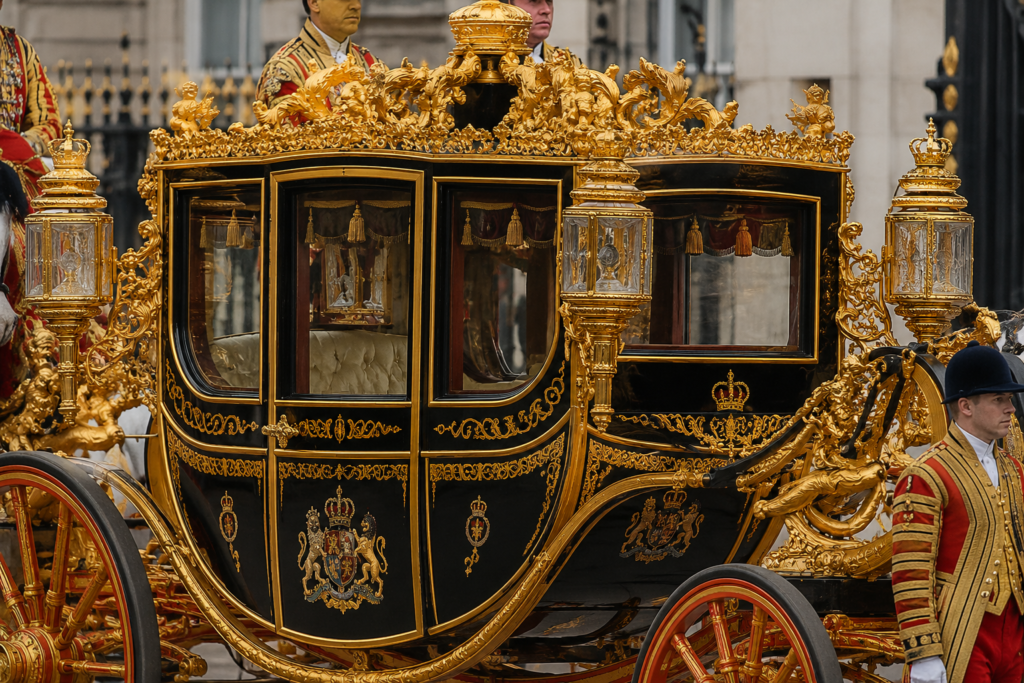
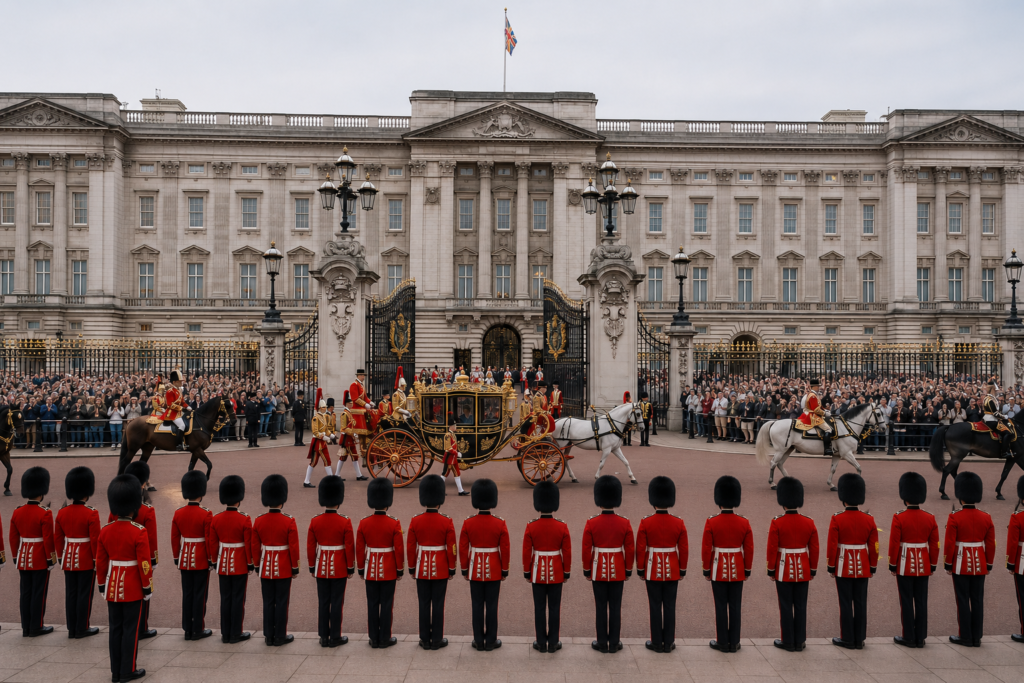
Few objects associated with the British monarchy capture the imagination quite like the Gold State Coach.
The moment it appears outside Buckingham Palace, surrounded by scarlet uniforms, mounted guards and the slow rhythm of ceremonial procession, the atmosphere changes instantly. London no longer feels entirely modern. The scene begins to resemble something suspended between history, theatre and national ritual.
For many spectators, the carriage seems almost unreal at first sight — an enormous golden structure emerging from another century and somehow still moving through the heart of contemporary Britain.
That impression is precisely what gives the Gold State Coach its extraordinary power.
A Carriage Built for Majesty Rather Than Comfort
The Gold State Coach was commissioned in the eighteenth century for King George III and completed in 1762. From the very beginning, it was designed to impress rather than comfort.
Everything about it reflects excess and symbolism:
- the gilded panels,
- the sculpted cherubs,
- the painted allegories,
- the elaborate carvings,
- the monumental proportions.
Even today, its size remains astonishing.
The coach weighs several tons and stretches across the road with the imposing presence of a moving palace room. It was built during a period when monarchies still expressed authority visually, through spectacle, ornament and ceremony.
Britain understood that power had to be seen before it could be felt.