Inside Buckingham Palace: The Rules That Govern Royal Life
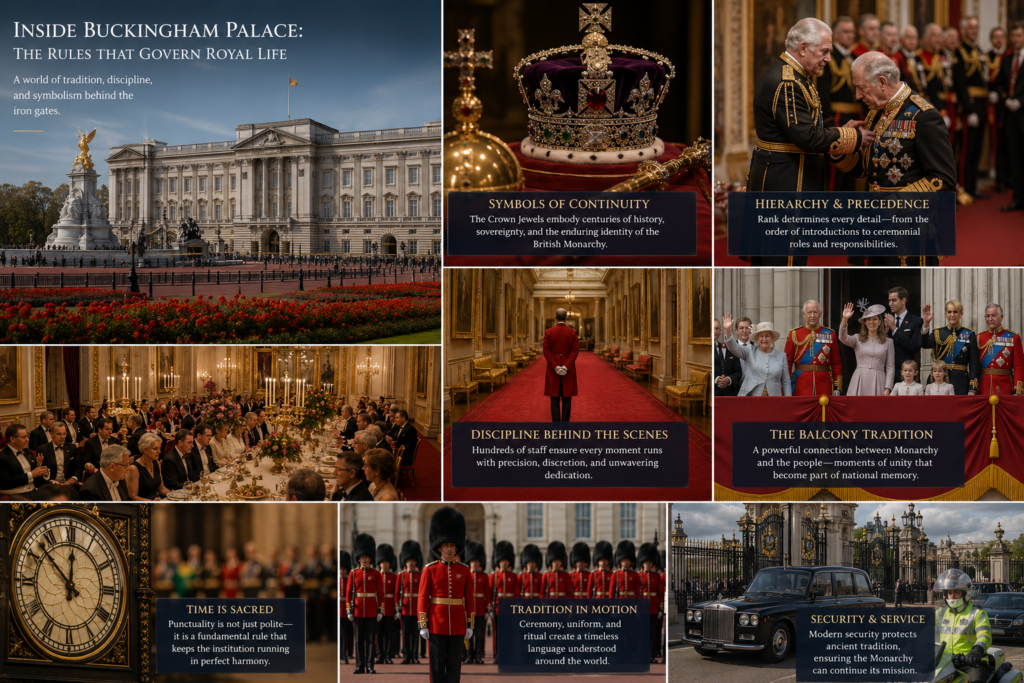
Few buildings in the modern world embody the language of power quite like Buckingham Palace. Beyond its iron gates unfolds a universe shaped by ritual, hierarchy, silence, and historical continuity — a world where symbolism still governs public life with remarkable precision.
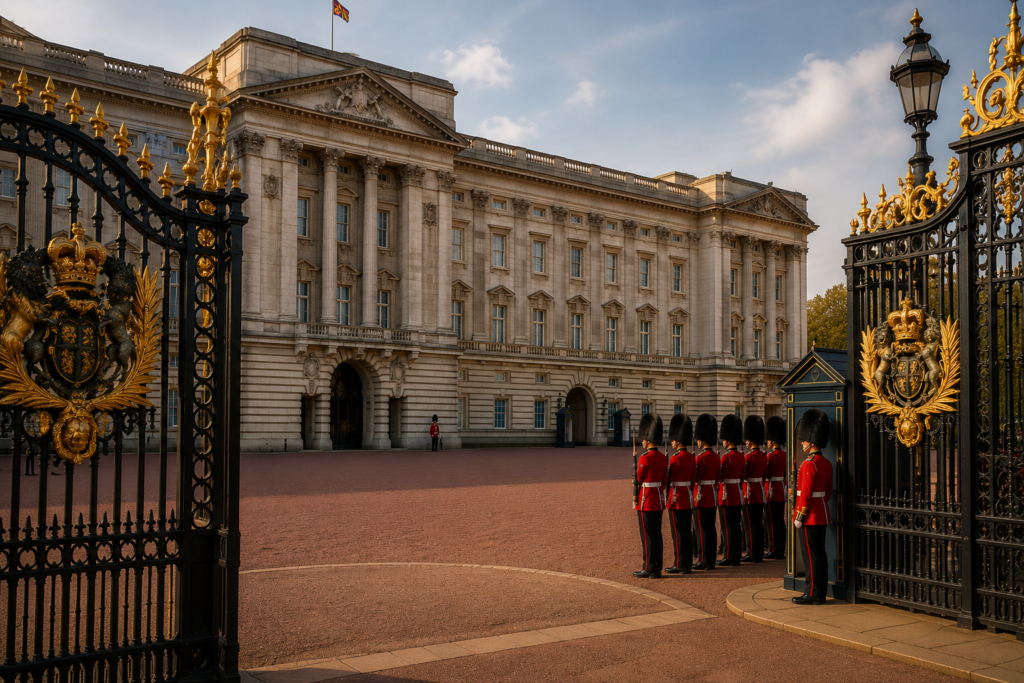
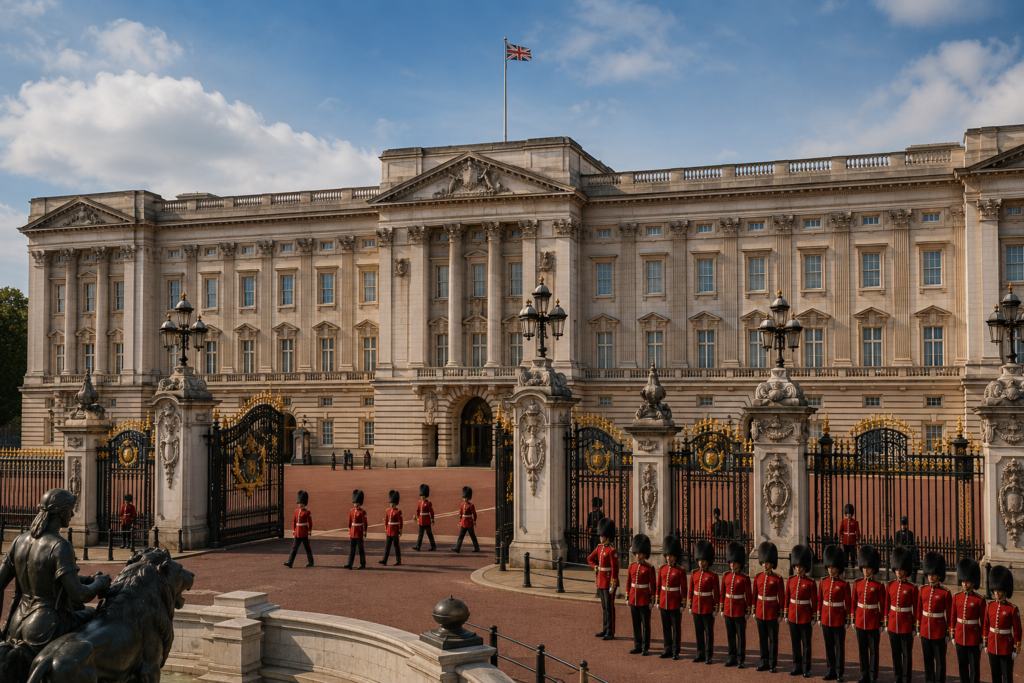
To the millions who gather each year along The Mall, Buckingham Palace represents splendour, monarchy, and ceremonial Britain. The scarlet uniforms of the guards, the measured cadence of military processions, the balcony appearances watched across continents, and the imposing neoclassical façade all contribute to an image deeply rooted in the British imagination. Yet behind this public spectacle lies something far more sophisticated than royal pageantry alone.
Buckingham Palace functions simultaneously as a constitutional nerve centre, a diplomatic theatre, a royal residence, and one of the most carefully choreographed institutions in Europe. Within its corridors, tradition is not decorative. It is structural.
Every movement carries meaning.
Every sequence follows protocol.
Every ceremony reinforces continuity.
The palace survives because it transforms discipline into symbolism.
The Palace as a Theatre of State
Public imagination often reduces Buckingham Palace to a luxurious residence occupied by the royal family. The reality is considerably more complex.
The palace operates with the rhythm of a state institution. Diplomatic receptions, audiences with ministers, ceremonial investitures, military briefings, official banquets, charity engagements, and constitutional rituals unfold continuously behind its guarded façade.
Its dimensions alone reveal the scale of the institution:
- more than 700 rooms,
- dozens of administrative offices,
- state apartments,
- private royal quarters,
- diplomatic salons,
- ceremonial galleries,
- and vast operational spaces hidden from public view.
Within these walls, hundreds of individuals contribute daily to the functioning of the monarchy:
- equerries,
- diplomatic advisers,
- ceremonial officers,
- archivists,
- security personnel,
- military aides,
- private secretaries,
- and household staff whose work remains largely invisible to the outside world.
The elegance visible during royal ceremonies conceals an extraordinary degree of organisation.
Buckingham Palace projects serenity because complexity is meticulously managed behind closed doors.
Hierarchy: The Invisible Architecture of Royal Life
Inside palace culture, hierarchy is neither incidental nor symbolic alone. It constitutes the organising principle of royal life itself.
Precedence governs:
- official entrances,
- seating arrangements,
- diplomatic introductions,
- ceremonial positioning,
- speaking order,
- and even the choreography of processions.
The monarchy’s institutional culture depends upon clarity of rank because protocol eliminates ambiguity. In diplomatic environments, ambiguity can quickly become political.
Members of the royal family themselves operate within this carefully structured framework. Senior royals carry constitutional visibility and representational responsibilities vastly different from those assigned to junior members of the institution.
This discipline became inseparable from the reign of Queen Elizabeth II, whose devotion to protocol shaped the atmosphere of Buckingham Palace for more than seven decades. Diplomats, ministers, and foreign dignitaries frequently remarked upon the precision with which ceremonial details were observed under her reign.
Her understanding of monarchy rested upon a simple principle: institutions endure through consistency.
That philosophy still permeates palace culture today.
The Monarchy’s Quiet Obsession With Time
Within Buckingham Palace, punctuality possesses almost ceremonial importance.
Royal schedules operate according to an exactitude more commonly associated with military institutions than domestic life. A state banquet, an audience with the Prime Minister, a diplomatic reception, or a ceremonial departure unfolds through sequences timed with extraordinary care.
This precision reflects necessity rather than rigidity alone.
A single royal appearance may involve:
- palace staff,
- police coordination,
- intelligence services,
- military units,
- diplomatic delegations,
- media organisations,
- transportation logistics,
- and government representatives.
One delayed movement can ripple across an entire chain of operations.
Yet the public rarely perceives this machinery. Royal ceremonies appear calm precisely because unpredictability is rigorously controlled beforehand.
Buckingham Palace has elevated preparation into an art form.
Silence as a Form of Institutional Power
Modern public culture rewards immediacy. Royal institutions, by contrast, continue valuing restraint.
Inside Buckingham Palace, discretion remains among the most deeply rooted traditions of all.
For generations, palace staff members operated according to an unwritten understanding that private conversations, internal tensions, diplomatic exchanges, and personal matters remain shielded from public exposure. Loyalty within royal service has historically been measured as much through silence as through efficiency.
This culture reflects more than tradition alone. It protects the monarchy’s symbolic authority.
The institution survives partly because it preserves a distinction between public representation and private reality. Unlike political leaders whose legitimacy depends upon constant visibility, monarchy derives part of its mystique from controlled distance.
Even during moments of intense controversy, Buckingham Palace frequently favours measured silence over emotional reaction.
In the age of permanent commentary, restraint itself has become a rare form of power.
Dining at Buckingham Palace: Diplomacy Beneath the Chandeliers
State banquets at Buckingham Palace belong among the most sophisticated ceremonial rituals in modern diplomacy.
Beneath towering chandeliers and gilded ceilings, political symbolism unfolds through extraordinary attention to detail:
- seating placement,
- diplomatic precedence,
- table arrangement,
- ceremonial entrances,
- orchestral timing,
- and synchronized service all contribute to the atmosphere.
Guests traditionally begin dining only after the sovereign has started. Conversations follow subtle conventions intended to preserve equilibrium among political leaders, ambassadors, ministers, and distinguished guests.
Nothing is entirely accidental.
Even floral compositions, menu selections, and wine pairings may contain discreet references to the visiting nation or the diplomatic relationship being celebrated.
Within Buckingham Palace, hospitality itself becomes an instrument of statecraft.
The monarchy’s influence increasingly resides not in executive power, but in symbolic prestige and diplomatic atmosphere.
Dress Codes and the Discipline of Representation
Royal appearance remains governed by an intricate visual language.
Within palace life, clothing communicates continuity, mourning, hierarchy, military affiliation, diplomatic respect, and institutional dignity. Every major ceremonial occasion carries distinct sartorial expectations.
State banquets preserve the tradition of white tie attire, tiaras, decorations, and military uniforms. During periods of national mourning, strict conventions surrounding black attire reinforce solemnity and collective respect.
Royal women, particularly during foreign visits, frequently employ fashion diplomatically:
- colours associated with host nations,
- historic jewellery,
- Commonwealth designers,
- or symbolic accessories linked to bilateral relationships.
Such details may appear subtle, yet within diplomatic culture symbolism carries immense significance.
Buckingham Palace understands profoundly that images shape political memory.
The Balcony: A Stage Above the Nation
Few architectural spaces possess the emotional resonance of the Buckingham Palace balcony.
It has witnessed:
- royal weddings,
- coronation celebrations,
- wartime appearances,
- jubilees,
- and moments of national mourning.
For Britain, the balcony functions almost as a ceremonial bridge between monarchy and people.
Every appearance follows carefully considered choreography. Positioning reflects hierarchy. Visibility reflects institutional priorities. Even the sequence of arrival may carry symbolic interpretation.
Yet despite this precision, the emotional effect often appears remarkably human.
Families gather below.
Flags rise across The Mall.
Crowds cheer not merely individuals, but continuity itself.
These balcony appearances endure because they transform monarchy into collective national theatre.
Security Behind the Grandeur
The tranquillity projected by Buckingham Palace conceals one of the most sophisticated security operations in Britain.
Visible guards outside the gates represent only the ceremonial surface of a far more extensive system involving:
- intelligence coordination,
- surveillance infrastructure,
- cybersecurity operations,
- diplomatic protection,
- controlled access zones,
- and highly rehearsed emergency planning.
Royal movements undergo extensive preparation before public appearances occur. Routes, timings, vehicle positioning, and ceremonial transitions are evaluated with meticulous care.
Modern monarchy survives through an unusual alliance:
ancient ritual supported by contemporary operational precision.
The Challenge of Remaining Timeless in a Restless Century
Under King Charles III, Buckingham Palace continues navigating a delicate balance between continuity and adaptation.
Contemporary audiences demand greater accessibility from public institutions. Digital communication, live broadcasts, social media visibility, and direct engagement have transformed expectations surrounding royal life.
Yet the monarchy understands that excessive familiarity risks weakening the symbolic distance upon which royal mystique partly depends.
This tension defines modern palace strategy.
Adapt carefully enough to remain relevant.
Preserve enough ritual to remain exceptional.
Buckingham Palace continues embodying that balance with remarkable discipline.
Why Buckingham Palace Continues Fascinating the World
The enduring fascination surrounding Buckingham Palace extends beyond luxury, celebrity, or tourism. The palace represents one of the last great ceremonial institutions still capable of transforming tradition into living political symbolism.
In an era dominated by immediacy, the monarchy offers continuity.
In a culture shaped by constant exposure, it preserves mystery.
In political systems increasingly marked by volatility, it projects permanence.
That is ultimately why the palace still captivates global audiences.
Not because Britain remains trapped in the past, but because within Buckingham Palace survives an extraordinarily refined understanding of how ritual, symbolism, and institutional discipline can continue shaping national identity long after empires, governments, and political generations have faded into history.