British Royal Etiquette Explained: The Traditions That Still Shape the Monarchy
The British monarchy survives in an age that no longer naturally favours inherited institutions. Parliament governs, elected ministers hold executive power, and public scrutiny reaches every ceremonial gesture within seconds. Yet the Crown continues to command fascination across continents. Part of that endurance rests upon something less tangible than constitutional law: ritual.
Royal etiquette, often dismissed abroad as theatrical pageantry, forms one of the monarchy’s most sophisticated instruments of continuity. Beneath the polished carriages, carefully choreographed processions, and restrained palace language lies a centuries-old system designed to preserve hierarchy, symbolism, and national memory. In Britain, ceremony rarely exists for ornament alone. It serves as political theatre with historical depth.
From the measured silence of a state banquet to the precise order of a royal procession, etiquette remains one of the monarchy’s quietest yet most enduring forms of power.
Why British Royal Etiquette Still Matters
Modern Britain presents itself as pragmatic, democratic, and socially fluid. Yet the monarchy operates according to codes that would appear almost medieval in many republics. That contradiction partly explains its durability.
Royal etiquette creates distance without entirely severing connection. The institution must remain visible enough to feel relevant, yet elevated enough to preserve mystique. Protocol fills that space.
The fascination surrounding royal customs intensified during the reign of Queen Elizabeth II, whose extraordinary consistency transformed ceremonial discipline into a symbol of stability. Her public appearances rarely departed from protocol, even during moments of national crisis. In doing so, she reinforced the idea that the monarchy represented permanence beyond politics.
Today, under King Charles III, etiquette continues to evolve carefully rather than disappear. The institution understands that abandoning ritual altogether would weaken the very distinction that justifies its existence.
The Language of Royal Greetings
Few aspects of royal etiquette generate more curiosity than greetings.
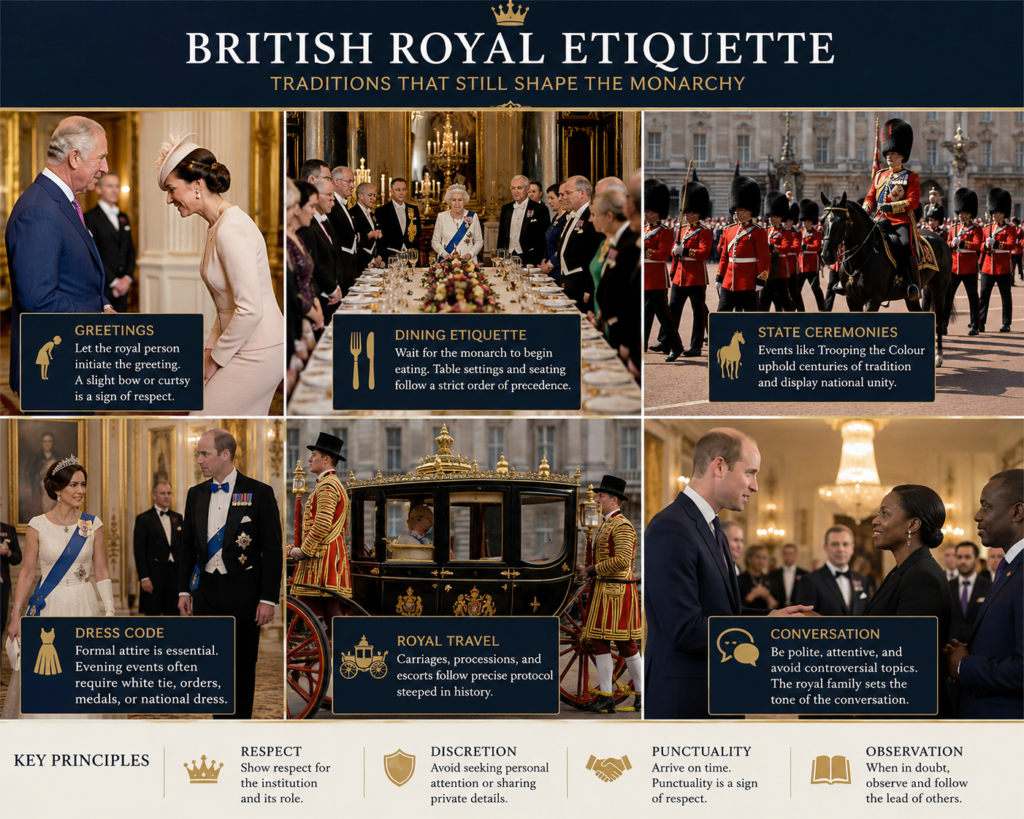
Contrary to popular belief, British law does not require subjects or foreign visitors to bow or curtsy before members of the royal family. The gesture remains voluntary. Nevertheless, during formal audiences or diplomatic receptions, many guests still observe the tradition as a mark of institutional respect.
Men traditionally perform a slight bow of the head. Women may offer a curtsy. Foreign heads of state often adapt according to their own diplomatic customs.
Protocol also shapes conversation. Royal figures generally initiate handshakes and open exchanges themselves. During official encounters, etiquette discourages overly familiar behaviour, unsolicited physical contact, or excessively personal questions.
This carefully maintained restraint contributes to the monarchy’s aura. Distance, in royal culture, communicates dignity.
Buckingham Palace and the Choreography of Ceremony
Few buildings embody ceremonial monarchy more vividly than Buckingham Palace. Far beyond its role as a royal residence, the palace functions as a stage upon which constitutional symbolism unfolds.
State banquets illustrate the precision of royal protocol. Seating arrangements follow diplomatic hierarchy with remarkable attention to detail. Political leaders, ambassadors, royals, military officials, and distinguished guests occupy positions determined by rank and convention rather than personal preference.
Even dining follows established rhythms:
- Guests wait for the monarch to begin eating.
- Courses proceed according to strict service order.
- Conversation etiquette discourages monopolising discussion.
- Staff movements remain discreet and synchronised.
Silverware, uniforms, chandeliers, and heraldic displays contribute to an atmosphere intended to project continuity rather than luxury alone.
The effect resembles carefully directed theatre, though with constitutional significance attached to every gesture.
The Hidden Political Function of Royal Etiquette
Royal etiquette performs a diplomatic function often underestimated outside Britain.
When foreign leaders attend ceremonies at Buckingham Palace or Windsor Castle, protocol becomes part of statecraft. Processions, military honours, carriage routes, and banquet rituals communicate respect, prestige, and political symbolism without explicit negotiation.
The monarchy’s ceremonial sophistication remains one of Britain’s most effective soft-power assets.
State visits illustrate this clearly. A carefully planned reception may include:
- Military salutes
- National anthems
- Historic carriage processions
- Banquet speeches
- Cultural references tailored to the visiting nation
- Symbolic gifts reflecting diplomatic history
Such rituals strengthen relationships through symbolism rather than policy. In diplomacy, atmosphere often matters almost as much as substance.
Dress Codes and the Symbolism of Royal Fashion
Clothing within royal culture rarely serves purely aesthetic purposes.
Ceremonial dress communicates hierarchy, mourning, celebration, military affiliation, or constitutional role. During major state occasions, uniforms and garments often contain historical references extending back generations.
At royal funerals, black attire follows highly codified expectations. During coronations or parliamentary ceremonies, robes and insignia reinforce institutional continuity dating back centuries.
Royal women frequently use fashion diplomatically as well. Colours, national designers, and symbolic accessories may subtly acknowledge host countries during overseas tours.
British royal fashion therefore operates as visual diplomacy.
Trooping the Colour and the Survival of Ritual Britain
Among the clearest examples of living royal ceremony stands Trooping the Colour.
Originally linked to battlefield traditions, the event evolved into the monarch’s official birthday celebration. Soldiers parade through London in immaculate formation while mounted regiments, military bands, and royal carriages create one of Europe’s most recognisable ceremonial spectacles.
To outside observers, the display may appear almost theatrical in scale. Yet for many Britons, such rituals provide continuity within a rapidly changing society.
The monarchy understands this instinctively. Ritual reassures because repetition suggests stability.
How the Modern Royal Family Adapted the Rules
The survival of the monarchy has depended partly upon selective flexibility.
Rigid Victorian formality softened during the late twentieth century as media culture transformed public expectations. Members of the royal family gradually adopted more approachable public behaviour during charity visits, walkabouts, and televised appearances.
Figures such as Diana, Princess of Wales accelerated that transformation dramatically. Her willingness to engage emotionally with crowds altered perceptions of royal distance forever.
More recent generations continue balancing accessibility with tradition. Informal photographs, social media communication, and modernised public engagements coexist alongside centuries-old ceremonial obligations.
The monarchy’s challenge lies precisely there: adapting without appearing ordinary.
Royal Etiquette in a Digital Age
Modern technology complicates traditional protocol.
Smartphones transformed royal appearances into global media events. A single awkward gesture during a diplomatic reception may circulate internationally within minutes. Etiquette therefore functions partly as risk management.
Palace staff carefully coordinate:
- Public entrances
- Greeting sequences
- Seating arrangements
- Press positioning
- Symbolic gestures
- Timing of appearances
The institution understands that ceremonial coherence contributes directly to public legitimacy.
In the digital era, symbolism travels faster than policy.
Why the World Remains Fascinated by British Royal Traditions
The endurance of British royal etiquette reflects more than curiosity about aristocratic customs. It reveals a broader fascination with continuity itself.
Modern societies change rapidly. Political cycles shorten. Public figures rise and disappear with extraordinary speed. Against that backdrop, the British monarchy projects an image of historical permanence.
Ceremony reinforces that perception.
Whether during a coronation at Westminster Abbey, a diplomatic banquet at Buckingham Palace, or the solemn precision of a royal funeral procession, etiquette transforms institutional survival into visual narrative.
The monarchy’s rituals continue shaping Britain’s national identity precisely because they connect the present to a carefully preserved past.
That may ultimately explain why royal etiquette still matters in the twenty-first century. In an age increasingly defined by immediacy, the Crown continues to derive authority from patience, continuity, and the enduring power of ritual itself.