National Anthem of Morocco: A Sound That Carries History, Pride, and Public Emotion
Some national anthems remain confined to ceremony. They appear on official calendars, mark diplomatic occasions, and then fade back into protocol. Morocco’s national anthem feels different. It lives in institutions, certainly, yet it also lives in memory, in schools, in football stadiums, in national celebrations, and in the emotional reflexes of ordinary people. It is one of the Kingdom’s official emblems, alongside the flag and coat of arms, which already says something important about its symbolic weight in Moroccan public life.
What gives the Moroccan anthem its staying power is not only its melody or its words. Its real force comes from repetition across generations. A child hears it early. A student stands for it. A citizen encounters it at moments of solemnity or collective joy. A member of the diaspora may hear it abroad and suddenly feel distance collapse into memory. Over time, the anthem becomes more than a composition. It becomes a national language of feeling.
An Anthem Known as the Cherifian Anthem
Morocco’s national anthem is widely known as the Cherifian Anthem, or in Arabic, an-Nashid al-Watani al-Maghribi. The melody was composed by Léo Morgan in 1952, and it remained in use when Morocco regained independence in 1956. The lyrics were added later, in 1970, by the Moroccan poet Ali Squalli Houssaini.
That chronology gives the anthem a distinctive place among national symbols. It did not emerge in one single historical instant, complete and finished from the start. It took shape in stages. First came the music, already solemn and recognisable. Later came the words, which gave the anthem a fuller patriotic identity. That gradual formation is part of what makes it interesting. The anthem was not simply declared. It was formed, refined, and then absorbed into national life.
This layered background also reflects Morocco’s twentieth-century journey. The country moved through protectorate rule, independence, state-building, and the consolidation of modern national symbols. The anthem stands at the intersection of those developments. It carries traces of history, while speaking in the language of unity and sovereignty.
A Melody Before Words
There is something striking about the fact that the melody came first. Even without lyrics, music can shape ceremony. It can impose silence, gather attention, and create posture. Morocco’s anthem did that before its present words were added. The melody already possessed a formal, dignified, public character. It sounded like a state symbol before it became complete in the way people know it today.
That matters because music often does the first emotional work of an anthem. Before people analyse the meaning of the text, they react to rhythm, tempo, and atmosphere. Morocco’s anthem has that ceremonial firmness one expects from a national composition. It rises with discipline. It does not drift. It does not hesitate. It announces itself.
Many official songs sound correct without sounding memorable. Morocco’s anthem avoids that trap. It has enough gravity to suit formal state occasions, yet enough emotional clarity to remain accessible in popular settings. That balance is rare. It helps explain why the anthem can feel equally natural in a diplomatic ceremony and in a crowded stadium full of supporters singing from the heart.
The Arrival of the Lyrics in 1970
When Ali Squalli Houssaini wrote the lyrics that were adopted in 1970, he gave the anthem its verbal soul. His text elevated the anthem from a ceremonial melody to a fully articulated declaration of attachment, honour, and patriotic commitment.
The language of the anthem is elevated, but it is not emotionally distant. It speaks of freedom, radiance, glory, response, devotion, and sacrifice. It presents Morocco as a homeland worthy of loyalty and active service. The text does not describe the nation in cold, abstract terms. It addresses it with warmth and resolve. The speaker is not detached from the homeland. The speaker belongs to it, answers its call, and carries it physically and spiritually.
This is one reason the anthem continues to resonate even among those who do not know every line perfectly. Its emotional direction is clear. It moves from praise toward commitment. It gathers dignity and then turns it into action. It does not merely admire Morocco. It pledges itself to Morocco.
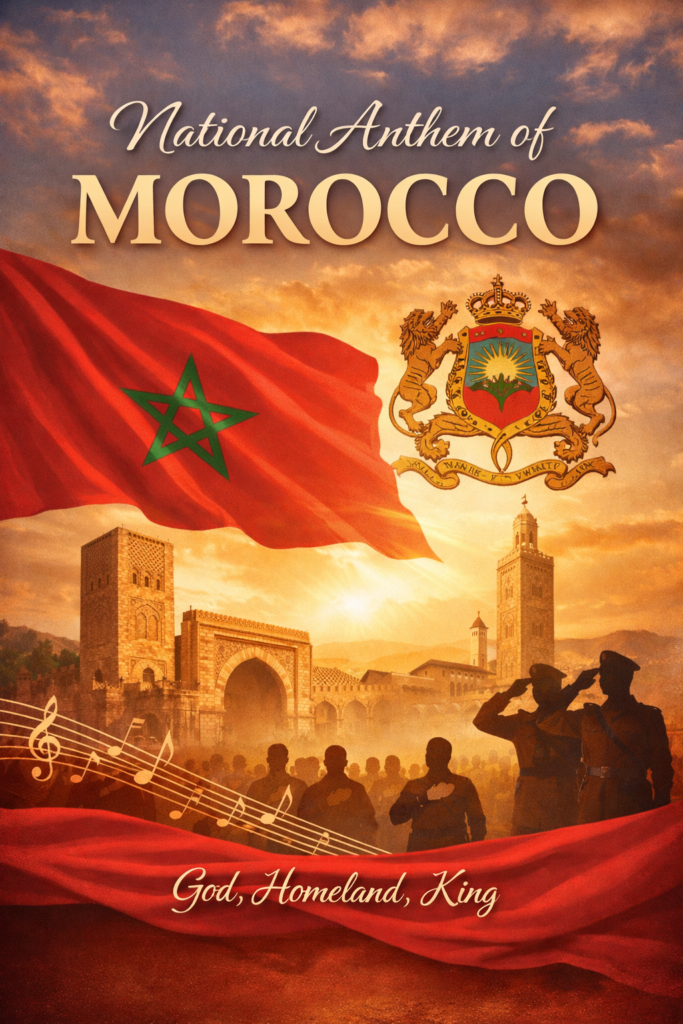
The well-known concluding motto, God, Homeland, King, gives the anthem its unmistakable political and symbolic architecture. That final line condenses a broad vision of Moroccan national identity into a short, memorable formulation.
Why the Words Still Feel Powerful
An anthem survives when its text remains larger than its era. Morocco’s anthem still feels alive because its message rests on enduring themes rather than temporary slogans. Honour, unity, loyalty, sacrifice, belonging, and national elevation remain intelligible across generations. The style is formal, but the sentiment is human.
That is why the anthem can mean different things to different listeners without losing coherence. For one person, it may evoke school mornings. For another, royal ceremonies. For another still, the World Cup, international football, and the charged stillness just before a match begins. For Moroccans living abroad, it may carry homesickness, memory, and the sudden return of emotional proximity.
In that sense, the anthem is not static. The text stays the same, yet the experiences attached to it continue to multiply. Each generation inherits the same song, then fills it with its own moments.
The Anthem in Public Life
In Morocco, the anthem is not an obscure symbol tucked away behind official protocol. It is present in civic life. It appears at public ceremonies, educational settings, diplomatic events, and moments of national visibility. That repeated use gives it social depth. People do not know it only because the state recognises it. They know it because they have heard it throughout life.
This constant presence matters. National symbols become meaningful through use. A flag gains force when it is seen again and again. An anthem gains force when it is heard in moments that matter. That is exactly what has happened in Morocco. The anthem is part of the national soundscape. It enters childhood, adulthood, public institutions, and moments of collective emotion.
In schools, it can function as an introduction to civic consciousness. In official settings, it marks continuity and legitimacy. In international contexts, it becomes the audible form of sovereignty. It says, in effect, that the nation is present here, recognisable, and represented.
A Stadium Anthem, A Shared Emotion
Few places reveal the emotional life of a national anthem more clearly than a football stadium. In Morocco, that truth has become especially visible in recent years. When the anthem is played before an international match, it can transform the atmosphere instantly. The crowd rises. Scarves lift. Voices swell. Faces change. For a brief moment, thousands of individual emotions align.
What is striking in those moments is the anthem’s double role. It remains a formal national symbol, yet it also becomes intensely personal. Supporters are not simply observing protocol. They are feeling the anthem. They project hope, pride, anxiety, belonging, and expectation into it. The song becomes a vessel for all of that.
This may be where many younger people now experience the anthem most vividly. Not only in school or ceremony, but in sport, where national identity becomes visible, dramatic, and collective. The anthem, in that setting, stops being something merely respected. It becomes something lived.
More Than Protocol for Moroccans Abroad
For Moroccans living outside the country, the national anthem often acquires another layer of meaning. Distance changes symbols. What feels familiar at home can feel piercingly emotional abroad. A melody heard in another country can reopen a sense of origin in seconds.
For members of the diaspora, the anthem may stand for family memory, language, travel, return, and continuity. It can evoke the homeland not as an abstract state, but as a lived inheritance. This is one reason national anthems often feel strongest far from home. They gather identity into a form that can be heard instantly, without translation.
Morocco’s anthem lends itself to that emotional role because of its seriousness and clarity. It does not sound casual. It sounds rooted. It sounds like something that expects fidelity. That tonal quality gives it unusual strength for those who live between countries, cultures, and systems.
The Place of the Anthem in Morocco’s Symbolic World
Morocco remains a country where public symbols still carry visible dignity. The monarchy, the flag, religious language, historical continuity, and national ceremony all retain a strong place in civic imagination. The anthem fits naturally within that world. It is not a secondary object. It belongs to a broader symbolic order in which statehood is not merely administrative, but ceremonial and historical.
That helps explain why the anthem does not feel disconnected from Moroccan identity. In some countries, official symbols and everyday feeling drift apart. In Morocco, the anthem continues to bridge those worlds with notable effectiveness. It remains recognisable both as a state emblem and as an emotional marker of belonging.
The official Moroccan portal’s treatment of the anthem as one of the Kingdom’s core emblems reinforces this point. It is not presented as a decorative tradition. It is presented as part of the country’s official symbolic architecture.
What the Anthem Ultimately Represents
At its deepest level, Morocco’s national anthem represents more than patriotism in the narrow sense. It represents continuity. It offers a ritual through which the nation hears itself. In a time when much public life feels fragmented, fast, and distracted, the anthem imposes a pause. People stand. They listen. They align themselves, however briefly, with something larger than private routine.
That is one of the quiet strengths of a national anthem. It does not need to explain a country in full. No song can do that. Its task is more concentrated. It gathers history, aspiration, and loyalty into a form that can be repeated across generations. It gives memory a melody and belonging a public voice.
Morocco’s anthem does exactly that. It is ceremonial, yet never empty. It is dignified, yet never lifeless. It is official, yet capable of carrying deeply personal emotion. That combination explains its endurance. It remains one of those rare national symbols that can still move people without needing to reinvent itself.
When the first notes begin, what follows is never just a formal obligation. It is a reminder that a nation can also be heard. And in Morocco, that sound continues to carry pride, gravity, memory, and a very particular sense of collective dignity.