Morocco and UK: A Summer Day in London That History Almost Forgot
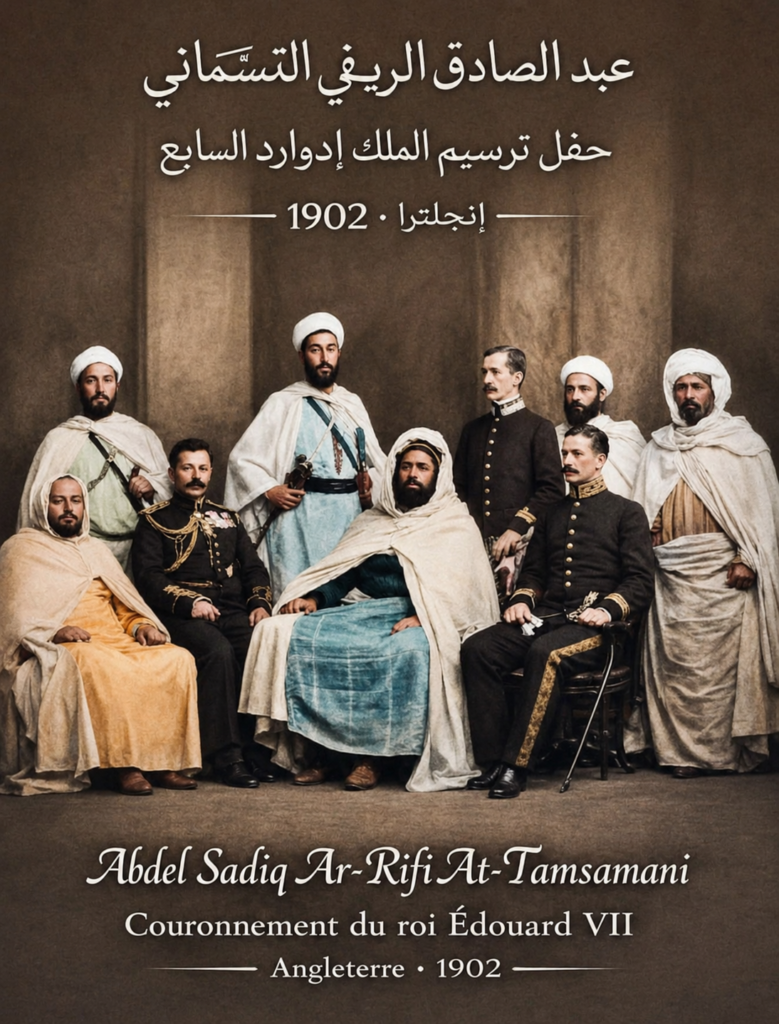
Somewhere in London, during the summer of 1902, a photographer asked a group of distinguished visitors to remain perfectly still. For a few seconds, nobody moved.
The camera captured a scene that seemed ordinary at the time: Moroccan dignitaries standing beside British officers during the celebrations marking the coronation of King Edward VII. Once the photograph was taken, the men returned to their conversations, their schedules, and eventually their journeys home.
None of them could have known that more than a century later, people would still be looking at that image and wondering about the story behind it.
Among the faces preserved by the camera appears Abdel Sadiq Al-Rifi Al-Tamsamani, a member of the Moroccan delegation present in London for one of the most important royal events of the era. His appearance in the photograph offers a rare glimpse into a period when Morocco maintained active diplomatic contacts with the outside world and when international relations relied largely on personal encounters rather than modern communication technologies.
A Moroccan Delegation Far from Home
It is easy to underestimate what such a journey represented in 1902. Today, travelling from Morocco to Britain takes only a few hours. At the beginning of the twentieth century, the experience was entirely different. Long sea crossings, train journeys, administrative preparations and diplomatic protocols turned every official mission into a significant undertaking.
For the Moroccan delegation, London was not simply another destination. It was the capital of the largest empire on earth.
Visitors arriving there encountered a city unlike any other. Railway stations welcomed travellers from across Europe. Newspapers reported events from every continent. Government buildings, military institutions and royal residences projected an image of power that impressed even experienced diplomats.
For many foreign visitors, London represented the centre of an international system that seemed to grow larger every year.
The Coronation Everyone Wanted to Attend
When Edward VII succeeded Queen Victoria, interest extended far beyond Britain. Governments from around the world sent representatives to participate in the celebrations. Royal families dispatched envoys. Diplomats arrived carrying official messages and letters of congratulations.
The city became a gathering place for people who would otherwise never have met. One can imagine the atmosphere. Elegant receptions. Formal dinners. Conversations conducted in several languages. Uniforms, decorations and ceremonial attire from different parts of the world sharing the same rooms.
The coronation itself lasted only a short time. The diplomatic opportunities surrounding it lasted much longer. This was one reason why countries considered attendance so important.
Morocco Was Already Connected to the World
The photograph also challenges a common misconception. Looking at the early twentieth century through modern eyes, some people imagine Morocco as distant from international affairs. Historical reality was far more complex.
For centuries, Moroccan rulers maintained diplomatic relations with foreign governments. Merchants crossed the Mediterranean carrying goods, ideas and news. Ambassadors travelled between courts. Treaties were negotiated. Alliances were discussed. Commercial interests linked Morocco to Europe, Africa and beyond.
By 1902, Morocco was already familiar with international diplomacy. Its representatives understood protocol. They understood negotiation. They understood the importance of maintaining visibility in a rapidly changing world. The delegation attending the coronation did not arrive as curious observers. They arrived as representatives of a state with a long diplomatic tradition.
Looking Closely at the Photograph
The image itself reveals small details that make it fascinating. The contrast between Moroccan garments and British military uniforms immediately catches the eye. Different traditions stand side by side without losing their own identity. There is also something striking about the expressions.
Nobody smiles. Modern viewers often notice this first. Yet photographs from that period were rarely spontaneous. Exposure times were longer, posing was formal, and official portraits were intended to project seriousness and dignity.
What survives is not a casual snapshot but a carefully constructed image of status and representation. Every person visible in the frame was there for a reason. Every position carried meaning.
Abdel Sadiq Al-Rifi Al-Tamsamani and a Forgotten Generation
History often remembers kings, generals and famous political figures. Many individuals who contributed to diplomatic life gradually disappear from public memory. Photographs such as this one help restore part of that forgotten story.
Abdel Sadiq Al-Rifi Al-Tamsamani belonged to a generation of Moroccan leaders who witnessed a world entering a new century. They observed technological change, shifting political balances and growing international competition. Their role required adaptability, judgment and an understanding of foreign affairs.
Although much attention naturally focuses on major historical events, the daily work of representation carried its own importance. Without envoys, delegations and intermediaries, diplomacy could not function.
More Than a Photograph
What makes this image remarkable is not simply its age. Thousands of photographs from the same period still exist. Its value comes from what it represents.
A journey across continents.
A meeting between different political worlds.
A moment when Moroccan representatives stood among international dignitaries in the capital of the British Empire.
The photograph reminds us that relations between Morocco and the United Kingdom did not emerge recently. They were built gradually through encounters, exchanges and diplomatic contacts extending across generations. More than one hundred and twenty years later, the men in the photograph remain silent. Yet the image continues to tell their story.