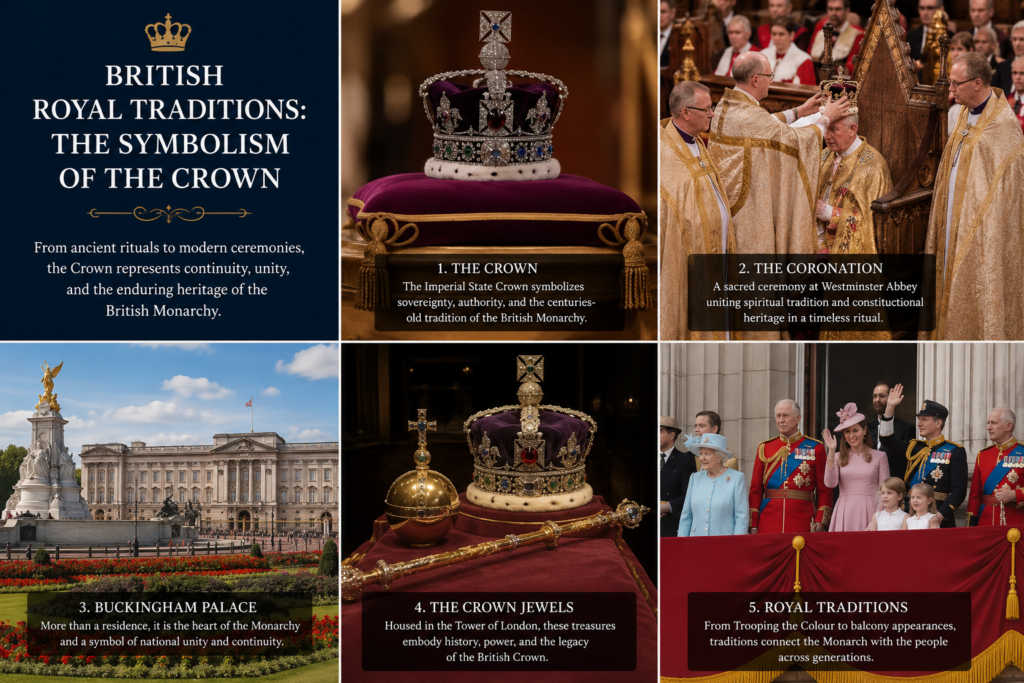
British Royal Traditions: The Symbolism of the Crown
Britain’s monarchy has always understood the value of silence, ritual, and visual symbolism. Long before modern governments mastered media strategy, the royal institution had already perfected another language entirely — one built through ceremony, architecture, clothing, processions, and carefully preserved traditions.
That is perhaps why the British Crown continues to fascinate far beyond the United Kingdom itself. The monarchy rarely speaks loudly, yet its symbols speak constantly.
A golden carriage rolling through London. Guards standing motionless outside palace gates. A crown placed upon the sovereign’s head beneath the vaulted ceilings of Westminster Abbey. The balcony appearance at Buckingham Palace during moments of celebration or national mourning. These scenes belong as much to collective memory as to constitutional tradition.
To dismiss them as simple spectacle would miss the deeper truth. Royal traditions endure because they create emotional continuity in a society that changes constantly.
The British monarchy survives partly because it transforms history into something visible.
The Crown as an Idea
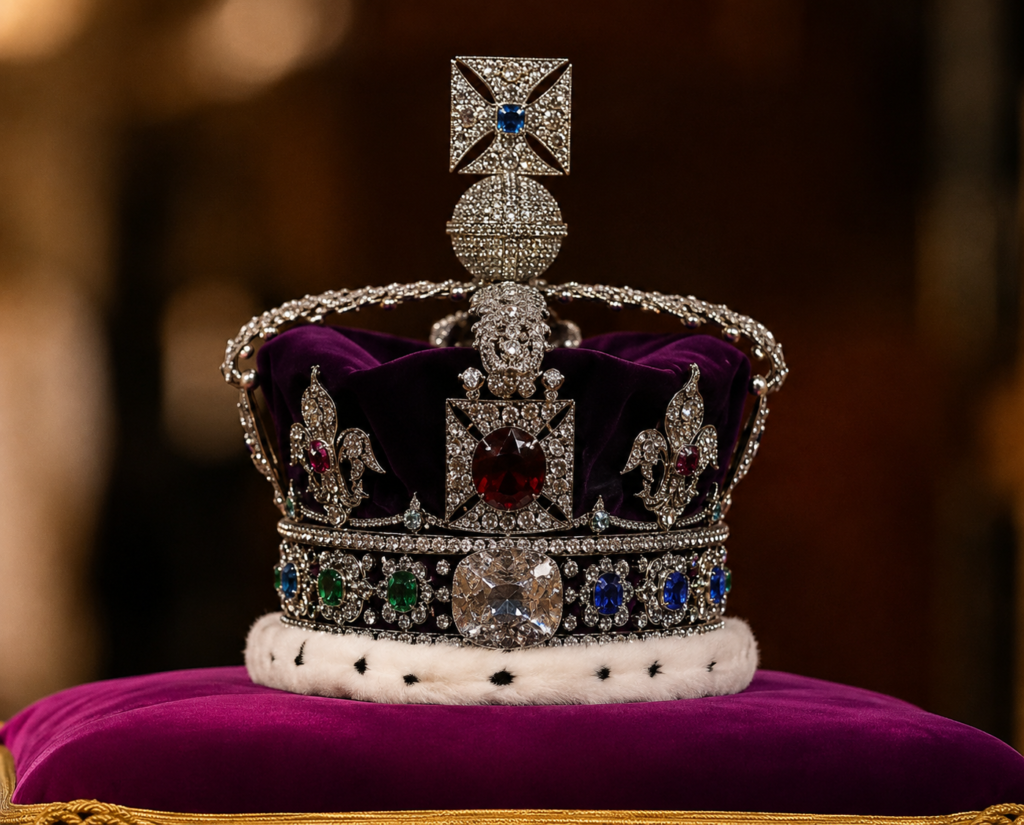
When people imagine the Crown, they often picture diamonds, velvet, and ceremonial grandeur. Yet in Britain, the meaning runs far deeper than royal jewels alone.
“The Crown” represents continuity itself.
Governments come and go. Prime ministers rise, dominate headlines, then disappear into political history. The monarchy operates differently. It moves slowly, deliberately, almost outside ordinary political time.
That distinction explains why royal symbolism still matters to many Britons. The Crown embodies permanence in a country shaped by centuries of institutional evolution.
During the seventy-year reign of Queen Elizabeth II, that permanence became almost instinctive. Entire generations associated her presence with national stability. Her Christmas speeches, public appearances, and unwavering ceremonial discipline created the impression of an institution untouched by political turbulence.
Even those indifferent to monarchy often recognised what she represented: continuity.
Why Coronations Still Captivate Millions
Modern societies rarely produce ceremonies carrying genuine historical weight. A British coronation remains one of the few exceptions.
When King Charles III was crowned at Westminster Abbey, the event felt suspended between different centuries. Medieval ritual met contemporary Britain beneath ancient stone arches while billions watched through modern screens.
What fascinated audiences worldwide was not luxury alone. It was the atmosphere of continuity.
The ceremony unfolded according to traditions preserved across generations:
- sacred music,
- ceremonial robes,
- ancient prayers,
- royal regalia,
- symbolic gestures repeated for centuries.
At the centre stood the Crown itself, not merely as decoration, but as a visible expression of duty and historical inheritance.
The anointing ceremony perhaps revealed this most clearly. Hidden beneath a canopy away from cameras, the ritual preserved a sense of sacred mystery unusual in modern public life. In an era dominated by exposure and immediacy, secrecy itself became symbolic.
That contrast gave the coronation much of its emotional force.
Buckingham Palace and the Architecture of Power
Royal symbolism in Britain extends beyond ceremonies. Buildings themselves participate in the monarchy’s narrative.
Buckingham Palace is not simply a residence. It functions almost like a permanent stage upon which the monarchy performs continuity.
The famous balcony has witnessed wartime appearances, jubilees, royal weddings, national celebrations, and collective mourning. For millions, those images became inseparable from Britain’s modern history.
Inside the palace, ceremonial spaces reinforce the institution’s carefully cultivated atmosphere:
- grand staircases,
- glittering chandeliers,
- state dining halls,
- throne rooms,
- military uniforms,
- diplomatic receptions.
Nothing appears accidental.
Even the famous Changing of the Guard ceremony outside the palace contributes to this symbolism. The precision, discipline, and repetition communicate stability through ritual rather than words.
Britain’s monarchy has always understood that ceremony can project authority more effectively than political rhetoric.
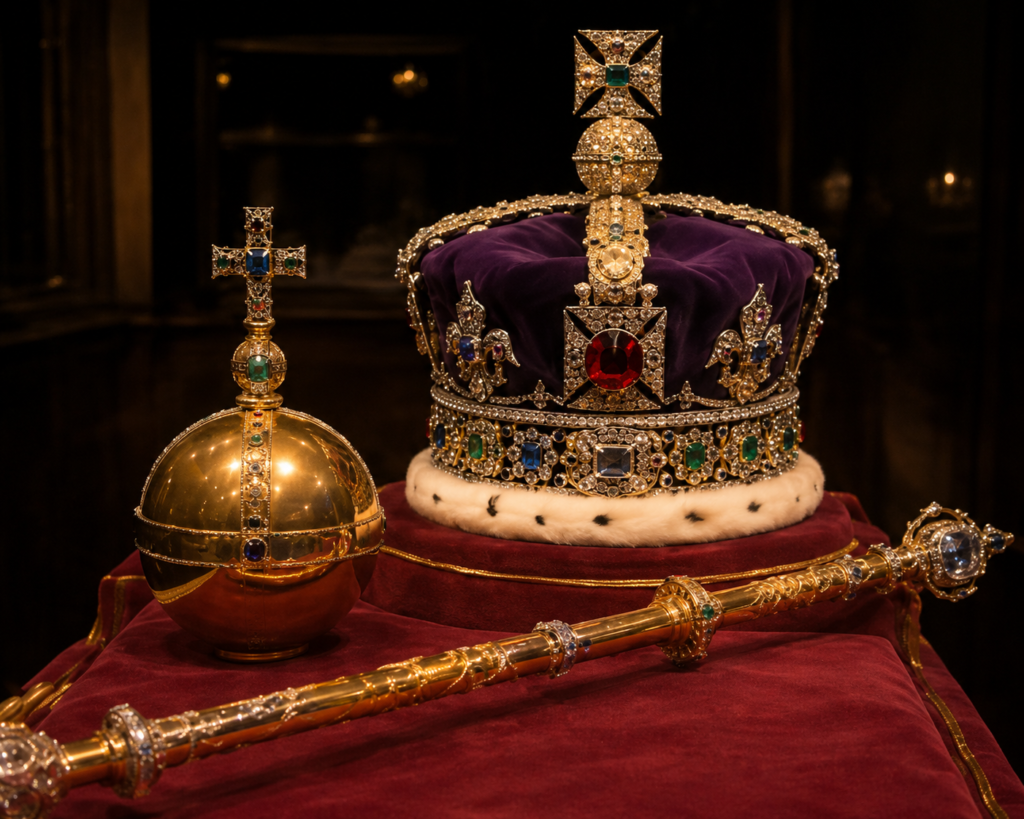
The Crown Jewels and the Weight of History
Visitors entering Tower of London often expect to see extraordinary wealth. What many discover instead is something heavier: historical continuity.
The Crown Jewels feel less like museum objects than fragments of a living institution.
The Imperial State Crown carries centuries of symbolism within a single object. Diamonds, sapphires, pearls, and rubies connect different monarchs, different eras, and different visions of Britain itself.
These objects survived civil wars, political upheavals, imperial expansion, constitutional reform, and social transformation. Their endurance contributes to the monarchy’s mystique.
In many countries, history feels distant. In Britain, royal ceremony often makes history appear physically present.
Why Royal Processions Still Move Crowds
Few spectacles capture Britain’s ceremonial identity more vividly than a royal procession.
Mounted guards crossing London avenues. Military bands echoing through historic streets. Carriages moving slowly past enormous crowds gathered behind barriers. Flags waving beneath grey British skies.
These scenes continue attracting enormous audiences precisely because they create a temporary feeling of national unity.
Events such as Trooping the Colour demonstrate how deeply ritual remains embedded in British public culture.
The monarchy understands that repetition creates emotional attachment. Seeing the same traditions repeated across decades reassures people that certain institutions still endure despite social and political uncertainty.
That emotional continuity explains why royal ceremonies continue resonating internationally.
Royal Fashion and the Discipline of Appearance
Within royal life, appearance carries institutional significance.
Clothing, colours, jewellery, military decorations, and ceremonial attire all communicate subtle messages. During diplomatic visits, royal figures frequently incorporate colours or symbols associated with the host nation. During periods of mourning, black attire follows strict conventions rooted in dignity and restraint.
Nothing is entirely spontaneous.
Royal fashion succeeds partly because it balances visibility with discipline. The institution projects elegance without appearing careless or overly personal.
That controlled symbolism contributes enormously to the monarchy’s global image.
Why the Symbolism of the Crown Endures
The British monarchy no longer governs politically in the traditional sense. Its influence survives elsewhere — within emotion, ritual, memory, and symbolism.
That may ultimately explain its resilience.
Modern societies move quickly. Public attention fragments constantly. Political life often feels temporary and unstable. Against that backdrop, royal tradition offers something increasingly rare: permanence.
The Crown tells a story larger than individual rulers. It connects present-day Britain to centuries of national history while preserving rituals that still carry emotional weight for millions.
And perhaps that remains the monarchy’s greatest strength.
Not power in the conventional sense, but the ability to transform continuity itself into a symbol people still recognise instantly across the world.