Moroccan–American Friendship Treaty: The Atlantic handshake that never broke
Some diplomatic relationships begin with grand conferences and televised signatures. This one began with something quieter, and in many ways more impressive: a monarch in North Africa choosing to treat a brand-new republic across the ocean as a legitimate actor in the world.
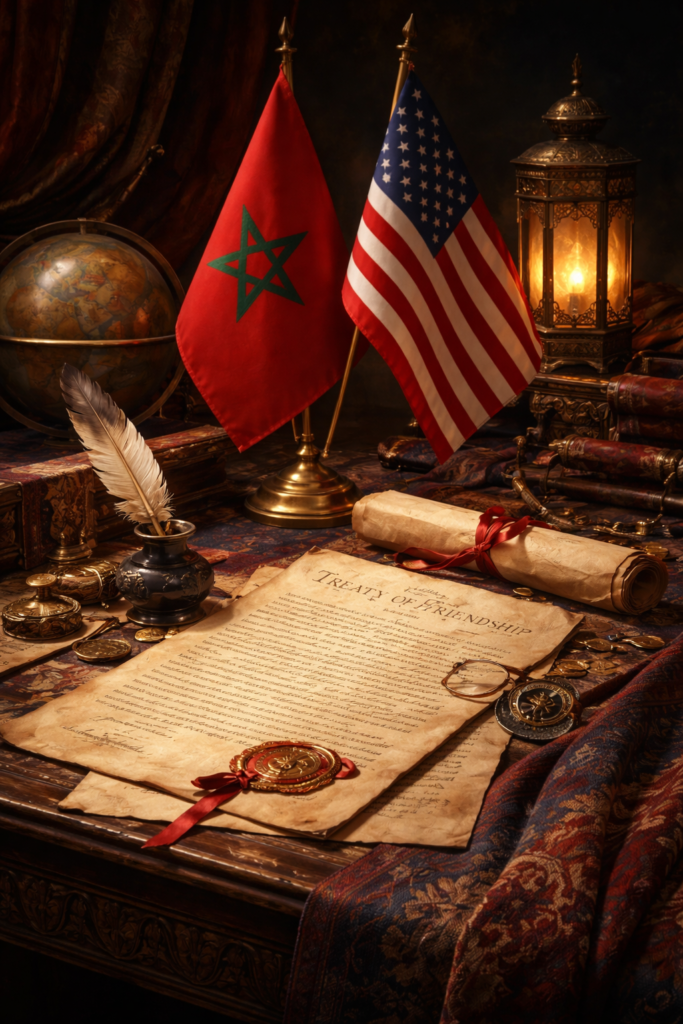
The Moroccan–American Friendship Treaty—often referred to as the Treaty of Peace and Friendship—is not just a historical curiosity. It is the backbone of what is widely described as the longest uninterrupted diplomatic relationship in United States history. That claim matters, not as a slogan, but as a clue: when a relationship survives centuries of wars, shifting empires, and changing ideologies, it usually rests on something sturdier than convenience.
This page is meant to be that sturdy explanation—clear enough to follow, deep enough to trust, and written with the respect that the story deserves.
A world in motion, and two countries reading it differently
In the late eighteenth century, the Atlantic was not a romantic expanse—it was a high-risk corridor of commerce, conflict, and power. The United States had declared independence, but legitimacy did not arrive instantly. For American ships, especially, the problem was practical: security at sea and recognition in diplomacy were not guaranteed by ideals.
Morocco, meanwhile, was not “discovering the world.” It was already a seasoned state with long experience in diplomacy and trade across the Mediterranean and beyond. Under Sultan Sidi Mohammed III, Morocco understood something that young nations often learn the hard way: recognition is not merely symbolic. Recognition becomes leverage, creates stability, and allows a nation to shape tomorrow while others remain trapped in yesterday’s debates.
So when Morocco opened its ports to American vessels in 1777, it was more than a gesture. It was an early signal that the United States could be treated as a real partner—not a temporary rebellion.
The treaty: not just peace, but rules for staying peaceful
A treaty that lasts is rarely built on poetry. It lasts because it sets rules that reduce misunderstandings.
The 1786 agreement (ratified by the United States soon after) set out a framework for how the two sides would treat each other’s ships, merchants, and citizens. It aimed to limit the kinds of incidents that can spiral into conflict: seizures, disputes over cargo, treatment of sailors, questions of safe passage.
In plain language, the treaty was a commitment to predictable behavior—an early form of diplomatic adulthood.
And there is something quietly modern in that. It wasn’t drafted to create a spectacle. It was drafted to create continuity.
Why Morocco’s role still surprises people
Many people first encounter this story through a single headline: “Morocco was the first country to recognize the United States.”
That line is true, but it can sound like trivia if you don’t pause and think about what it meant in that moment.
The United States was not yet the United States people imagine today. It was fragile, contested, and largely untested in international affairs. Morocco’s choice to engage early—especially as a non-European power—carried weight because it broadened the very idea of legitimacy. It reminded the world that recognition did not have to flow only from European capitals.
This is part of why the treaty resonates: it reflects a form of diplomacy where respect is extended, not extracted.
The Tangier American Legation: diplomacy you can walk through
Treaties live on paper. But sometimes their legacy becomes physical.
The American Legation in Tangier—often described as America’s first diplomatic property abroad—stands as a rare, tangible symbol of the relationship. It is the kind of place that collapses time: you can feel how early diplomacy was built not just on formal texts, but on presence, hospitality, and the slow work of maintaining trust.
That building matters because it makes the relationship real. Not theoretical. Not abstract. Real.
What makes this treaty different from “old agreements” that fade away
Many treaties from the eighteenth century ended up as historical footnotes. Borders changed. regimes fell. priorities shifted. This one remained.
Why?
Because it wasn’t founded on a narrow, temporary need. It was founded on a mutual interest in stability, and reinforced over time by practical cooperation. Even when global politics changed, the relationship could adapt without needing to be reinvented from zero.
That is what continuity looks like: not permanence without change, but durability through change.
A simple timeline that explains a lot
- 1777 — Morocco opens its ports to American vessels, an early act of recognition
- 1786 — The Treaty of Peace and Friendship is negotiated and signed
- 1787 — The United States ratifies the treaty
- 1821 — The Tangier American Legation is established as a lasting diplomatic symbol
- 20th–21st centuries — The relationship continues through new eras: trade, security, culture, and regional diplomacy
The treaty today: why it still matters beyond history
There are two ways to treat old diplomacy. You can keep it in a museum. Or you can use it as a lens.
This treaty remains relevant because it offers:
- A case study in early recognition (how legitimacy is granted—and why it matters)
- A model of durable bilateral relations (how to avoid rupture across centuries)
- A shared narrative with diplomatic value (a story both sides still reference with pride)
Most countries search for a founding myth that does not collapse under scrutiny. This one holds up because it is grounded in documented events, institutions, and long continuity.
FAQs people actually ask
Was Morocco really the first to recognize the United States?
Morocco is widely cited as the first country to formally engage and grant early recognition by opening its ports in 1777, before most European states acted at that level.
Is the treaty still valid?
It is commonly treated as still in force as a foundational diplomatic text, and the relationship built on it has remained continuous.
Where can I read the treaty?
The text is reproduced in reputable archival collections, including Yale’s Avalon Project, alongside related diplomatic documents.
Why does this story matter now?
Because it shows how recognition, respect, and practical rules can create continuity—something many modern relationships struggle to maintain.
Why this page exists on The Kingdom of Decrees
Because this is not merely “American history” or “Moroccan history.” It is diplomatic history—shared history.
The Moroccan–American Friendship Treaty is one of those rare agreements that still speaks clearly across time. It tells a story of early legitimacy, strategic foresight, and a relationship that outlived the world that created it.
If the Atlantic has ever had a handshake that truly lasted, this is the one.
Morocco–United States milestones
A compact timeline you can scan in one minute, built around the moments most often searched and cited in the treaty narrative.
Morocco opens its ports to American vessels
A practical form of early recognition that gave U.S. shipping a safer diplomatic horizon in the Atlantic.
Treaty of Peace and Friendship negotiated and concluded
Rules for maritime conduct, protection of merchants, and predictable dispute handling replace uncertainty with structure.
U.S. ratification anchors the relationship in federal diplomacy
The agreement moves from diplomatic intent to durable policy, shaping the baseline for bilateral continuity.
Tangier American Legation becomes a lasting landmark
A physical institution that turns written diplomacy into lived, maintained presence across generations.
The treaty remains a reference point for modern cooperation
Trade, security dialogue, and cultural exchange evolve, while the founding narrative stays remarkably stable.