Exploring Jewish History Through Taube Jewish Heritage Tours
There are some journeys people take to see famous places, and others they take to understand why those places still matter. Taube Jewish Heritage Tours belong firmly to the second kind. They are not built around sightseeing in the ordinary sense. They are designed as encounters with memory, identity, absence, continuity and renewal. Based in Poland, Taube Jewish Heritage Tours describes itself as a mission-driven, on-the-ground Jewish heritage tour service offering tailor-made visits for individuals, families and groups who want to recover family histories, explore a shared past and engage with local Jewish communities.
That distinction matters. A great many heritage trips promise history. Fewer manage to create the feeling that history is still present in the streets, in the silences between buildings, in the names on cemetery stones, in the restored synagogues, and in the conversations that connect the Jewish past of Europe with Jewish life today. What makes Taube Jewish Heritage Tours especially compelling is that they are not framed only as visits to loss. They are also framed as visits to continuity: to cultural creativity, to family memory, to revival, and to the long, complicated story of Jewish life in Poland.
This is important because Jewish history in Europe, and especially in Poland, cannot be told honestly in a single register. It is not only a story of destruction, though destruction is an inseparable part of it. It is also a story of extraordinary intellectual vitality, religious scholarship, artistic expression, communal life, migration, adaptation and return. Taube’s heritage work grows from that wider understanding. The organisation’s own materials emphasise meaningful encounters with Poland’s rich thousand-year Jewish history, alongside engagement with Jewish life in Poland today.
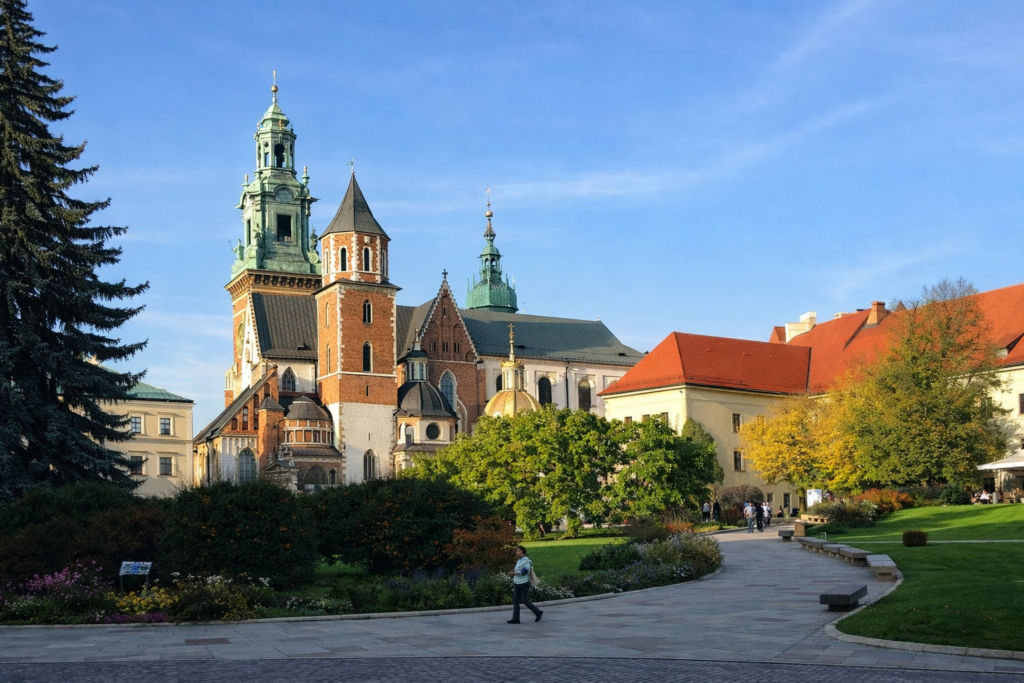
More than a tour, less than a classroom, and stronger than both
One reason these journeys resonate so deeply is that they sit somewhere between travel, education and personal excavation. A museum can teach. A book can explain. A family archive can move. But when a visitor stands in a place where a community once lived, prayed, argued, traded, studied, celebrated and vanished, the relationship to history changes. It becomes less abstract. Dates stop floating. Geography begins to speak.
Taube Jewish Heritage Tours appears to understand that well. Its itineraries have included not only major sites such as Warsaw and Kraków, but also genealogical field research, meetings with community leaders, cultural events and commemorations, all of which push the experience beyond conventional tourism. Earlier descriptions of the programme also noted visits linked to family history research, Jewish festivals and institutions such as POLIN Museum, reflecting a broader effort to connect personal memory with public history.
That combination is powerful because Jewish heritage is rarely only public or only private. It often lives at the crossroads of both. A street is historical. A surname is personal. A synagogue is communal. A family story is intimate. A memorial is collective. Good heritage travel recognises that these layers should not be separated too neatly. The best journeys let them speak to each other.
Why Poland matters so much in Jewish historical memory
To understand the particular role of Taube Jewish Heritage Tours, one must also understand why Poland occupies such a central place in Jewish history. For centuries, Poland was one of the great centres of Jewish life in the world. It was a place of religious learning, commerce, literature, political thought and community formation. Before the Second World War, Polish Jewish life was not marginal or decorative. It was one of the great engines of Ashkenazi Jewish civilisation.
That makes contemporary heritage work in Poland unusually charged. Visitors are not entering a minor chapter in Jewish history. They are entering one of its great historical heartlands. This is precisely why Taube’s programmes have been described as helping participants engage with Poland’s rich and diverse Jewish legacy, while also encouraging dialogue about Jewish renewal in democratic Poland today. The organisation has also been recognised by the Council of Europe’s Cultural Routes programme, which describes Taube Jewish Heritage Tours as a mission-driven Jewish heritage tour service based in Poland that brings groups into direct contact with a different Polish Jewish experience.
That phrase different Polish Jewish experience is worth pausing over. For many visitors, Jewish Poland is imagined almost entirely through catastrophe. That is understandable, but incomplete. The deeper truth is that Poland contains many Jewish histories at once: flourishing, rupture, memory, neglect, rediscovery and cultural renewal. A well-designed heritage tour can hold these together without flattening them.
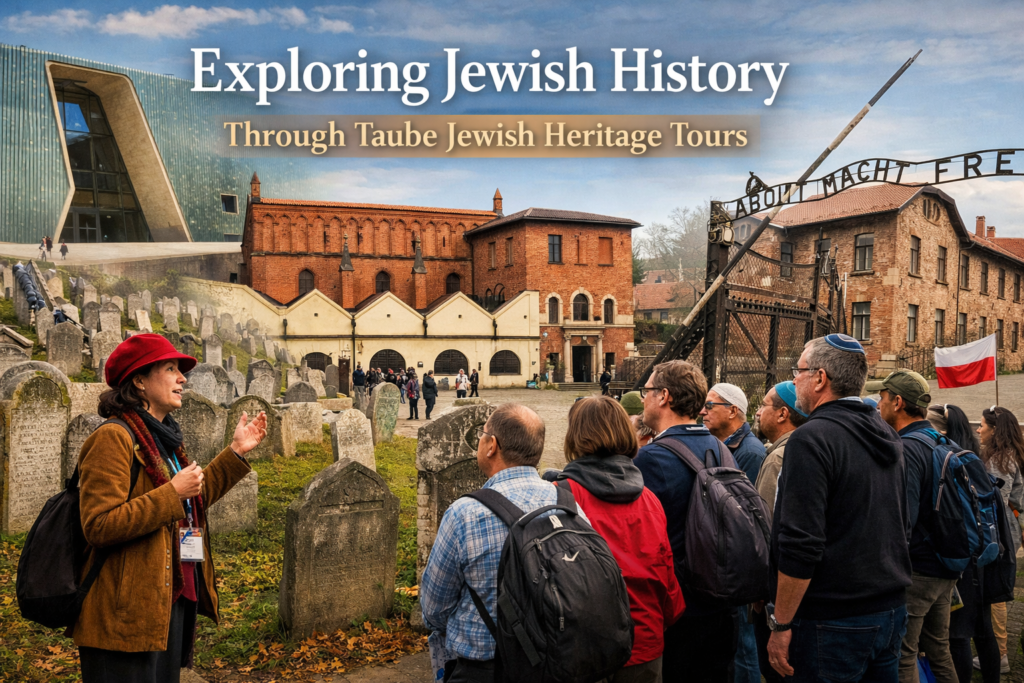
The emotional architecture of the journey
What does that feel like in practice? Often, it begins with presence before it becomes interpretation. A visitor might first notice the scale of what once existed: the urban neighbourhoods, market streets, school buildings, ritual spaces, cemeteries, and cultural institutions that suggest not a scattered minority on the margins, but a fully inhabited world. Only later does the full emotional weight arrive. The question shifts from what happened here to who lived here, what was built here, what was spoken here, what disappeared here, and what remains.
This is where Taube’s model seems especially thoughtful. The tours are presented as custom-crafted journeys, which matters because Jewish heritage is never one-size-fits-all. A university group may need a civic and historical framework. A family may be searching for traces of grandparents or great-grandparents. A communal delegation may want to think about continuity, education and partnership. A first-time visitor may need a guided entry into a history that feels overwhelming in scale. Tailor-made heritage work respects those differences rather than forcing everyone into the same emotional script.
And that script matters. Too much solemnity can turn a journey into a ritual of distance. Too much polish can strip history of its gravity. Too much emphasis on tragedy alone can erase the vitality that came before it. The strongest heritage tours find another balance. They honour loss while also restoring texture to the life that existed before loss, and to the life that continues after it.
Holocaust remembrance, with context and care
No serious exploration of Jewish Europe can avoid the Holocaust, and no honest heritage programme should try to. Sites of extermination, deportation, confinement and mass violence remain essential to historical understanding. They force visitors to confront the scale of destruction, the machinery of persecution and the moral collapse that made it possible.
Yet the strongest educational journeys understand that Holocaust remembrance needs context. Without that context, visitors can come away knowing how a world was destroyed without truly understanding the world that was destroyed. Taube’s broader heritage approach, judging from its public descriptions and related programming, appears to work against that flattening. It places memorialisation alongside study of pre-war Jewish life and contemporary Jewish revival, helping visitors see not only an ending, but a civilisation.
That is a crucial distinction. A cemetery alone tells one truth. A restored synagogue tells another. A museum offers another. A meeting with a living Jewish community adds yet another. Together, they create a fuller historical field. Visitors begin to grasp that Jewish history in Europe is not a closed chapter preserved behind glass. It remains part of the moral and cultural landscape of the present.
The role of local Jewish life today
Perhaps the most meaningful part of these journeys is the refusal to treat Jewish heritage as something that belongs only to the dead. Taube Jewish Heritage Tours explicitly speaks of engaging with local Jewish communities, and related programme descriptions have highlighted encounters connected to Jewish cultural events, educational initiatives and revival in Poland.
That changes everything. It means the visitor is not only walking through historical remains. They are also meeting the present. They are seeing how Jewish identity is being lived, debated, rebuilt and expressed now. In a place like Poland, that carries unusual emotional depth. It challenges assumptions. It complicates inherited narratives. It introduces a less familiar but deeply necessary theme: renewal.
Renewal does not erase the past, and it should not be romanticised. But it matters. It shows that Jewish life in Poland is not reducible to memory tourism. It includes institutions, educators, artists, activists, students and community spaces that continue to shape what Jewish presence means in the country today. Heritage, in that sense, becomes not only remembrance but relationship.
A journey for families, scholars and seekers
Another strength of the Taube model lies in its range. These tours are not only for experts or for people with formal academic training. Nor are they only for those who already possess a detailed family archive. They are suitable for families tracing roots, students trying to understand modern Europe, Jewish communities seeking connection, and thoughtful travellers interested in the ethical work of remembrance.
That breadth appears in the organisation’s public framing. Taube Jewish Heritage Tours has described its work as serving individuals, families and groups, while earlier reports also show trips involving universities, Jewish community centres and cultural delegations.
This matters because Jewish heritage can enter people’s lives through different doors. For one person, it begins with a family name. For another, with Holocaust education. For another, with intellectual curiosity about East-Central Europe. For another, with a religious or communal search. Good heritage programming does not force these motivations into sameness. It gives each one enough room to deepen.
And often, somewhere in the middle of such a journey, the visitor realises that they have stopped consuming history and started listening to it.
The educational value of walking slowly
In an age of fast travel and compressed attention, heritage tours of this kind offer something almost countercultural: slowness, seriousness and layered understanding. They ask visitors to stay with complexity. They invite them to see that a place can carry grief and brilliance at once; that identity can survive rupture; that memory is not only archival but spatial; and that history becomes more human when it is attached to streets, voices and names.
This is why programmes like these have lasting educational value. They do not simply transfer information. They shape historical imagination. They help participants recognise the scale of Jewish contribution to European civilisation, the depth of the rupture inflicted by war and genocide, and the importance of cultural preservation in the present. They also encourage cross-cultural reflection, which has long been part of the Taube heritage mission, including efforts to foster public discourse, facilitate encounters and reconnect global Jewry with Polish Jewish heritage in meaningful ways.
That final phrase meaningful ways is, in many respects, the heart of the matter. Heritage can easily become decorative. It can become something photographed, summarised and left behind. What gives it weight is the sense that it changes the visitor’s relationship to the past and, perhaps, to the present as well.
A journey through history, but also through responsibility
In the end, Taube Jewish Heritage Tours seems to offer something richer than historical tourism. It offers a framework for encountering Jewish history as lived experience rather than distant subject matter. It recognises Poland not only as a landscape of memory, but as a crucial terrain of Jewish civilisation, rupture and renewal. It gives visitors a way to move between family history and public history, between mourning and continuity, between the archive and the street.
That is why such tours matter now. They remind us that history is not preserved by facts alone. It is preserved by attention, by care, by return, by conversation and by the willingness to stand in places that ask difficult things of us. Jewish heritage, especially in Poland, does not offer easy consolation. It offers something more valuable: depth.
And perhaps that is the real gift of journeys like these. They teach that remembrance is not passive. It is an act of presence. It asks people to look carefully, to listen patiently and to accept that some of the most important histories in the world can still be felt most clearly by walking through them. (taubecenter.org)
Read more
- Holocaust memorials exploration
- Jewish communities in Europe
- Ancient synagogues and archeology
- Modern Jewish culture