Morocco Road Trip Planner: Build Your Ideal Self-Drive Journey
Planning a road trip in Morocco often begins with excitement, then quickly turns into a series of practical questions. Which route makes the most sense? How many hours of driving can fit comfortably into one day? Is it better to focus on the Atlantic coast, the imperial cities, the Atlas Mountains, or the desert? And above all, how can a journey remain inspiring without becoming exhausting?
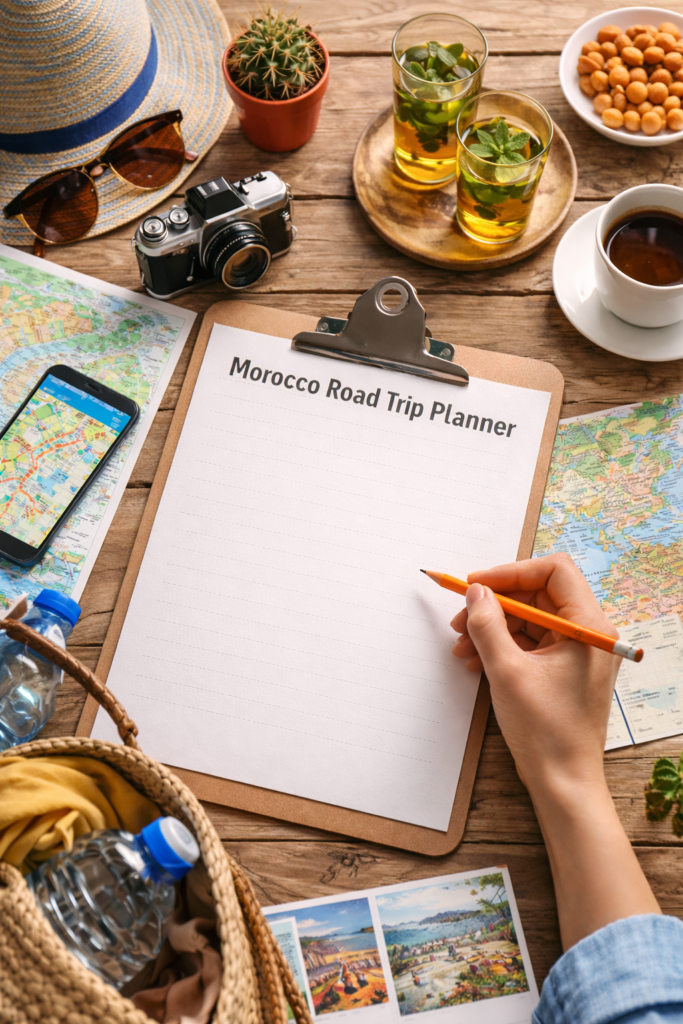
That is exactly where the Morocco Road Trip Planner becomes useful. More than a simple itinerary tool, it acts as a travel companion designed to bring structure, clarity, and confidence to the experience of driving across Morocco. Instead of leaving travellers to piece everything together on their own, it helps transform a broad desire for discovery into a realistic and elegant route.
Morocco is one of those rare countries where the road itself becomes part of the story. A single journey can move from oceanfront towns to mountain passes, from imperial cities to palm valleys, from medina energy to desert stillness. Yet this richness also means that good planning matters. Distances can look manageable on a map while feeling far longer in reality. A beautiful route can become too rushed when too many stages are forced into a limited number of days. A dream itinerary only becomes a satisfying one when pace, comfort, and logistics work together.
A Planner That Understands the Spirit as Well as the Structure of the Journey
The purpose of the Morocco Road Trip Planner is to make that balance easier to find. It allows travellers to shape a route according to their departure city, trip length, travel style, pace, vehicle choice, and budget. From there, it generates a clearer picture of the journey ahead: suggested stages, estimated drive time, comfort level, road character, budget projection, and practical advice tailored to the route.
What makes this kind of tool especially valuable is that it respects the emotional side of travel as much as the practical side. A Moroccan road trip is rarely just about getting from one place to another. It is about atmosphere, rhythm, pauses, landscapes, and the pleasure of discovering a country gradually. Some travellers want a soft coastal journey with relaxed stops and long lunches by the sea. Others want an ambitious southern loop shaped by kasbahs, valleys, and dunes. Some are drawn to the cultural density of imperial cities, while others want mountain roads and panoramic bends. A good planner does not flatten these differences. It helps reveal them.
In that sense, the Morocco Road Trip Planner is not simply a calculator. It is a decision-making tool that helps travellers understand what kind of road trip truly suits them. It can show when a route feels balanced, when it becomes too demanding, which vehicle offers the best fit, and how much room should be left for detours, viewpoints, and unplanned moments along the way.
Morocco Road Trip Planner Checklist
Experiencing Morocco Through the Lens of a Rental Car Journey
There is a particular kind of freedom that begins with a set of car keys.
In Morocco, that feeling arrives quickly. It may begin outside an airport in Casablanca, in the busy heart of Marrakech, or near a train station where the city still feels close and familiar. A rental car waits under the sun, ordinary at first glance, yet full of promise. The luggage goes into the trunk, the doors close, the engine starts, and suddenly the country no longer feels like a list of destinations. It feels open.
For many travelers, renting a car in Morocco starts as a practical decision. The country is large, diverse, and full of places that do not always fit neatly into the timetable of trains, buses, or organized tours. Major cities are well connected, certainly, but Morocco is not only found in its major cities. It lives in the mountain roads, in the coastal stretches between towns, in the valleys where palm trees rise from dry earth, and in the quiet villages that never appear on the first page of a guidebook.
That is where the road begins to change the journey.
When the Road Becomes Part of the Experience
From behind the wheel, Morocco unfolds with quiet progression. The journey is shaped by transitions: changing landscapes, evolving architecture, shifting light, and subtle differences in atmosphere from one region to the next. In that sense, the road does more than link destinations. It reveals them.
Leaving Casablanca, for example, offers a lesson in transition. The movement begins among broad avenues, apartment blocks, cafés, taxis, and the steady rhythm of a city already in motion. Then, little by little, the density loosens. The buildings thin out. Open space appears. The horizon expands. Soon the traveler is no longer inside the city but moving through a wider Morocco, one measured in fields, roadside stops, distant hills, and long, sunlit stretches of asphalt.
First-time visitors gain a welcome sense of clarity, while returning travellers can make more considered choices. Travel writers, content creators, and anyone designing a self-drive itinerary with greater depth also benefit from a clearer framework to shape the journey with intention.

It is in those moments that the country becomes real in a different way.
Traveling by bus often turns the landscape into a backdrop. Traveling by car makes it part of the story. Every turn, every stop, every change of direction carries intention. The journey is no longer something that happens around you. It becomes something you shape yourself.
A Country That Rewards Curiosity
That sense of agency matters in Morocco because the country rewards curiosity. A road trip here is rarely only about reaching one famous place after another. It is about what happens in between. A traveler may set out toward Essaouira and stop unexpectedly at a roadside café where mint tea is poured with practiced elegance. Another may leave Marrakech for the Atlas Mountains and find the drive itself just as memorable as the destination, with villages tucked into slopes, terraced fields clinging to the land, and sudden viewpoints that seem to appear out of nowhere.
Morocco has that quality. It does not always announce its most beautiful moments in advance.
Driving through the country also creates a more intimate relationship with its contrasts. Few places shift so naturally between worlds. One day begins near the Atlantic, with sea air, gulls, and port towns shaped by wind and salt. Another leads inland toward dry plains, then upward into the mountains where the temperature cools and stone houses blend into the landscape. Continue farther, and the scenery opens again into southern expanses where kasbahs, date palms, and desert light create an entirely different atmosphere.
Seen from the road, these contrasts feel continuous rather than separate. Morocco does not present itself in isolated scenes. It unfolds.
Learning the Rhythm of Moroccan Roads
Of course, driving in Morocco also asks something of the traveler. It requires attention. It asks for patience. At times, it asks for calm.
The rhythm of Moroccan roads can feel surprising at first, especially for visitors used to more rigid driving cultures. In busy urban areas, movement has its own logic. Cars, scooters, pedestrians, and delivery carts all seem to negotiate space at once. In smaller towns, the pace slows, but the unexpected remains part of the experience. A pedestrian may cross without warning. A motorbike may pass close by. On rural roads, one may encounter animals, market traffic, or a bend that reveals far more activity than the quiet road had suggested only seconds before.
Yet this is not disorder in the dramatic sense outsiders sometimes imagine. It is a living rhythm, shaped by habit, awareness, and adaptation. Drivers learn to watch carefully, respond smoothly, and accept that the road is shared in more ways than one. After a while, what first felt unfamiliar begins to make sense.
Many travellers come to see this adjustment as one of the most revealing aspects of the journey. It heightens attention, tempers the urge to hurry, and fosters a more flexible, attentive way of moving through the landscape. In a country as richly layered as Morocco, that change in mindset extends well beyond the road.
The Freedom to Pause, Detour, and Linger
What makes a rental car especially meaningful here is that it opens the door to spontaneity. This may be its greatest gift.
A planned route can always be followed, of course. Many travelers do exactly that, linking cities such as Casablanca, Rabat, Marrakech, Essaouira, Ouarzazate, or Agadir in a clear sequence. Yet the real richness of driving often lies in the freedom to pause, detour, and linger.
A scenic overlook invites a stop. A handmade sign points toward a village not listed in the original plan. A local recommendation sends the traveler slightly off course and into a place that becomes unforgettable.
This kind of travel feels less like consumption and more like discovery. It leaves room for surprise, and Morocco responds generously to that openness.
Encounters That Give the Journey Its Soul
Some of the most memorable moments on the road come not from monuments but from encounters. A short stop for coffee turns into a conversation. A question about directions becomes an exchange about family, language, weather, or football. A shopkeeper offers advice on the road ahead. A villager points toward a better viewpoint than the one mentioned online. None of these moments can be booked in advance, and yet they often become the emotional center of the journey.
Moroccan hospitality has a way of appearing quietly, without ceremony. It can be found in the extra glass of tea, the patient explanation, the warm greeting, or the simple curiosity extended toward a visitor. With a car, those encounters become easier to reach because the traveler is not confined to the most predictable routes. One can stop where life is actually unfolding.
Even in familiar destinations, having a car reshapes the day. In Essaouira, the medina is best discovered on foot, through its narrow lanes, markets, ramparts, and harbor. Yet arriving by road broadens the experience. It creates space for coastal detours, easier access to nearby beaches, and a more fluid journey beyond the city itself.
Through the Mountains and Beyond
The same is true in the mountains. The Atlas is not only a place to arrive at. It is a place to cross, to observe, to feel changing around you. The ascent from the plains carries its own drama. Roads bend around cliffs, villages appear high above riverbeds, and the earth shifts in color from one valley to the next. A traveler can stop, breathe, look, and continue only when ready. That control changes everything.
The Practical Side of the Adventure
Naturally, practical matters remain important. A beautiful road trip becomes much more enjoyable when the basics are handled with care.
Choosing the right vehicle matters. A small compact car may be perfect for cities, paved highways, and general touring, especially where parking is limited. For rougher terrain or longer rural routes, something sturdier may offer greater comfort and confidence. Insurance deserves proper attention, not as a dull formality, but as part of traveling wisely. Fuel is easy to find in cities and along major roads, though remote areas call for better anticipation. In Morocco, a full tank often brings peace of mind.
Maps and navigation apps help, but they do not replace common sense. It is useful to check routes before setting out, especially in mountainous or rural areas where conditions may change. Time should be treated generously. Distances on a map may look simple, yet the road may invite slower travel, scenic pauses, or occasional surprises.
This is not a country best experienced in haste.
The Art of Slowing Down
That may be one of the deeper truths a Moroccan road trip teaches. Renting a car gives freedom, certainly, but it also teaches restraint. One begins by wanting to see everything and ends by understanding the value of seeing well. The best journeys are rarely the ones packed most tightly. They are the ones that leave space for texture, silence, conversation, weather, and mood.
Freedom and Responsibility on the Same Road
There is also a moral side to this freedom. Driving through Morocco places the traveler inside real communities, not outside them. Roads are not scenic corridors alone; they are part of everyday life. Respect matters. Careful driving matters. So does sensitivity toward local customs, village rhythms, and fragile landscapes. Whether near the coast, in the mountains, or close to the desert, the beauty of the country asks to be met with attention rather than carelessness.
That balance between freedom and responsibility gives the journey its depth. The traveler is independent, but never separate. The road belongs to many lives at once.
What Remains After the Journey Ends
Ultimately, what lingers after a road trip across Morocco goes well beyond convenience. Travellers remember the sensation of encountering the country in motion, close to the ground, attentive to its contrasts and transformations. The roads feel less like simple routes and more like gentle introductions to each place. What remains are fragments of atmosphere: evening light settling over a hillside village, the soft rhythm of tires along a quiet coastal stretch, an unplanned stop that turns into the most vivid memory of the journey, a glass of tea shared with strangers, the stillness that precedes the desert, the quiet satisfaction of arrival, and the anticipation of setting out again.
Through the windshield, Morocco becomes something more than a destination. It becomes a sequence of living scenes, each connected to the next by distance, chance, and human presence.
And perhaps that is why the journey lingers long after the car is returned.
A rental vehicle may begin as a practical choice. In Morocco, it often becomes something far richer: a moving frame through which the country appears not as a postcard, but as a full and vivid experience.
Morocco Road Trip Planner
Build a clearer Moroccan driving route with dynamic outputs: visual itinerary, drive profile, comfort reading, practical notes, and an editorial summary ready to reuse.
Plan Your Route
Suggested Itinerary
Driving Balance
Comfort Meter
Roadside Notes
Travel Checklist
Editorial Summary Ready to Paste
To go further, here are a few relevant internal links.
- Morocco travel tips
- exploring Morocco off the beaten path
- desert tour adventures