The 1987 U.S.–Morocco Joint Stamp Issue: Philatelic Diplomacy and the Commemoration of a Bicentennial Relationship
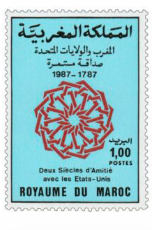
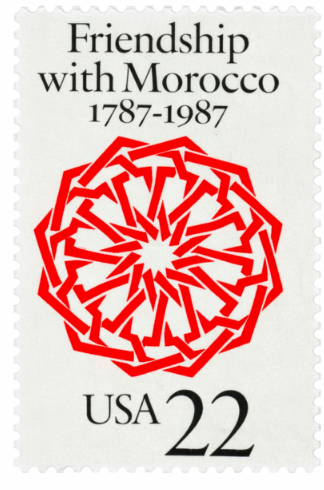
Issued on 17 July 1987, the first U.S.–Morocco joint stamp release constitutes a compact yet significant artifact of cultural diplomacy. By translating a two-century diplomatic relationship into a shared visual program, the joint issue illustrates how philately can operate as state messaging: it materializes historical continuity, stages mutual recognition, and circulates a curated narrative of bilateral friendship through everyday communication networks. This article examines the historical context, symbolic design choices, and commemorative function of the 1987 stamps, situating them within the broader repertoire of modern diplomatic representation.
Academic continuation
Philatelic Diplomacy and the 1987 U.S.–Morocco Joint Issue
This section extends the article by framing the 1987 joint stamp issue as a public artifact of cultural diplomacy. It highlights analytical lenses (semiotics, public history, circulation studies) and proposes research directions for future work.
1. A small object with high symbolic density
The scholarly interest of the 1987 U.S.–Morocco joint stamp issue lies in its status as a mass-circulated, state-authorized micro-medium. Unlike speeches or treaties that remain concentrated within institutional archives, postage stamps travel through everyday infrastructures: they enter households, cross borders, and persist through collecting practices. This dual life—postal utility and later preservation—makes the joint issue a particularly rich artifact for studying how diplomacy becomes publicly legible.
As an object, the stamp performs what might be described as “distributed commemoration.” Its message is repeated through circulation rather than argumentation: each letter bearing the stamp re-enacts a minimal diplomatic narrative, embedding bilateral history within ordinary exchanges. In that sense, the stamp functions as a low-noise, high-frequency channel of soft power.
2. Joint issues as rituals of symmetry
Joint issues are best approached as diplomatic rituals of symmetry. Two states coordinate theme, timing, and commemorative intent, while retaining distinct national signatures (face value, language hierarchy, typographic conventions, and official inscriptions). The result is a carefully balanced communicative form: common remembrance without full visual uniformity.
This symmetry is not merely aesthetic. It signals reciprocity and mutual recognition in a manner that is simultaneously formal and accessible. The act of issuing in parallel transforms bilateral relations into a shared public event—an institutional handshake rendered as design.
3. Semiotics of geometry and the politics of “heritage”
Iconographically, the central geometric motif invites a semiotic reading that connects form with diplomatic intention. Geometry—repetition, rotation, and balance—can be interpreted as a visual vocabulary of order and continuity. At the same time, the motif resonates with Moroccan decorative traditions, allowing the U.S. stamp to “cite” Moroccan heritage without relying on figurative imagery.
This produces an instructive ambiguity: the design performs respect through cultural reference while remaining compatible with American norms of legibility and minimalism. The stamp thus becomes a site of translation rather than representation—a visual compromise that is itself a diplomatic act.
4. Bicentennial time as diplomatic authority
Bicentennial commemoration functions as a political technology of time. By foregrounding duration (“two centuries”), the joint issue converts continuity into authority: longevity is presented as evidence of reliability, legitimacy, and exceptional bilateral stability. This rhetorical effect matters because it reshapes how the relationship is remembered—less as a sequence of contingent events than as a coherent historical arc.
For historians, this invites a productive question: what does the commemorative narrative select, emphasize, or omit when transforming treaty history into a public symbol of “friendship”?
Methodological note (recommended lenses)
- Semiotic analysis: treat the stamp as a sign system (form, hierarchy, typography, language placement).
- Public history: examine how official commemoration translates diplomatic archives into popular memory.
- Circulation studies: track how meaning changes through postal use, collecting, cataloguing, and exhibition.
- Comparative philately: compare joint issues across countries to identify recurring diplomatic design conventions.
Future research agenda (topics worth developing)
A) Joint issues as soft-power rituals
What institutional negotiations shape “symmetry” in joint issues—date selection, design approvals, language hierarchy, and ceremonial framing?
B) Treaty memory: from legal text to public narrative
How does treaty language become “friendship” language? Which historical details survive the transition into commemoration, and which fade?
C) A semiotics of geometry in diplomatic design
How do geometric forms communicate continuity, order, and mutual respect, especially when figurative imagery could be politically sensitive?
D) Reception studies: collectors, institutions, and media
How did philatelic communities, exhibitions, and catalogues narrate the joint issue? Do U.S. and Moroccan framings converge or diverge?
E) Connected histories: Meknes 1836 and commemorative design
How does the 1836 Meknes treaty milestone get mobilized in later commemorations? What role does place play in diplomatic storytelling?
Suggested follow-up paper titles
- From Treaty Text to Postage Stamp: How Morocco–U.S. Friendship Became a Public Narrative
- Designing Symmetry: Negotiation and Visual Balance in Joint Stamp Issues
- Geometry as Diplomacy: Heritage Motifs and Soft Power in the 1987 U.S.–Morocco Stamps
- Collecting Friendship: Philatelic Communities and the Politics of Bilateral Memory
- Meknes in the Archive: Place, Treaty Renewal, and Commemoration Across Two Centuries
Short Bibliography (Primary and Secondary Sources)
Primary sources
- The Avalon Project (Yale Law School). Treaty of Peace and Friendship, U.S.–Morocco (1786). (transcription of treaty text)
- The Avalon Project (Yale Law School). Treaty with Morocco (1836), signed at Meccanez (Meknes). (article-by-article transcription)
- U.S. Embassy in Morocco. History of the U.S. and Morocco. (official diplomatic-history summary; includes reference to the 1836 treaty signed in Meknes)
- United States Postal Service (USPS). Stamp announcement / issue information for “Friendship with Morocco” (1987). (official philatelic issuance data and first-day details)
Secondary sources
- Mystic Stamp Company (Info Desk). The First U.S.–Morocco Joint Issue. (philatelic narrative and contextual notes on the 1987 joint issue)
- U.S. Department of State (Background Notes / Morocco). U.S.–Morocco Relations. (overview referencing the treaty’s longevity and continued force)
- Encyclopedic reference. Treaty with Morocco (1836). (summary entry useful for quick orientation; verify details against primary texts)
- Philatelic catalogues (Scott Catalogue). United States: “Friendship with Morocco” (Scott #2349). (standardized listing and metadata for the U.S. stamp issue)