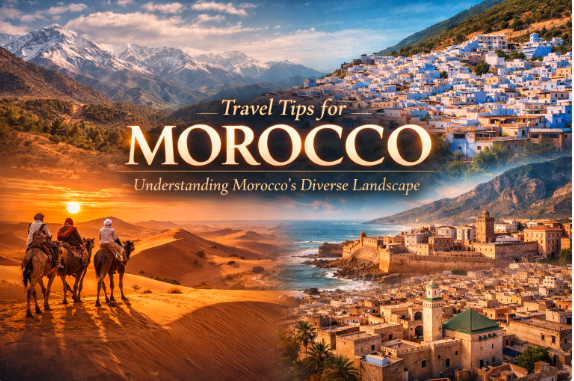
Travel Tips for Morocco : Understanding Morocco’s Diverse Landscape
Morocco’s geography unfolds as a striking continuum, stretching from the austere expanses of the Sahara to mountain chains that rise in layered ridgelines, and onward to coastal cities animated by trade winds, ports, and promenades. This isn’t scenery alone; it’s a practical map that shapes everything a traveler will face on the ground. Climate shifts sharply with altitude and latitude, roads and rail links behave differently across plains, passes, and desert corridors, and even lodging styles vary—from compact urban riads to remote desert camps and highland guesthouses built for colder nights.
The result is simple: a one-size-fits-all itinerary rarely holds. Planning must be regional, almost tactical—calibrated to temperature swings, seasonal snow or heat, and the real rhythm of transport connections. Visitors who read each zone on its own terms, then time their crossings with weather and accessibility in mind, don’t just avoid friction; they unlock Morocco at its most generous.
Navigating Cultural Complexities
Morocco isn’t just “a mix of influences” on paper—you can feel it in everyday life. One moment you’re hearing Arabic in a café, the next you catch Amazigh words in a market, and French appears on street signs, menus, and official offices. That blend shapes how people greet each other, what feels polite, and what feels intrusive. And it doesn’t play out the same way everywhere.
In Casablanca, the pace is faster, the social codes can be more relaxed, and people are used to a wide range of visitors. In smaller towns or rural areas, things often run on a different rhythm: introductions matter more, privacy is valued, and the idea of “showing respect” can be tied to clothing, tone, and how you move through public spaces. None of this is about walking on eggshells—it’s about paying attention.
When you adjust with a bit of tact—asking before taking photos, greeting properly, dressing thoughtfully when the context calls for it—you don’t just avoid awkward moments. You earn trust, conversations become warmer, and Morocco starts to feel less like a destination you’re passing through and more like a place that’s genuinely meeting you back.
Transport Modalities and Infrastructure
Getting around Morocco is less about choosing “the best” transport and more about picking what fits the day. Between big cities, the trains—especially the high-speed line—are the smooth option: clear schedules, decent comfort, and time saved when you’re trying to cover distance quickly. But once you head toward smaller towns or rural areas, you’ll notice the rhythm changes. Buses become the workhorse, and shared taxis often step in where routes are more flexible and timetables aren’t always strict.
If you take a few minutes to understand how each option actually runs—when departures are frequent, where delays are common, how much a shared taxi really costs—you can plan routes that feel realistic. That’s how you keep the trip balanced: spending on speed when it matters, saving money when time is on your side.
Health and Safety Considerations
In Morocco, you stay healthy and safe by doing the same things you’d do anywhere you want to feel good: keep it simple, stay aware, and look after yourself like you matter.
Start with the basics. Drink bottled or treated water, especially on hot days when you don’t realize how quickly you’re drying out. Eat where locals actually eat—places that are busy tend to be fresher—and go gently with raw foods if your stomach isn’t used to them. The sun can surprise you, even when the air feels cool, so light clothes that cover your skin, sunglasses, and regular breaks make a huge difference.
Safety depends on context. Big cities usually feel straightforward when you keep your phone and wallet secure, stay alert in crowds, and use trusted transport at night. More peripheral areas call for a bit more planning: avoid isolated streets after dark, know your route, and listen to that quiet instinct when something feels off. Staying informed through local updates keeps your trip calm and controlled.
Economic Insights for Budget Optimization
Traveling through Morocco often feels affordable, yet the real cost of a day can shift quietly depending on where you are and the time of year. A seaside city in high season doesn’t play by the same prices as a small inland town in autumn. The travelers who keep their budget under control usually think beyond hotel and transport. They remember the small lines that add up—entry tickets to monuments, museum passes, the everyday habit of tipping, and the gentle art of bargaining in markets where the first price rarely tells the full story.
A little research before arrival pays off more than any last-minute scramble. Looking at accommodation options early—whether a simple hostel bed, a mid-range hotel, or a traditional riad tucked inside a medina—helps you match spending to comfort without surprises. With that balance in place, money stops being a stress point and becomes just another tool shaping the experience rather than limiting it.
Language Dynamics and Communication
In Morocco, you don’t need to be fluent—you just need to be willing. You’ll hear Arabic everywhere, Amazigh in many regions, and French showing up constantly in cafés, taxis, shops, and anything administrative. That language mix can actually make your life easier, because there’s usually a way to meet people halfway.
What changes the trip is noticing what works where. In a busy city, a few French words can help with tickets or directions. In smaller towns, simple Arabic greetings go a long way, even if the rest of the sentence falls apart. And when you’re bargaining or trying to clarify a price, being able to say a few key phrases often saves you from confusion and awkward back-and-forth.
Yes, a translation app helps when you’re stuck. But the real magic is the human part: a warm “Salam,” a sincere “Shukran,” or a friendly “Bslama.” People respond to effort, and that tiny effort often turns a quick transaction into a genuine moment.
Pick a Moroccan region and get a quick, field-ready planning snapshot
Fast guidance on climate, transport, clothing, best timing, and one local-minded tip—built for readers who want clarity without overplanning.
Choose a region
Atlas Mountains
Climate
Cooler air, bright sun, cold nights; winter snow possible in higher passes.
Transport
Car + local taxis for villages; buses to main towns; roads can slow in winter.
What to wear
Layers + a warm outer piece; sturdy shoes; sun protection still matters.
Best timing
Spring and early autumn for hiking comfort; winter for snow scenes.
Travel Tips for Morocco: Understanding Morocco’s Diverse Landscape
Five visuals you can place inside the article to “prove” the diversity: desert, mountains, coast, medina life, and the Rif’s blue city.

Sahara dunes at sunset Heat + cold nights
Use this image to introduce temperature swings and “layering”. Source: Wikimedia Commons.

Atlas Mountains Altitude planning
Perfect for tips on road timing, hiking starts, and cooler evenings. Source: Wikimedia Commons.

Atlantic coast in Essaouira Wind + mild air
Great for “bring a light jacket” and coastal transport tips. Source: Wikimedia Commons.

Fez medina view Walkable intensity
Supports advice about walking hours, navigation, and crowd awareness. Source: Wikimedia Commons.
.jpg?width=1600)
Chefchaouen (Rif) North escape
Useful to illustrate “different Morocco” in the north: cooler feel + mountain backdrop. Source: Wikimedia Commons.
src URLs.