Tracing the Roots of Moroccan Social Activities
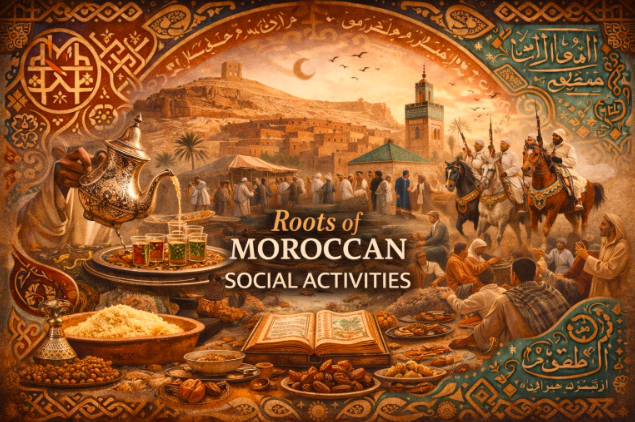
Moroccan social activities have deep roots in tribal solidarity, Amazigh and Arab customs, and Islamic community rhythms. Long before modern cafés and festivals, people built belonging through family visits, market life, seasonal work, and collective celebrations—weddings, harvest gatherings, and moussem events that mixed spirituality, trade, storytelling, and matchmaking. Over time, urbanization moved these habits into new spaces (public squares, cinemas, clubs), but the core stayed the same: hospitality, shared time, and community support. In short, the roots of Moroccan social life come from a culture of gathering—where faith, family, and everyday cooperation turn simple moments into lasting social bonds.
From Tribal Gatherings to Urban Festivities
Long before Morocco had rooftop cafés, packed football cafés, and weekend festivals, people already knew how to “make community.” In villages and tribal areas, social life didn’t need neon lights or event posters. It happened naturally—around a shared tea, a family meal, a wedding that brought everyone out, a harvest day where neighbors helped without being asked, or an evening where voices, drums, and ululations filled the air. These moments weren’t only for celebration. They were how people stayed connected, how news traveled, how conflicts were eased, how respect was shown, and how children learned what it means to belong.
Today, cities offer different spaces—boulevards, malls, cultural centers, beach corniches—but the same need is there: to gather, to be seen, to laugh, to feel part of something bigger than yourself. What changed is the décor and the pace. What stayed is the Moroccan instinct for togetherness—warm, social, and deeply rooted. Morocco didn’t abandon its old ways; it simply carried them forward into modern streets, with the past still quietly present in the way people meet, host, and celebrate.
Ancient Traditions as Foundations of Social Life
Morocco’s older social life was built like a tapestry—Amazigh (Berber) and Arab threads woven so tightly together that community felt natural, almost automatic. People didn’t need to “plan” connection; it was already there. The year moved to a familiar rhythm: tribal assemblies where elders and neighbors talked things through, seasonal moments that everyone recognized, and religious ceremonies that gathered families in the same place, at the same time. And then there was the moussem—not just a spiritual event, but a real social crossroads. You could pray, yes, but you could also shop, exchange news, meet someone who might become family one day, and sit with others while stories traveled from mouth to mouth like precious goods.
In rural areas, the same warmth showed up in work. Harvesting olives or picking dates wasn’t only labor—it was teamwork, with jokes, shared meals, and hands that helped without counting. Traditional weddings, too, were community-wide celebrations. Through effort and joy, people kept renewing the feeling that they belonged to one another.
The Influence of Islamic Culture on Social Practices
Islam became one of the most powerful “shared languages” in Morocco—something people could recognize immediately, whether they lived in the mountains, the desert, or the coastal cities. On Fridays, the mosque didn’t only gather worshippers; it gathered neighbors. You’d see familiar faces, exchange greetings, and feel that quiet sense of being part of the same community, even if daily life was busy or divided by work and status. Ramadan, too, reshaped the country’s mood. Days felt calmer, evenings felt warmer, and when the call to prayer signaled iftar, families and friends sat down at the same time—sometimes even sharing plates with others, because generosity is part of the season’s spirit. Charity during Eid and other holidays wasn’t just a “good deed”; it was a social bridge that kept people connected.
And then there were the madrasas and zawiyas. They weren’t only places to pray. They were places to learn, to listen, to debate, to hear poetry, to meet travelers and scholars, and to keep knowledge alive—like cultural homes that held communities together.
Urbanization and the Transformation of Social Activities
The 20th century changed everyday life in Morocco with a speed people could actually feel. As more families left villages for cities like Casablanca and Marrakech, they didn’t arrive empty-handed—they brought their habits, their celebrations, their music, their way of greeting, even the foods that “taste like home.” In the city, all of that mixed together. Neighborhoods became little mosaics: one street might feel rural in its warmth and solidarity, while the next felt modern, fast, and noisy. Social life found new stages too. Public squares turned into evening meeting points, cinemas gave people new stories to talk about, and cafés became the place where friendships formed, debates started, and generations crossed paths.
Festivals grew bigger and more open to the world. The Festival of World Sacred Music in Fès is a good example: international voices, but a clear echo of Morocco’s spiritual heritage. And for younger people, new outlets mattered—sports clubs, bands, theater groups—spaces to express themselves, to be seen, and to belong. Tradition didn’t disappear; it learned to live in new places.
Family and Gender Roles in Moroccan Social Activities
Historically, Moroccan social activities revolved around family structures and clearly defined gender roles. Men often participated in public gatherings, political councils, and market transactions, whereas women’s roles largely centered on household rituals, storytelling, and organizing family celebrations.
In modern times, these roles have been evolving with increased urban education and globalization. Women are progressively visible in public cultural events, social organizations, and leadership roles, reshaping communal interactions.
Preserving Heritage Amid Global Change
In Morocco, the story isn’t simply “men outside, women inside.” It’s more like two worlds that used to run in parallel. The street—markets, cafés, local meetings—was where men built networks and handled public affairs. The home—family visits, celebrations, daily rituals—was where women built relationships, kept traditions alive, and made sure everyone stayed connected.
What’s changing today is the bridge between those worlds. More women are stepping into public spaces through education, work, associations, and culture—organizing events, leading initiatives, creating new communities beyond the family circle. And at the same time, many men are becoming more present in family life. The result feels less like a “role swap” and more like a wider, more shared way of belonging.
Urban pull (why the map changed)
- Urban population: Morocco rose from 38.0% (1975) to 65.2% (2024) — a major shift toward city-based social hubs.
- Cross-check: World Bank series also reports ~65.64% urban (2024), confirming the same trend.
City anchor example (Casablanca)
Casablanca’s scale amplifies everyday public socializing (cafés, venues, clubs, malls). A commonly cited 2024 urban-area figure is ~3.218M.
Time-use data (how it’s measured)
Morocco’s HCP ran a National Time Use Survey (2011–2012) to quantify daily routines, including leisure and socializing.
- Households: 8,990
- People (15+): 15,486
Festival signal (Fès example)
The Fez Festival of World Sacred Music (founded 1994) is a high-visibility “social node” where spirituality, debate, and performance meet.
Social Activity Cartography (Where things happen)
1) Home & Family Network
The first map is the home: family visits, tea rituals, weddings, Ramadan iftar, Eid meals—belonging organized by kinship and neighborhood trust.
Spaces: living rooms, courtyards, rooftops, extended-family homes across districts.
2) Street & Market Life
Souks and neighborhood shops act like social routers—news, humor, bargaining, recognition, and quick solidarity all travel through them.
Spaces: medina lanes, local markets, weekly rural souks, transport hubs.
3) Cafés & Public Squares
In cities, cafés and squares become daily social rooms—football nights, debates, work breaks, people-watching, and friendships built over time.
4) Faith & Community Institutions
Mosques, madrasas, and zawiyas create recurring social rhythms—Friday flows, Ramadan evenings, charity moments, learning circles.
Often overlaps with family and neighborhood networks rather than replacing them.
5) Youth Spaces (Sports, Music, Theater)
Sports clubs, gyms, rehearsal rooms, small theaters, festival stages—where younger generations build identity beyond family circles.
Often densest around universities and major-city districts.
6) Signature Cultural Festivals
Festivals concentrate social energy into “high-visibility nodes” mixing locals, visitors, artists, and debate—anchoring cultural diplomacy in lived experience.
Quick Data Snapshot
| Indicator | Value | Why it matters | Notes |
|---|---|---|---|
| Urban share of population (Morocco) | 65.2% (2024) | More city-based “third places” (cafés, venues, clubs, squares) | OECD figure used as benchmark |
| Urban share (World Bank series) | ~65.64% (2024) | Independent confirmation of the same structural shift | Use as cross-check |
| National Time Use Survey (HCP) | 2011–2012 | Method to quantify leisure + socializing + daily routines | Useful for gender/age comparisons |
| NTUS sample size | 8,990 households + 15,486 people (15+) | Enough scale to map patterns by place and population group | Copy-friendly credibility line |
| Fez Festival of World Sacred Music | Founded 1994 | Shows how local gathering becomes international cultural exchange | A “festival node” example |
| Casablanca (urban area) | ~3.218M (2024) | Density multiplies public socializing opportunities | Use as anchor city example |
What shifts first
- Time: days slow down; evenings become the social peak.
- Spaces: homes, mosques, and neighborhood streets feel more “collective.”
- Habits: eating, sleeping, shopping, and visiting reorganize around sunset.
Core social values
Ramadan is social because it’s synchronized: many people do the same key moments at the same time.
Typical “visible” changes
- Shopping patterns shift closer to late afternoon and evening.
- More family visiting and shared meals.
- Night walks after prayer become common.
- Public life becomes calmer during the day, livelier after sunset.
The Ramadan Day in Morocco (Activity Timeline)
Community & Charity
- Food sharing with relatives, neighbors, and people in need.
- Quiet, practical acts of charity (money, groceries, meals).
- Collective support: checking on elders, helping families prepare.
In many neighborhoods, generosity is “everyday,” not performative—people give because it’s expected of a decent community.
Family & Visiting Culture
- Iftar invitations (close family, then wider circles).
- Short evening visits after prayer (tea, sweets, conversation).
- Reconnecting with relatives you rarely see outside Ramadan.
Public Life (City vs. Village)
Cities: more late-night movement, cafés and corniches after prayer, bigger shopping peaks.
Villages: stronger family clustering, more shared preparation, quieter public spaces, deeper neighborhood ties.