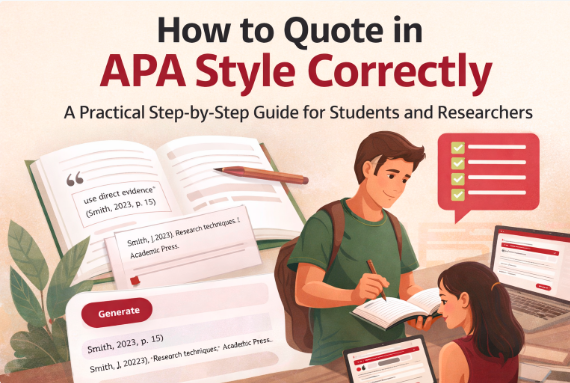
How to Quote in APA Style Correctly — A Practical Step-by-Step Guide for Students and Researchers
Use an APA Citation Generator ⬇️ – Learn how to quote in APA style in minutes, not hours. This guide shows you exactly where to place quotation marks, how to format in-text citations, and how to build a clean reference entry you can copy instantly. Use the included generator and examples to produce accurate APA quotes for essays, reports, and academic papers—saving time while strengthening the credibility of everything you write.
A Practical, Human Guide You Can Actually Use
Quoting in APA style is often presented as a strict academic rulebook. In reality, it is much simpler than it looks. APA quoting is not about sounding “scholarly.” It is about being transparent. You are telling your reader: these words are not mine, and here is exactly where they came from.
When you quote correctly, three things happen naturally:
- Your writing gains credibility.
- Your reader gains clarity.
- You protect yourself from plagiarism without stress.
Think of APA quoting as a small act of intellectual honesty. You are giving credit, and at the same time, strengthening your own argument.
What Does “Quoting” Mean in APA?
In APA style, quoting simply means using someone else’s exact words.
There are two main ways you can bring a source into your writing:
- Direct Quote – You copy the exact sentence or phrase.
- Paraphrase – You rewrite the idea in your own words.
Both are acceptable. Both require a citation. The difference is that direct quotes need quotation marks (or a block format), while paraphrases do not.
A helpful mindset:
- Quote when the original wording is powerful or precise.
- Paraphrase when the idea matters more than the exact wording.
The Core Formula of APA In-Text Citations
Most APA citations follow a simple and repeatable pattern:
(Author, Year, p. X)
That is the heart of APA. Once you understand this pattern, everything else becomes variation.
- Author – Who wrote it
- Year – When it was published
- Page – Where it appears
If there is no page number, you use another locator such as a paragraph number.
Short Quotes: Under 40 Words
Short quotes stay inside your paragraph and use quotation marks.
Example (Parenthetical Style)
“Leadership is practiced, not so much in words as in attitude and actions” (Geneen, 1984, p. 27).
Example (Narrative Style)
Geneen (1984) observed that “leadership is practiced, not so much in words as in attitude and actions” (p. 27).
Both are correct. The difference is stylistic. Narrative citations feel more fluid in essays; parenthetical ones feel more neutral in research papers.
A small but important detail:
In APA, the period goes after the citation, not before it.
Long Quotes: 40 Words or More
Long quotes are treated differently because they visually interrupt the flow. APA turns them into a block quote.
Key rules:
- Start on a new line
- Indent the entire quote
- No quotation marks
- Citation comes at the end
This format signals to the reader: these words are fully borrowed.
A long quote should feel intentional, not accidental. If you use too many, your paper starts sounding like a collage instead of an argument.
What If There Are No Page Numbers?
Websites and online articles often lack pages. APA does not leave you stranded. Instead, you use:
- Paragraph numbers → (Author, Year, para. 4)
- Section headings → (Author, Year, “Conclusion,” para. 2)
This keeps your citation precise even in digital environments.
Sources Without an Author
Sometimes there is no clear individual name. In that case, use:
- The organization’s name, or
- The title of the article/page
Example:
“Style communicates before words do” (“Why Style Matters,” 2022, para. 3).
This is not a workaround. It is standard APA practice.
Multiple Authors
APA simplifies this quickly:
- Two authors → (Smith & Lee, 2021, p. 12)
- Three or more → (Smith et al., 2021, p. 12)
“Et al.” simply means “and others.” It keeps citations readable instead of crowded.
Quoting Videos, Podcasts, and Social Media
Modern writing is not limited to books. APA adapts easily.
Video or YouTube
Use a timestamp instead of a page:
“Discipline is a form of freedom” (Peterson, 2018, 2:14).
Social Media
Cite the author and date. If possible, include paragraph numbers for long posts.
The principle remains the same: help the reader find the original moment.
Secondary Citations (Use Sparingly)
Sometimes you discover a quote inside another book or article. APA allows this, but it is a last resort.
Format:
(Original Author, Year, as cited in Secondary Author, Year, p. X)
You only list the secondary source in your references, because that is what you actually read.
This is acceptable, but whenever possible, try to locate the original source yourself.
How to Avoid Over-Quoting
One of the most common beginner mistakes is quoting too much.
A page filled with quotation marks weakens your voice.
A good rhythm looks like this:
- Introduce the idea.
- Quote a short, precise line.
- Explain it in your own words.
This keeps you in control of the narrative instead of letting sources speak for you.
The Reference List: The Other Half of APA
In-text citations are only half the job. At the end of your document, you include a reference list with full details.
A book reference typically includes:
Author. (Year). Title. Publisher.
A website reference typically includes:
Organization. (Year). Title of page. URL.
The in-text citation points the reader to this list. Think of it as a map and a legend working together.
A Simple Mental Checklist Before Submitting
- Are quotation marks used for short quotes?
- Are long quotes formatted as blocks?
- Did you include author and year every time?
- Did you add page or paragraph numbers where possible?
- Does every citation appear in the reference list?
If you can answer “yes” to these, your APA quoting is already strong.
Final Thought
APA quoting is not about memorizing rules; it is about respecting ideas. You are participating in a conversation that existed before you and will continue after you. Each citation is a small sign that you understand where knowledge comes from—and that you are contributing to it honestly.
Once you internalize that mindset, APA stops feeling mechanical and starts feeling natural.
Quick User Guide (APA Citation Generator)
- Choose your source type (Website, Book, Journal article, or Video).
- Fill in the key fields: Author (or Organization), Year, and Title.
- Add a locator only if you are quoting (page, paragraph, or timestamp).
- Click Generate to instantly update all citation outputs.
- Use Copy buttons to copy one block, or click Copy to Word to copy everything in a Word-ready format (italics + line breaks).
- Click Reset to clear the form and start a new citation.
APA Citation Generator
Generate clean APA in-text citations and a reference entry, then copy to Word in one click.
APA 7 basics • Copy-ready • Word-friendlyPick the closest type. This tool generates a clean APA 7 baseline format.
If unknown, leave blank → n.d.
For organizations, type the full name (no comma needed).
Use the title as it appears in the source.
For a journal article, put the journal name here.
Recommended for websites and videos.
Use this for direct quotes. Optional for paraphrases.