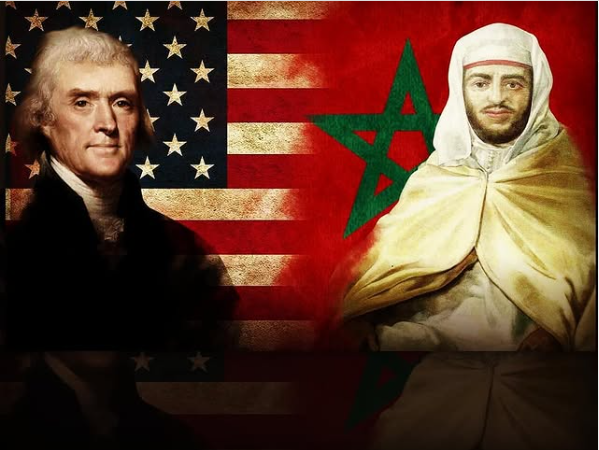
George Washington and the Sultan Sidi Mohammed III : The Moroccan-American Friendship Treaty
The idea of George Washington as a “Sultan of Morocco” is a poetic way to reflect on the depth of the historical relationship between the United States and Morocco. It celebrates the vision of Sultan Mohammed III, who recognized the potential of a fledgling republic, and the gratitude of George Washington, who valued the Sultan’s support. Their alliance, built on trust and foresight, remains an enduring example of international friendship and collaboration.
The suggestion that George Washington, the first president of the United States, might be thought of as a “Sultan of Morocco” is not literal but symbolic. It reflects the unique and fascinating diplomatic relationship between the newly formed United States and the Kingdom of Morocco in the late 18th century. This relationship, rooted in mutual recognition and respect, serves as a remarkable chapter in the history of international relations.
Morocco: The First Country to Recognize the United States (1777)
Long before formal treaties were drafted, Morocco played a decisive role in the emergence of American diplomacy. In December 1777, Sultan Sidi Mohammed III opened Moroccan ports to American vessels, effectively recognizing the United States during its struggle for independence.
This strategic decision positioned Morocco as the first nation to acknowledge American sovereignty. At a time when maritime security determined survival in global trade, the Sultan’s gesture offered legitimacy and protection to a young republic navigating uncertain waters.
Recognition preceded diplomacy, and diplomacy soon produced one of the most enduring agreements in international history.
The Origins of US-Morocco Relations
The connection between George Washington and Sultan Mohammed III of Morocco began against the backdrop of the American War of Independence (1775–1783). As the United States declared its independence from Britain, it sought allies and recognition from global powers. Morocco, under the leadership of Sultan Mohammed III, became the first country to formally recognize the independence of the United States in 1777.
This act was not merely symbolic; it was a practical decision by the Sultan to protect American ships. At the time, piracy in the Mediterranean and Atlantic posed significant risks to international trade. By recognizing the United States, Sultan Mohammed III extended Morocco’s protection to American vessels, ensuring their safe passage through Moroccan waters.
The Moroccan-American Treaty of Friendship
In 1786, the United States and Morocco formalized their relationship through the Moroccan-American Treaty of Friendship, negotiated by Sultan Mohammed III and signed by American representatives, including Thomas Jefferson and John Adams. This treaty, the longest-standing unbroken treaty in U.S. history, laid the groundwork for mutual trade, protection, and collaboration.
George Washington, then president, expressed his gratitude to Sultan Mohammed III in a letter, highlighting the importance of their partnership. In his correspondence, Washington praised the Sultan’s foresight and generosity, acknowledging the significance of Morocco’s recognition in legitimizing the United States on the international stage.
The Moroccan-American Treaty of Friendship: A Legacy of Over 225 Years
Sultan Mohammed III’s Vision
Sultan Mohammed III was not only a ruler of great diplomatic acumen but also a forward-thinking leader who understood the shifting dynamics of global power. His decision to engage with the United States reflected Morocco’s strategic interest in fostering new alliances beyond Europe. This was particularly important as European powers, such as Britain and France, dominated the geopolitical landscape and often marginalized smaller nations like Morocco.
By establishing a formal relationship with the United States, the Sultan demonstrated Morocco’s independence and ability to navigate the complexities of international diplomacy. His actions set a precedent for Morocco’s enduring commitment to fostering peace and cooperation.
George Washington’s Reverence for Morocco
While the title “Sultan of Morocco” might seem exaggerated when associated with George Washington, it captures the mutual respect between the two leaders. Washington’s letters to Sultan Mohammed III expressed admiration for the Sultan’s vision and leadership, describing their partnership as one of mutual benefit and goodwill.
This respect was not one-sided. Sultan Mohammed III viewed Washington as a leader who had successfully achieved independence for his people, embodying principles of sovereignty and self-determination that resonated with Morocco’s own struggles against colonial pressures.
The Legacy of Moroccan-American Relations
The relationship forged by George Washington and Sultan Mohammed III has left a lasting legacy. The Moroccan-American Treaty of Friendship remains a cornerstone of the two nations’ diplomatic history, symbolizing the enduring values of respect, mutual benefit, and cooperation. Today, Morocco and the United States maintain strong ties, with collaboration spanning trade, security, and cultural exchange.
The symbolic connection between George Washington and the Sultan of Morocco serves as a reminder of the power of diplomacy and the importance of alliances rooted in shared principles. It highlights how two vastly different nations, separated by geography and culture, came together to navigate the challenges of their time and create a partnership that continues to thrive centuries later.
The Moroccan-American Treaty of Friendship: A Lasting Testament to Visionary Diplomacy
The Moroccan-American Treaty of Friendship, signed in 1786 and ratified under the Articles of Confederation before the adoption of the U.S. Constitution, is often regarded as the oldest treaty still in effect in the history of the United States. Its remarkable longevity and unbroken continuity make it a shining symbol of the diplomatic relations between two vastly different nations, united by a shared vision of cooperation and mutual respect.
Early and Visionary Recognition
Morocco, under the reign of Sultan Sidi Mohammed ben Abdallah, also known as Mohammed III, played a pioneering role in recognizing the United States. On December 20, 1777, the Sultan issued a historic decree allowing ships flying the American flag to dock in Moroccan ports. This act, later recognized as the first official acknowledgment of the United States by a foreign power, preceded France’s recognition in 1778. This strategically visionary gesture reflected the Sultan’s desire to engage with a new world order and support a nascent nation.
At the time of the Sultan’s decree, however, the Americans themselves were deeply entrenched in their struggle for independence. On December 19, 1777, just one day before Morocco’s decision, George Washington and his Continental Army entered winter quarters at Valley Forge, Pennsylvania, where the dream of independence felt as distant as the sunny shores of Morocco.
Why the Moroccan–American Treaty Still Exists Today
The Moroccan–American Friendship Treaty holds a singular distinction: it remains the longest unbroken diplomatic treaty in United States history. Signed in 1786 and ratified in 1787, the agreement established principles of peace, maritime cooperation, and mutual respect that transcended political change.
Unlike many eighteenth-century alliances shaped by temporary interests, this treaty rested upon commercial stability and diplomatic continuity. Successive governments in both nations reaffirmed its spirit, allowing the agreement to survive revolutions, world wars, and shifting geopolitical landscapes.
A Diplomatic Context: Balancing Opportunity and Necessity
Morocco’s recognition was not merely symbolic; it was rooted in the complex geopolitical dynamics of the time. European powers paid tribute to North African states (known as the “Barbary States”) to secure their trading routes. With American independence, British tribute no longer extended to American ships, necessitating formal agreements to ensure safe passage.
In 1778, the Sultan appointed a French merchant, Caille, as consul for nations without representation in Morocco. Caille wrote to Benjamin Franklin, then the U.S. representative in Paris, proposing negotiations for a formal treaty. While the Continental Congress approved the idea as early as 1780, significant progress was only made after the 1783 peace treaty with Great Britain.
The Signing of the Treaty: A Meeting of Two Worlds
In 1785, Thomas Barclay, U.S. Consul General in Paris, was dispatched to Morocco to negotiate the treaty’s terms. Endorsed by John Adams and Thomas Jefferson, Barclay arrived in Marrakech, the Sultan’s capital, on June 19, 1786. Less than two weeks later, on June 28, 1786, the treaty was signed and sealed by Sultan Mohammed III.
Initially valid for 50 years, the treaty was renewed in 1836. An additional article was signed by Jefferson in Paris and by Adams in London in January 1787, before its ratification by Congress on July 18, 1787. The treaty, still in effect today, established a unique and enduring bilateral relationship.
Diplomatic Legacy: The Tangier Consulate
Sultan Mohammed III’s impact on Moroccan-American relations extended beyond the treaty. In 1821, his successor gifted the United States a property in Tangier that became the American Consulate. This site holds a unique place in diplomatic history as the oldest continuously used U.S. property outside the country. Listed on the National Register of Historic Places, it now houses the Tangier American Legation Institute for Moroccan Studies, combining a museum and cultural center.
An Alliance Built on Vision and Respect
The correspondence between George Washington and Sultan Mohammed III reflects the mutual respect between the two leaders. Washington praised the Sultan’s foresight and generosity, recognizing the importance of Morocco’s support in establishing the United States’ legitimacy on the global stage. For his part, Mohammed III viewed this alliance as a strategic opportunity to assert Morocco’s independence in the face of European dominance.
The text, taken from the Mount Vernon website:
New York City, December 1, 1789
Great and Magnanimous Friend,
Since the date of the letter that the previous Congress addressed to Your Imperial Majesty through its President, the United States of America has seen fit to change its government and institute a new one, as established by the Constitution. I have the honor of enclosing herewith a copy of that document. The time necessarily devoted to the arduous task of implementing such a significant, though peaceful, revolution may explain and account for why Your Majesty has not received the regular tokens of attention from the United States that the friendship and magnanimity of Your Majesty’s conduct toward them gave reason to expect.
The United States, having unanimously entrusted me with the supreme executive authority of this nation, now have the honor of responding to Your Majesty’s letter of August 17, 1788. Due to the dissolution of the previous government, Your letter had remained unanswered until now. I have also received the letters Your Imperial Majesty graciously addressed to the Bashaws of Tunis and Tripoli on behalf of the United States. Please accept the sincere gratitude of this nation for such a significant mark of your friendship.
We deeply regret that the hostile disposition of those regencies toward this nation—despite having done them no harm—has not yet abated. We remain limited in our ability to address this matter, given the resources at our disposal.
In our territories, there are no mines of gold or silver, and this young nation, only recently recovering from the devastation and disarray of a prolonged war, has not yet had the opportunity to accumulate wealth through agriculture and trade. However, our soil is fertile, and our people industrious, giving us every reason to hope that we will, over time, become increasingly valuable to our friends.
The encouragement Your Majesty has generously extended to our trade with your states, the diligence with which you have upheld the treaty, and the just and magnanimous actions taken in the case of Captain Proctor have left a deep impression on the United States and have strengthened their respect and affection for Your Imperial Majesty.
I am pleased to assure Your Majesty that, as long as I remain at the head of this nation, I shall not cease to promote all measures that may strengthen the friendship and harmony so happily existing between your empire and ours. It will always be my privilege to express, on every suitable occasion, the profound respect and admiration that I, along with this entire nation, feel for the magnanimity, wisdom, and benevolence of Your Majesty.
May the Almighty bless Your Imperial Majesty, our Great and Magnanimous Friend, with His constant guidance and protection.
With great respect,
George Washington
Gallery: Faces and Documents Behind the Morocco–U.S. Friendship
A compact visual set to anchor the narrative: the statesman, the sovereign, and a treaty page that signals the seriousness of early transatlantic diplomacy.

George Washington, diplomatic symbolism in a new republic
A period portrait often used to visually frame early American statecraft—useful as the “American face” of the story.

The Treaty page: seal, script, permanence
A high-impact document visual—perfect for a mid-article break or a “primary sources” section.

Sultan Sidi Mohammed III: strategic opening and recognition
A contextual portrait widely circulated in press/history summaries—use as an illustrative visual while you cite official diplomatic sources in the text.
Timeline of Moroccan–American Friendship
- 1777 — Morocco recognizes the United States.
- 1786 — Treaty signed in Marrakesh.
- 1787 — Ratification by the U.S. Senate.
- 1821 — American Legation established in Tangier.
- 1836 — Treaty renewed.
- Today — Oldest active diplomatic treaty in U.S. history.
Frequently Asked Historical Questions
Was Morocco the first country to recognize the United States?
Yes. Morocco recognized American independence in 1777 by opening its ports to American ships.
Why is the Moroccan-American treaty important?
It represents the longest unbroken diplomatic relationship in United States history.
Is the treaty still valid today?
The agreement remains symbolically active and reflects ongoing diplomatic cooperation.
Where was the treaty signed?
The treaty was concluded in Marrakesh in 1786.