
Analyzing Shuttle Diplomacy Through Notable Cases
Diplomatic history is often remembered through iconic images: leaders shaking hands before cameras, treaties signed beneath national flags, or carefully staged summits presented as historic breakthroughs. Yet many negotiations that later shaped international stability began far from public view. Before official agreements emerged, there were usually months — sometimes years — of discreet conversations conducted through intermediaries moving patiently between hostile sides. That quieter process is known as shuttle diplomacy.
Unlike traditional negotiations where adversaries meet directly across the same table, shuttle diplomacy relies on an intermediary who travels repeatedly between rival parties, carrying proposals, clarifications, counteroffers, and strategic signals. The mediator becomes the channel through which dialogue survives when direct communication has collapsed or become politically impossible.
This method rarely produces immediate miracles. In reality, shuttle diplomacy often unfolds slowly, through exhausting rounds of discussion where progress appears fragile and reversible at every stage. Yet some of the world’s most difficult conflicts have depended on precisely this type of indirect negotiation.
Its enduring relevance says something important about international politics itself: diplomacy is not only about agreements. It is also about preventing silence from becoming permanent.
Understanding Shuttle Diplomacy Beyond the Definition
At its simplest level, shuttle diplomacy refers to a negotiation process in which a third party moves back and forth between disputing sides that refuse to meet directly. The mediator relays messages, explores possible compromises, and gradually attempts to reduce tensions.
In practice, however, shuttle diplomacy involves far more than carrying information from one room to another.
Conflicts severe enough to require indirect diplomacy are usually shaped by:
- deep mistrust,
- political trauma,
- domestic pressure,
- ideological hostility,
- or unresolved historical grievances.
Under such conditions, even symbolic gestures become politically sensitive. A direct meeting may be interpreted as weakness. A photograph beside an adversary may provoke domestic outrage. Public negotiations often harden positions instead of softening them because leaders begin speaking more to their own audiences than to one another.
Shuttle diplomacy creates a different environment.
Separate discussions allow negotiators to explore possibilities privately without immediate public scrutiny. The intermediary reduces emotional confrontation while preserving communication during moments where direct dialogue might collapse entirely.
The mediator’s role therefore becomes extraordinarily delicate. Every message must be framed carefully. Tone matters. Timing matters. Certain expressions may calm tensions while others inflame them instantly.
Diplomacy at this level often depends less on dramatic speeches than on subtle psychological judgment.
The Historical Emergence of Shuttle Diplomacy
Although forms of indirect negotiation existed long before the modern era, the term “shuttle diplomacy” became internationally famous during the 1970s through the efforts of Henry Kissinger following the Yom Kippur War.
The geopolitical atmosphere surrounding the Middle East at that time was exceptionally volatile. Israel, Egypt, and Syria remained locked in profound hostility, while Cold War rivalries heightened the strategic stakes globally. Direct negotiations between leaders carried enormous political risks.
Kissinger responded through relentless diplomatic movement between regional capitals.
Rather than pursuing immediate comprehensive peace, he focused initially on smaller objectives capable of reducing military tensions incrementally. His repeated trips between Jerusalem, Cairo, and Damascus became emblematic of shuttle diplomacy itself.
What made the process effective was not theatrical diplomacy or grand rhetoric. It was persistence.
The negotiations recognized a difficult political reality: trust could not be restored instantly after war. Communication had to be rebuilt gradually through limited but meaningful agreements before broader reconciliation could even become conceivable.
That lesson continues to shape diplomatic strategy today.
Case Study 1: The Middle East Peace Process
The Middle East remains one of the clearest examples of shuttle diplomacy in practice.
Following the Yom Kippur War, tensions throughout the region remained dangerously high. Direct negotiations between Israel and its neighboring states faced almost insurmountable obstacles. Public hostility remained intense, military uncertainty persisted, and domestic political pressures limited diplomatic flexibility on all sides.
Kissinger’s strategy relied upon constant movement.
He travelled repeatedly between capitals, holding separate meetings with Israeli, Egyptian, and Syrian leaders. Discussions focused first on ceasefires and troop disengagement agreements rather than broader political settlement.
This gradual approach proved crucial.
Attempting to solve every dispute immediately would almost certainly have failed. Instead, shuttle diplomacy concentrated on reducing immediate risks while slowly rebuilding enough confidence for future negotiations.
One of the most important achievements of this process was psychological rather than purely political. The negotiations demonstrated that communication between bitter adversaries remained possible despite profound mistrust.
That alone altered the diplomatic landscape.
The agreements reached during this period later contributed to broader peace initiatives, including the eventual diplomatic normalization between Egypt and Israel. Shuttle diplomacy did not create instant harmony, but it helped prevent renewed escalation while opening pathways toward longer-term stability.
Case Study 2: The Cyprus Conflict
The Cyprus conflict provides another important example of shuttle diplomacy operating within a deeply divided political environment.
Since the island’s partition between Greek Cypriot and Turkish Cypriot communities, negotiations have repeatedly faced obstacles linked to sovereignty, security, identity, and historical memory. Direct talks have frequently stalled due to mutual suspicion and political sensitivities surrounding legitimacy.
International mediators therefore relied extensively on shuttle diplomacy.
Intermediaries moved between leaders from both communities, attempting to narrow differences gradually while preventing negotiations from collapsing entirely. Confidential discussions allowed proposals to be explored privately before entering public debate.
The Cyprus case also highlights one of shuttle diplomacy’s limitations.
Despite decades of intermittent negotiations, a comprehensive settlement remains elusive. Yet the absence of a final agreement does not necessarily mean shuttle diplomacy failed. In many prolonged conflicts, diplomacy serves another equally important purpose: managing tensions and preventing deterioration.
Without sustained indirect communication, divisions can harden even further.
Shuttle diplomacy in Cyprus has repeatedly helped preserve channels of dialogue during moments where complete diplomatic breakdown appeared possible.
Case Study 3: The Iran Nuclear Negotiations
The negotiations surrounding Iran’s nuclear program demonstrate how shuttle diplomacy adapted to modern geopolitical complexity.
For years, discussions between Iran and Western powers unfolded under conditions marked by profound mistrust, economic sanctions, regional instability, and domestic political pressure on all sides. Direct engagement remained politically sensitive, particularly during periods of heightened confrontation.
Diplomatic intermediaries played a crucial role in maintaining communication.
European envoys, American officials, and international negotiators moved constantly between Tehran and major global capitals, carrying proposals, clarifications, and technical adjustments back and forth. Many discussions occurred through discreet channels away from public attention.
The process was extraordinarily detailed and often frustratingly slow.
Negotiators debated technical nuclear issues alongside broader geopolitical concerns. Small wording changes sometimes required extensive discussion because every formulation carried political implications domestically.
Yet shuttle diplomacy helped sustain momentum even during difficult phases.
The eventual signing of the Joint Comprehensive Plan of Action illustrated how indirect negotiation could gradually transform prolonged hostility into a structured diplomatic framework — even if political disagreements persisted afterward.
The negotiations also demonstrated an important reality about modern diplomacy: trust does not need to be complete for agreements to emerge. Sometimes diplomacy functions precisely because structured communication reduces uncertainty enough to make limited cooperation possible.
Why Shuttle Diplomacy Sometimes Works
Shuttle diplomacy succeeds most effectively under specific conditions.
Credible Mediation
The intermediary must possess sufficient credibility with all sides involved. If negotiators suspect manipulation or bias, trust erodes rapidly.
Confidential Communication
Private discussions reduce political theatre and allow negotiators to test ideas without immediate public backlash.
Incremental Progress
Complex conflicts rarely disappear overnight. Shuttle diplomacy works best when agreements emerge gradually through smaller confidence-building steps.
Strategic Patience
Diplomatic breakthroughs often require long periods of persistence. Some negotiations advance through months of seemingly repetitive discussion before meaningful progress appears.
Political Timing
Even well-designed negotiations can fail if domestic or international political conditions deteriorate unexpectedly.
Diplomacy depends heavily on timing.
The Limitations of Shuttle Diplomacy
Despite its usefulness, shuttle diplomacy also faces important limitations.
Indirect communication creates possibilities for misunderstanding. Nuances may weaken as messages pass between parties, especially during emotionally charged crises.
The process can also become extremely slow.
Critics sometimes argue that shuttle diplomacy allows governments to prolong negotiations strategically without committing to genuine compromise. In certain situations, parties participate primarily to reduce international pressure or improve diplomatic image.
Another challenge concerns transparency.
Because shuttle diplomacy often relies upon confidential discussions, public understanding of negotiations remains limited. This secrecy can generate suspicion or weaken political support for eventual agreements.
Yet diplomats frequently accept this trade-off because excessive public exposure can destabilize fragile discussions before they mature sufficiently.
The Human Dimension Behind Shuttle Diplomacy
One of the most overlooked aspects of shuttle diplomacy concerns exhaustion.
Major diplomatic crises rarely unfold neatly. Negotiators often work under relentless pressure, moving between heavily secured locations while attempting to manage tensions capable of influencing regional stability or military escalation.
Meetings stretch late into the night. Draft agreements are rewritten repeatedly. A single paragraph may consume hours of debate because wording acceptable in one capital may sound politically humiliating in another.
Diplomacy at this level becomes intensely human.
Patience matters. Emotional intelligence matters. So does the ability to remain calm while negotiations fluctuate constantly between optimism and collapse.
Some of the most important diplomatic achievements in modern history emerged not from dramatic speeches, but from individuals willing to continue talking long after easier solutions had disappeared.
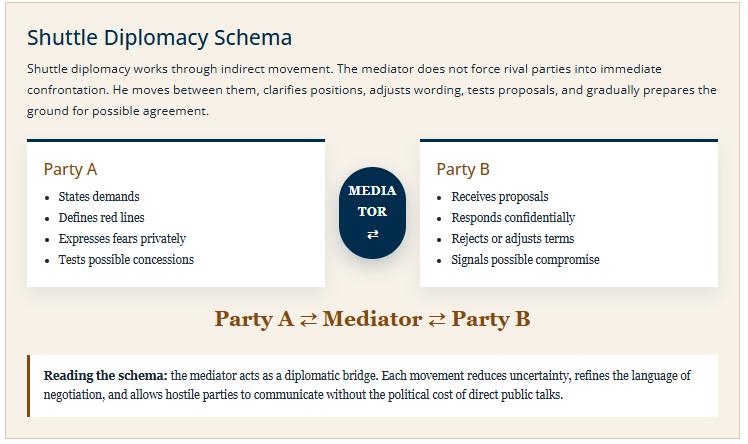
Shuttle Diplomacy Schema
Shuttle diplomacy works through indirect movement. The mediator does not force rival parties into immediate confrontation. He moves between them, clarifies positions, adjusts wording, tests proposals, and gradually prepares the ground for possible agreement.
Party A
- States demands
- Defines red lines
- Expresses fears privately
- Tests possible concessions
⇄
Party B
- Receives proposals
- Responds confidentially
- Rejects or adjusts terms
- Signals possible compromise