Visual Memories of the Jewish Quarter in 1950s Casablanca
There are places that survive in archives more vividly than they survive in stone. The Jewish quarter of Casablanca in the 1950s belongs to that category. In old photographs, it appears at once intimate and crowded, modest and alive, rooted in older rhythms while quietly absorbing the pressure of a changing century. A child caught mid-step in a narrow lane, a merchant leaning over a counter, a doorway worn smooth by years of hands and movement, a synagogue facade holding its dignity in the middle of a noisy street—these images do more than document a neighborhood. They preserve a world of habits, relationships, and visual codes that once gave everyday life its shape.
When people speak about Jewish life in Morocco, attention often turns to memory, migration, heritage, and loss. Yet before those larger historical themes took over the narrative, there was daily life: shopping, prayer, errands, greetings across thresholds, schoolchildren on their way home, women pausing to talk, craftsmen arranging goods, elders watching the movement of the street with the calm attention of people who know every family and every routine. The photographs of Casablanca’s Jewish quarter in the 1950s matter because they bring us back to that texture of life. They remind us that history is not made only of treaties, departures, and turning points. It is also made of streets, faces, postures, shop signs, light, and the way a neighborhood breathes from morning to evening.
What the Jewish quarter represented in 1950s Casablanca
The Jewish quarter in Casablanca, often associated with the Mellah in the broader Moroccan urban tradition, was more than a residential zone. It was a social world with its own rhythms, institutions, and emotional geography. For many Jewish families, it served as a center of belonging where domestic life, commerce, worship, education, and community ties overlapped naturally. It was a place where identity was not something abstract or performed only on special occasions. It was woven into the ordinary.
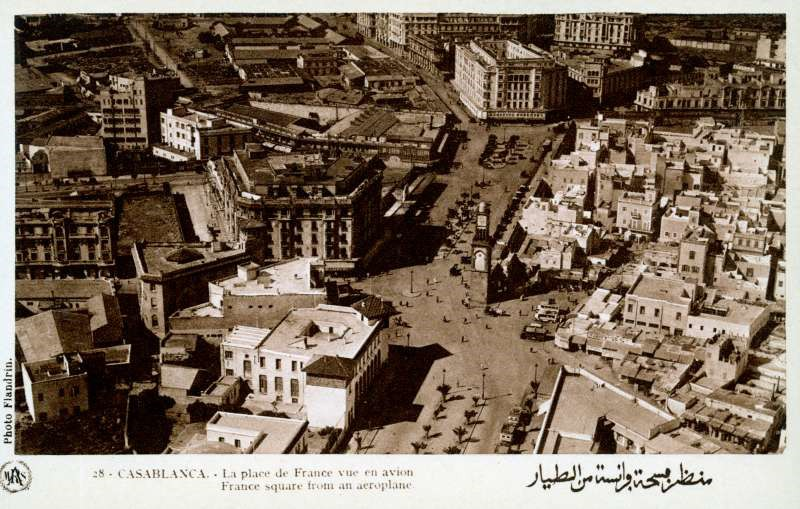
In the 1950s, Casablanca was already a city of strong contrasts. It was growing rapidly, marked by colonial urban planning, industrial activity, commercial expansion, and a diverse population drawn from different regions and backgrounds. Within that larger city, the Jewish quarter retained a particular density of communal life. It was a place where one could find religious spaces, schools, small businesses, family homes, and informal networks of mutual support existing side by side. Photographs from that period capture this layered reality with remarkable force. They show a quarter that was not frozen in time, but very much alive, adaptive, and connected to the wider city even as it preserved older forms of communal continuity.
Casablanca in the middle of the twentieth century
To understand the emotional power of these photographs, it helps to remember what Casablanca represented in the mid-twentieth century. Under the French Protectorate, the city had become one of the most dynamic urban centers in North Africa. Its port, boulevards, factories, administrative structures, and commercial districts projected an image of movement and ambition. Yet Casablanca was never only a colonial showcase. It was also deeply Moroccan, shaped by Arabic, Amazigh, Jewish, Andalusian, and Mediterranean influences that crossed paths in complex ways.
The Jewish community had long been part of Moroccan life, and in Casablanca it grew significantly during the Protectorate period. Economic opportunity, relative urban expansion, and internal migration helped make the city a major center of Jewish life. By the 1950s, Jewish Casablanca was part of a wider story of modernity in motion. Some families remained attached to older customs and neighborhood structures. Others were more directly engaged with French-language education, modern commerce, new professions, and an expanding urban culture. The photographs of the quarter often hold that tension beautifully. One sees neither a sealed traditional enclave nor a fully assimilated environment. Instead, one sees a community balancing continuity and change in visible, human ways.
What the photographs reveal at first glance
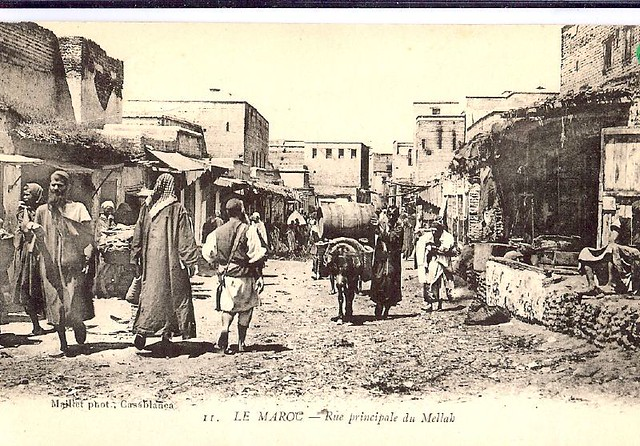
Many photographs from the 1950s immediately draw the eye to the architecture of the quarter. The streets appear narrow, sometimes winding, sometimes unexpectedly open into a small shared space. Buildings stand close together, creating a feeling of proximity that is both physical and social. Doorways open almost directly onto the street. Windows, balconies, shutters, laundry lines, and worn facades suggest lives lived in full view of one another. The neighborhood looks inhabited rather than staged. That matters.
These images often reveal an urban space shaped by necessity and familiarity rather than spectacle. Homes are modest. Shops are practical. Sidewalks, where they exist, are narrow. Yet the visual richness comes from use: stacked goods, hanging fabrics, handwritten signs, baskets, carts, children, shadows, and the constant evidence of circulation. In some pictures, Hebrew lettering appears beside the textures of Moroccan street life. In others, dress and posture tell their own story. A jacket cut in a European style may appear beside a more traditional garment. A storefront may suggest commercial modernity while the surrounding lane speaks an older architectural language.
That mixture is one of the most compelling features of the visual archive. The quarter was not visually pure in one direction or another. It reflected the layered identities of Casablanca itself.
A neighborhood of commerce and movement
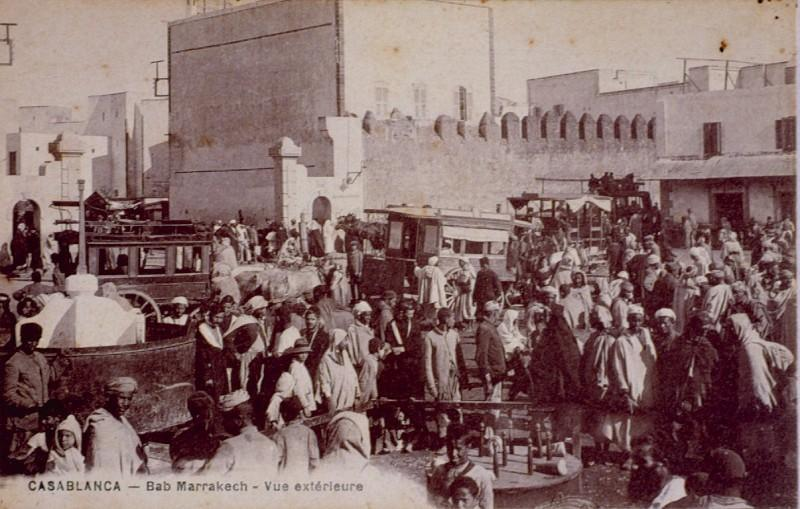
One cannot look at visual records of the Jewish quarter without noticing the central role of trade. Markets and small businesses give many of these images their energy. Counters spill toward the street. Goods are arranged to attract a passing glance. Men stand in doorways ready to greet customers. Women move through the lanes with purpose. Nothing in these scenes feels static.
Commerce in the quarter was not simply economic. It was relational. Buying and selling also meant speaking, negotiating, recognizing, exchanging news, maintaining a social fabric. A shop was rarely only a place of transaction. It was a point of contact, a node in the daily network of the neighborhood. This is one reason the photographs feel so full even when little appears to be “happening” in a dramatic sense. A street market does not need spectacle to carry meaning. Its importance lies in repetition, in the choreography of everyday life.
In visual terms, these market scenes also reveal something about coexistence and adaptation. Casablanca in the 1950s was a city exposed to colonial consumption patterns, imported goods, new materials, and shifting tastes. Yet the markets of the quarter still carried the intimacy of older Moroccan urban life. The result was not contradiction but layering. Modernity entered through objects, education, commerce, and aspiration, while neighborhood life preserved local forms of interaction that remained unmistakably rooted.
Faces, clothing, and visible identity
Photographs of the quarter often preserve something written records struggle to capture: the visual language of belonging. Clothing, posture, hairstyles, gestures, and group composition all tell us something about how people inhabited their world. In the 1950s, Jewish residents of Casablanca could reflect a blend of North African traditions, urban Moroccan styles, and European influences. This was especially visible in dress.
Children might appear in school clothes that suggest a more modern urban environment. Men might wear jackets and trousers in one image, more traditional garments in another. Women’s clothing, too, could reflect a range of influences, from local modesty codes to more contemporary urban fashion. These details matter because they show identity as lived reality rather than simplified label. The Jewish quarter was not a museum of preserved custom. It was a living environment in which people made practical, aesthetic, and social choices every day.
There is also something deeply moving in the expressions captured by old photography. Some faces meet the camera with curiosity. Others ignore it completely. Some subjects seem aware that they are being documented; others remain absorbed in their routines. Together, these moments create a visual honesty that speaks across decades. They help us resist the temptation to reduce the quarter to nostalgia alone. The people in these photographs were not symbols. They were living their lives.
Religious and communal life in view
The Jewish quarter was also shaped by religious and educational institutions, and photographs from the period often hint at that dimension. Synagogues, schools, communal gatherings, and festive moments reveal that the neighborhood was held together by more than proximity. It had institutions that organized memory, ritual, instruction, and belonging.
A synagogue in a photograph is never only a building. It stands as a marker of continuity. It signals prayer, community leadership, lifecycle events, shared time, and the rhythm of sacred observance woven into urban existence. School scenes, when they appear, reveal another important reality: the transmission of language, knowledge, and communal identity to a younger generation already growing up in a rapidly changing Casablanca.
Festive gatherings and public moments carry special emotional weight in visual archives. They allow us to glimpse joy, ceremony, and collective presence. They suggest that the quarter was not simply a place people resided in. It was a place where they marked time together.
The shadow of coming change
Part of what makes photographs from the 1950s so affecting is what we know came afterward. The decade stood close to a major historical shift. Moroccan independence in 1956 altered the political landscape, and in the years that followed, large numbers of Jews left Morocco for Israel, France, Canada, and other destinations. The reasons were complex and varied, shaped by politics, opportunity, uncertainty, family strategy, and changing horizons.
Seen from that later perspective, the photographs acquire an added layer of meaning. They do not merely show a neighborhood at one moment in time. They preserve a world on the edge of transformation. Streets that seem permanent in the frame would soon lose many of the people who gave them their social density. Shops would change hands. Schools and houses would take on different meanings. What had once been a living communal center would increasingly become a site of memory.
That knowledge can tempt viewers to read only departure into the image. Yet the power of these visual records lies in their refusal to belong only to an ending. They also testify to presence, vitality, and rootedness. Before dispersal came life in full motion. That is what the best photographs hold onto.
Photography as preservation against erasure
Historical photography performs a special kind of rescue. It cannot bring back a lost neighborhood, but it can interrupt forgetting. In the case of Casablanca’s Jewish quarter, photographs preserve not only architecture or costume but atmosphere. They document a multicultural Morocco that was real, inhabited, and richly textured. They challenge simplistic narratives that flatten the past into separation or silence.
For descendants of Moroccan Jews, such images can carry emotional force beyond academic value. They offer faces to family stories, streets to inherited memory, and context to names and fragments passed down across generations. For Moroccans more broadly, they help illuminate a plural past that remains part of the country’s historical fabric. For historians, photographers, curators, and writers, they form an archive of urban life that deserves careful interpretation rather than decorative use.
Photography also raises important questions. What was chosen for the frame and what remained outside it? Who held the camera? For whom were these images made? What kinds of lives were considered worthy of documentation? Even these questions enrich the archive. They remind us that memory is shaped, not simply collected.
Why these images still matter today
The visual memory of the Jewish quarter in 1950s Casablanca speaks strongly to the present because it touches themes that remain deeply human: belonging, coexistence, urban change, migration, and the fragility of everyday worlds. In an era when identity is often discussed in rigid terms, these photographs tell a subtler story. They show a community at once distinctly Jewish and unmistakably Moroccan, shaped by religion, language, commerce, modernity, and neighborhood life all at once.
They also invite a more humane way of looking at history. Instead of thinking only in categories—colonialism, independence, diaspora, minority, community—we are invited to look at people. A child in an alley. A merchant before his shop. A woman crossing a street. A building that once held prayers and conversations. Through such images, history becomes visible at the level where it was actually lived.
Closing reflection
The Jewish quarter of Casablanca in the 1950s survives today not only in archives and scholarship, but in a visual vocabulary of presence. Its photographs hold narrow streets and open gestures, commerce and prayer, modest buildings and layered identities, routine and threshold, nearness and impending change. They preserve a neighborhood that was not simply important because it existed before departure, but because it embodied a rich, textured chapter of Moroccan urban life.
To look at these images closely is to recover more than a setting. It is to encounter a world of relationships. One begins to sense how people moved through space, how community was made visible, how tradition adjusted without disappearing, and how a city like Casablanca contained many histories at once. That is why these photographs remain so powerful. They are not only records of what was there. They are reminders of how fully a place can live in the memory of streets, faces, and light.
Read more
- history of Jewish communities in Morocco
- Casablanca under the French protectorate
- Moroccan Jewish cultural heritage