Decoding the Map of Ancient Mediterranean Cultures
Decoding the Map of Ancient Mediterranean Cultures
How to Read an Ancient World Without Forcing Modern Borders
You’re right: the previous versions sound “correct,” but they still feel like a polished textbook. Here’s a new, genuinely original version—more subtle, more lived-in, and actually useful: it teaches how to read an ancient cultural map like a human being, with concrete cues and mental images (without sounding like an AI summary).
Start With a Simple Truth: Ancient Maps Were More Like Weather Reports
A modern map is built to answer one main question: Who owns what?
An ancient cultural map answers a different question: Who touches whom—and how often?
That difference changes everything.
If you try to read the ancient Mediterranean with today’s habits—clean borders, fixed identities, “this land belongs to that people”—you’ll end up flattening a world that was constantly in motion. In antiquity, culture traveled the way smells do in a market: it drifted, mixed, lingered, and sometimes disappeared.
So the first step is mental: stop searching for lines.
Start searching for contact zones—places where people had no choice but to meet.
The Mediterranean Wasn’t the Middle of Things. It Was the Thread That Sewed Things Together.
It’s tempting to call the Mediterranean a “stage” or a “crossroads,” but that still suggests separate actors coming and going. A better image is a thread. It stitched together three huge worlds—Europe, North Africa, and the Near East—through the simplest force in history: repeated contact.
A map of ancient Mediterranean cultures is really a map of repetition:
- repeated docking in the same harbors
- repeated markets where languages collide
- repeated marriages and alliances
- repeated raids and reprisals
- repeated pilgrimages to the same shrines
Over time, repetition makes strangers familiar. Familiarity makes borrowing normal. Borrowing changes identity quietly.
That’s what the map is showing when it looks “messy.” The mess is the point.
If You Want to Read the Map Properly, Focus on Three Things
1) Ports, not capitals
Modern history loves capitals. Ancient Mediterranean life loved ports.
Ports were the places where a fisherman could meet a foreign sailor, where a merchant could hear a new prayer, where a local potter could copy a foreign style without thinking of it as theft. Ports were also where people learned a basic truth: a foreigner isn’t a myth; he’s a customer.
When you look at an ancient cultural map, ask:
- Which cities sit on natural harbors?
- Which islands “interrupt” the sea like stepping stones?
- Where do routes naturally narrow (straits) and force traffic to pass?
Those are your real centers of gravity.
2) Routes, not regions
Instead of asking “Where did the Phoenicians live?” try:
- Where did Phoenician ships stop often?
- Where did Greek settlers plant cities that became dense networks?
- Where did grain routes matter so much that entire empires had to protect them?
Because in the Mediterranean, movement shaped culture more than land did.
3) Edges, not cores
Cultures get strict and confident at the core. They get flexible at the edges.
Edges are where you see bilingual inscriptions, mixed religious symbols, hybrid art styles, and political compromises. On a map, edges are usually coastlines, straits, island chains, and frontier valleys.
If you want to spot cultural blending quickly, scan the edges first.
Phoenicians: The Culture You Can Track Like a Trail of Lamps
If you look at Phoenician influence on a map, it doesn’t appear as a big painted block. It appears as a string of lights along the shoreline—a sequence of coastal points that makes sense only if you imagine a ship that needs to stop, rest, trade, and sail again.
The Phoenicians didn’t spread by covering land. They spread by touching it—repeatedly, strategically.
That’s why their presence shows up in:
- coastal settlements
- island outposts
- narrow straits
- places with access to metals and timber
Their genius was logistical. They understood that the Mediterranean rewards those who can move goods reliably.
And then—almost as a side effect—they moved something much more powerful than goods: a writing system that other peoples adapted and reshaped. You can follow that spread not by borders, but by routes.
Greeks: The Sea as a Second Homeland
Greek expansion looks different on a map. It isn’t just dots; it’s constellations—clusters of settlements that feel like a second Greece scattered across the sea.
Why? Because Greek colonization created communities that reproduced a recognizable cultural package:
- language
- temple architecture
- civic life
- familiar gods
- public spaces
But here’s the subtle part: Greek colonies were rarely museum copies of the homeland. They were living organisms. They absorbed local influences because survival required it.
So when you see “Greek” on a map, read it as:
“Greek-speaking communities negotiating life with neighbors.”
That’s a much more accurate lens than “Greek territory.”
Egypt: The Mediterranean Power That Didn’t Need to Chase the Sea
Egypt sits on many ancient cultural maps like a giant presence that feels both near and separate.
It didn’t need to scatter colonies everywhere. It had something that gave it leverage without expansion: grain.
When you can feed cities, you can influence them.
Egypt also had another kind of power: symbolic gravity. Foreign visitors didn’t just trade with Egypt; they looked up to it. Egyptian monuments, rituals, and knowledge carried a prestige that traveled even when Egyptian armies didn’t.
So on a cultural map, Egypt functions less like “one region” and more like a reservoir—supplying food, imagery, and intellectual fascination outward.
Carthage: When a Colony Stops Being a Footnote
Carthage is the moment when a map becomes dramatic.
At first, it’s easy to think of Carthage as “Phoenician, but west.” Then you realize it grew into something else entirely: a maritime power with its own ambitions, its own allies, its own rhythm.
Carthage is what happens when a strategic port becomes:
- a fleet
- a trade system
- a political machine
- a competitor to a rising empire
On the map, Carthage is not just a dot. It’s a shadow cast across the western Mediterranean—especially near Sicily, Sardinia, and Iberia, where trade, naval control, and rivalry intensify.
And when Rome enters the picture, the map stops looking like a cultural mosaic and starts looking like a chessboard.
The Most Important Feature of the Map Is the Part Nobody Draws: The Blending
Here’s the uncomfortable truth about ancient cultural maps: the most real thing is the hardest to show.
A map can draw a city.
A map can label a people.
But it can’t easily draw:
- mixed households
- bilingual children
- local gods renamed to match a foreign pantheon
- craftsmen copying styles they admire
- merchants switching languages mid-sentence
Yet that blending is the daily reality of the Mediterranean.
So when you see separate labels—Greek here, Phoenician there—imagine the human layer underneath: markets, marriages, arguments, bargains, friendships.
The map is the skeleton. The living Mediterranean is the flesh.
Why Reconstructing These Maps Is Hard (And Why That’s Actually Useful)
People sometimes say reconstructing ancient cultural maps is “difficult” because evidence is limited. True—but the deeper challenge is conceptual: ancient cultures were not tidy.
A pot found in a port city might be:
- made locally
- inspired by Greek design
- traded by Phoenicians
- purchased by an Egyptian traveler
- placed in a burial with local rituals
So what culture does it “belong” to?
That question is exactly why these maps matter today. They train us to think in gradients, not boxes. They push us away from simplistic stories and toward real human complexity.
The Mediterranean’s Quiet Lesson: Identity Can Be Shared Without Being Weak
Modern borders often make identity feel like a wall. The ancient Mediterranean suggests something different: identity can be strong and still porous.
People preserved their languages and gods, yet borrowed freely. They competed and cooperated, sometimes in the same decade. They feared outsiders and traded with them the next day.
That’s not hypocrisy. That’s life.
And when you read an ancient Mediterranean map with that in mind, it stops being a static diagram and becomes a human document: a record of how people lived close enough to influence one another, whether they intended to or not.
A Final Way to Read the Map (A Trick That Changes Everything)
Next time you see a map of ancient Mediterranean cultures, do this:
- Cover the labels with your hand.
- Look only at coastlines, islands, straits, and rivers.
- Ask: Where would I travel if my job depended on it? Where would I stop if my ship needed safety?
- Then uncover the labels.
You’ll notice something surprising: cultures concentrated exactly where geography forces contact.
That’s the Mediterranean in one sentence:
Geography created meetings, meetings created exchange, exchange created history.
And once you see that, ancient Mediterranean cultures stop feeling like separate worlds. They start feeling like a single, restless conversation—spoken in many accents, across the same sea.
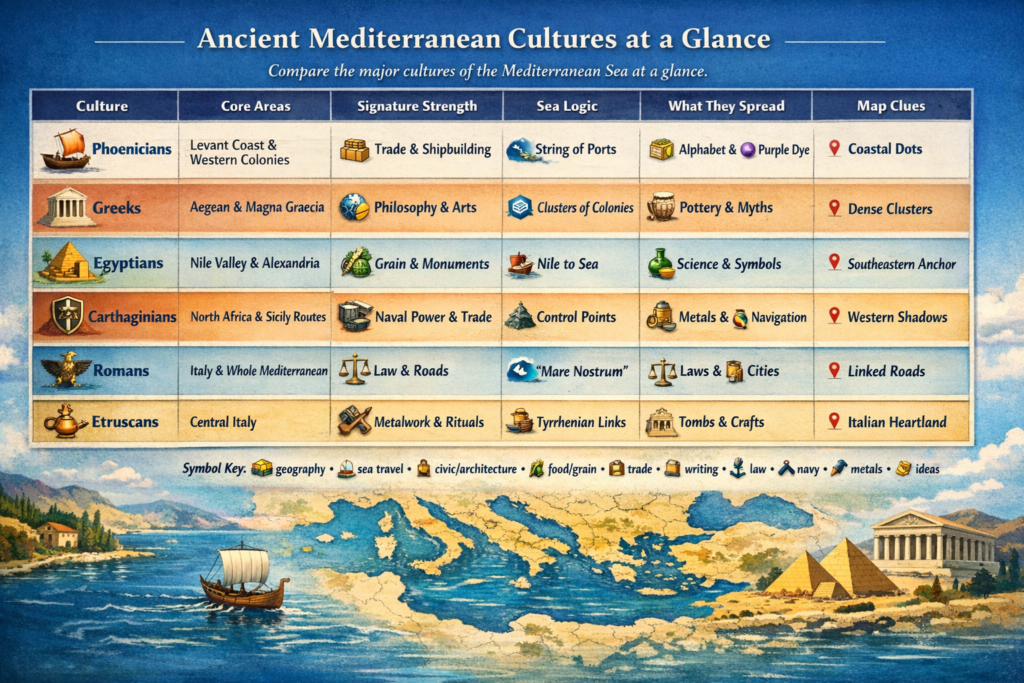
Ancient Mediterranean Cultures at a Glance
A practical, student-friendly table with symbols to help you compare major cultures without forcing modern borders.
| Culture | Core Areas | Signature Strength | Sea Logic | What They Spread | Map Clues |
|---|---|---|---|---|---|
|
⛵ Phoenicians
Sailor-merchants & coastal networks
|
🗺️ Levantine coast (Tyre, Sidon, Byblos) + western colonies | 📦 Trade logistics, shipbuilding, long-distance exchange | 🌊 “String-of-ports” strategy: stop-trade-sail, repeat | 🔤 Alphabetic writing, 📜 contracts, 🟣 purple dye prestige | 📍 Dots along coasts & islands; strong near straits and safe harbors |
|
🏛️ Greeks
City-states + colonies
|
🗺️ Aegean world + Magna Graecia (S. Italy & Sicily) + Anatolian coast + Black Sea | 🧠 Philosophy, civic life, public space, art & architecture | 🧭 “Constellations” of colonies: clusters that talk to each other by sea | 🏺 Pottery styles, 🏛️ temple forms, 🗣️ Greek language & myths | 📍 Dense coastal clusters, especially around islands and narrow passages |
|
🌾 Egyptians
Nile civilization & cultural prestige
|
🗺️ Nile Valley + Mediterranean ports (later Alexandria) | 🏺 Monumental culture, 🌾 grain supply, 📚 knowledge traditions | 🚣 River-to-sea pipeline: Nile connects interior wealth to coastal exchange | 🌾 Grain, 🧪 science/medicine ideas, 🛕 religious imagery & symbols | 📍 Strong south-eastern anchor; influence radiates via food + prestige |
|
🛡️ Carthaginians
Western Mediterranean powerhouse
|
🗺️ North Africa (Carthage) + western routes to Sicily, Sardinia, Iberia | ⚓ Naval dominance, 📈 trade systems, 🌿 advanced agriculture | 🌊 Control points: islands + chokepoints + sea lanes | 🪙 Metals flow (Iberia), 📦 western commerce, 🧭 maritime know-how | 📍 “Shadow zones” across the western sea; often near strategic islands |
|
🦅 Romans
Roads, law, and a sea-wide system
|
🗺️ Italy → expanded across the Mediterranean (North Africa, Iberia, Greece, Levant) | ⚖️ Law & administration, 🛣️ infrastructure, 🏗️ engineering | 🌊 “Mare Nostrum” logic: secure routes to keep food & taxes moving | ⚖️ Legal models, 🏟️ urban planning, 🪙 unified currency systems | 📍 Broad connected zones; roads + ports reinforce each other |
|
🪔 Etruscans
Italian culture before Roman dominance
|
🗺️ Central Italy (Tuscany and nearby regions) | ⚒️ Metalwork, 🏛️ early urban traditions, 🎭 ritual & art | 🚢 Tyrrhenian Sea links: coastal exchange with Greeks & Phoenicians | ⚒️ Craft techniques, 🪦 funerary art, 🏛️ early civic models influencing Rome | 📍 Compact zone in Italy; strong archaeological signatures (tombs, art) |
|
⛏️ Iberians
Local societies shaped by coastal trade
|
🗺️ Iberian Peninsula coasts + inland river valleys | ⛏️ Metals, regional kingdoms, coastal-inland exchange | 🌊 Trade magnet: ports connect mines to Mediterranean markets | ⛏️ Silver/copper/tin flows, 🧪 techniques via contact zones | 📍 Strong where rivers meet coasts; contact with Phoenicians/Carthage/Rome |
| Symbol Key: 🗺️ geography • ⛵ sea travel • 🏛️ civic/architecture • 🌾 food/grain • 📦 trade • 🔤 writing • ⚖️ law • ⚓ navy • ⛏️ metals • 🧠 ideas | |||||
Read more
To go further, here are a few relevant internal links.
- ancient trade across the Mediterranean
- rise of the Phoenicians
- Greek colonization efforts
- Carthaginian Empire