Diplomatic Pouch Address Lists as an Instrument of Statecraft: Word & PDF Template
A diplomatic pouch is often described in legal terms: an inviolable channel, protected by international practice and anchored in the daily mechanics of representation. Yet its true nature is more concrete. It is a disciplined corridor where the state moves documents, credentials, seals, ceremonial materials, and administrative instruments with a precision that cannot be improvised. In that corridor, the address list is not a mere directory. It is the map of authority, the grammar of routing, and the quiet guarantee that the state speaks to itself without confusion.
An address list, properly designed, does more than store locations. It standardises the way a ministry and its posts recognise one another, encode destinations, identify accountable offices, and preserve continuity when staff rotate, crises arise, or systems fail. When it is neglected, the pouch becomes vulnerable to the most banal forms of disorder: misrouting, delays, broken chains of custody, and avoidable escalation. When it is governed well, it becomes a calm, reliable backbone of diplomatic administration.
The Directory as a Registry Document
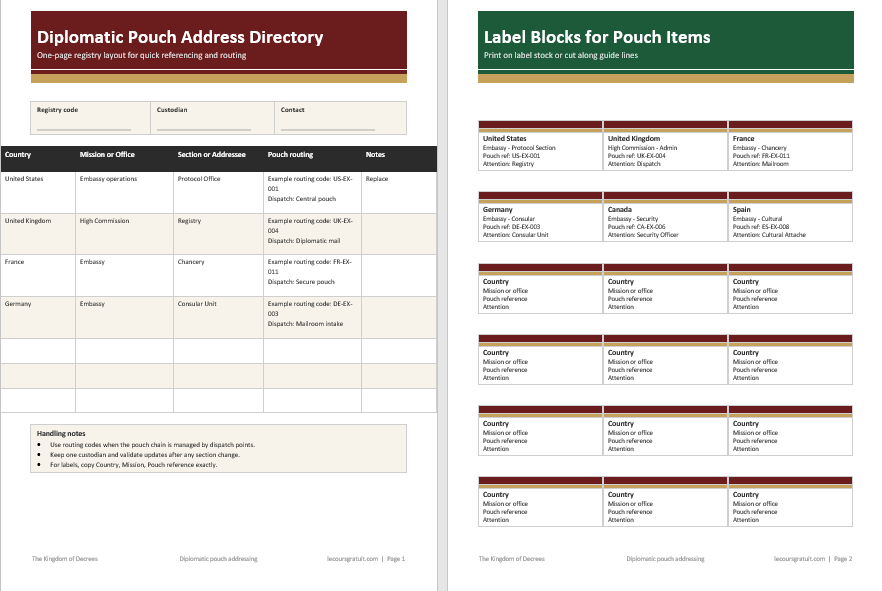
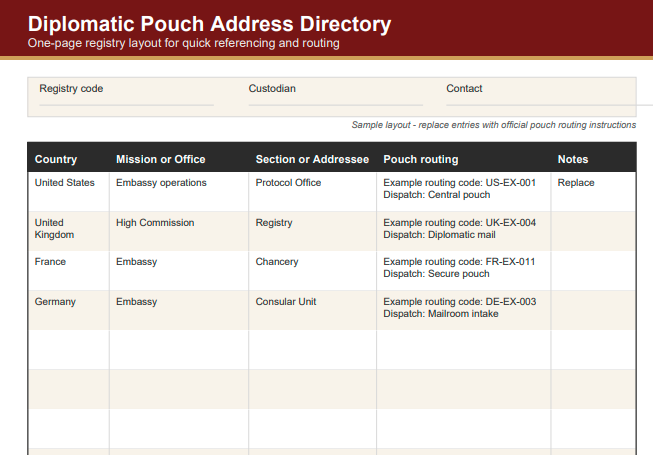
The most effective pouch address list adopts the logic of a registry. Its ambition is not aesthetic; its ambition is legibility under pressure. A registry layout privileges clarity, hierarchy, and consistency over ornament. It anticipates the moment when an officer must find the correct destination in seconds, verify a routing code, and produce a compliant label without hesitation.
A clean one-page A4 directory is therefore not a reduction of information but a disciplined selection. It highlights what must be visible at first glance:
- Post name and status (Embassy, High Commission, Consulate General, Permanent Mission)
- City and country
- Pouch routing code
- Attention line identifying the accountable section and function
- A controlled contact point for verification (registry, mailroom, or administrative section)
Everything else belongs in the underlying master file, not on the face of the document. The directory is the operational surface; the database is the memory beneath.
Why Attention Lines Matter More Than Address Lines
In diplomatic logistics, errors rarely originate from ignorance of geography. They originate from ambiguity of internal responsibility. A correct city with an incorrect internal addressee still produces loss: a pouch item can circulate within a chancery, stagnate on a desk, or be opened late when timing is the substance of the mission.
For that reason, the attention line is the keystone of the entire list. It should name the receiving function in terms that survive personnel changes:
- Registry
- Mailroom
- General Services Office
- Administrative Section
- Protocol Duty Officer
- Consular Section Mail Intake
A strong directory design treats the attention line as a formal element, not a casual note. It belongs in the same visual tier as the routing code because it is part of the routing.
Routing Codes as Controlled Language
A routing code is more than a convenience. It is controlled language: a compact identifier that reduces interpretive risk. When a pouch moves across teams, airports, contracted logistics, and internal handlers, language that requires interpretation becomes fragile. Codes convert interpretation into recognition.
A robust routing code system is typically:
- Unique across the entire network
- Stable across time
- Structured in a predictable pattern (country, city, post type, sequence)
- Short enough to be spoken, written, and checked quickly
When the ministry codifies routing, it is not merely labelling posts. It is formalising the ministry’s internal geography. That act has administrative weight, because it shapes the ministry’s ability to operate in volume, at speed, and under constraint.
The Second Page as a Tool of Execution
The directory alone does not complete the system. Operations demand artefacts that can be used immediately. This is where the second page becomes decisive: label-ready blocks designed for printing, cutting, and direct application on pouch items.
A label page is not a decorative add-on. It is a method of enforcing compliance at the point of dispatch. If staff must design labels manually, they will diverge. If labels are provided as standard blocks, the organisation converges naturally.
A good label block includes:
- A prominent DIPLOMATIC POUCH marker
- Post name and city in a clear hierarchy
- The attention line in bold or semi-bold
- The routing code in a dedicated line
- Standardised placeholders for official pouch facility address lines, when applicable
- A minimal contact line reserved for verification, not for general enquiries
The principle is simple: the label should be unambiguous even when partially obscured by handling marks or packaging.
Visual Identity as Discipline, Not Decoration
Some administrations hesitate to apply branding to operational documents, fearing that visual identity invites frivolity. The opposite is often true. A restrained diplomatic palette can reinforce hierarchy, reduce scanning time, and signal the seriousness of the document.
A style aligned with a formal diplomatic brand such as The Kingdom of Decrees can serve practical ends when it is used with restraint:
- A deep maroon for headings and key separators communicates authority and anchors the page visually.
- A muted green can be reserved for status cues and controlled highlights.
- A charcoal text base ensures readability in print.
- A parchment background maintains a ceremonial tone without sacrificing contrast.
- A fine gold rule can separate sections without creating clutter.
The purpose of this palette is not to impress. It is to stabilise attention and improve operational consistency. In administration, consistency is a form of respect: respect for the institution, for the receiving post, and for the chain of custody.
Governance and Update Cadence
A directory that is not governed becomes a liability. The risk is not only outdated addresses; the deeper risk is uncertainty about which version is authoritative. In diplomatic administration, uncertainty spreads quickly. One outdated list circulating in parallel with a corrected list can produce multiple routes, multiple labels, and a silent fracture in the system.
A mature governance approach typically includes:
- One owner, identified by function (Registry Division, Diplomatic Bag Unit, or Protocol and Mail Unit)
- One master file, controlled
- A clear versioning practice, visible on the document
- A defined update cycle (monthly or quarterly) plus an emergency update pathway
- A change log retained internally, even if the one-page directory stays clean
The strongest practice is cultural as much as procedural: staff must know where the authoritative list lives, and they must trust that updates are timely and deliberate.
Security Posture and Operational Prudence
Diplomatic pouch systems are protected by legal and customary safeguards, but their daily security posture is built through prudence. An address list is sensitive not because it reveals a city, but because it reveals patterns: routing structures, internal responsibilities, and contact points.
Prudent design reduces exposure while preserving usefulness:
- Publish only what is operationally necessary on the printable page.
- Use functional contact points rather than personal details.
- Separate the public-facing postal address of a mission from the official pouch facility address if the latter is restricted.
- Treat the directory as an internal operational document with controlled circulation.
Security, in this context, is the art of limiting the data footprint without weakening the workflow.
Standard Workflow From Dispatch to Receipt
A well-designed directory and label sheet supports a simple, repeatable workflow:
- The sender identifies the destination post in the directory.
- The sender verifies the routing code and the attention line.
- The sender copies the label block for that post and applies it to the pouch item.
- The dispatch log records the routing code, date, and item category.
- The receiving registry confirms receipt and routes internally to the named function.
Each step is modest. Together they create institutional reliability. In diplomacy, reliability is a form of credibility.
The Quiet Value of Registry Culture
Registry culture is often invisible from the outside. It is the difference between an institution that performs and an institution that merely intends. The pouch address list, when treated as a registry instrument, belongs to that culture. It signals that the state values exactness, traceability, and continuity.
This is why the most effective pouch systems look almost understated on paper. Their authority does not come from complexity. It comes from controlled language, disciplined layout, and the refusal to let operational detail become a matter of personality or improvisation.
In the end, a diplomatic pouch address list is a small document with a large implication: the state’s ability to move its own voice, safely and accurately, across distance and time.
Download the Word & PDF templates and deploy a clean, registry-style diplomatic pouch address system—ready to print, easy to update, and built for operational precision 📩