The Enduring Spirit of Moroccan Independence Movements
When a nation begins to breathe differently
Long before independence was officially restored, Morocco was already changing in quieter, deeper ways. The shift could be felt in conversations held behind closed doors, in the tension of public squares, in the dignity of those who refused to forget who they were. Independence did not suddenly appear in 1956 like a door opening all at once. It rose slowly through years of frustration, courage, and political awakening, until an entire people had learned to transform endurance into purpose.
The story of Moroccan independence movements carries that rare intensity found in great national turning points. It is a story of resistance, certainly, yet it is also a story of memory, identity, and moral patience. Beneath the political struggle stood something more profound: the refusal of a country with an old civilization, a living monarchy, and a deeply rooted sense of self to accept that foreign domination should define its future.
A protectorate imposed on an ancient nation
When Morocco became a protectorate in 1912, the change was not merely administrative. On paper, institutions remained. Symbols endured. The Sultan still existed. The forms of continuity were still visible. Yet in practice, power had shifted elsewhere. France, and in other regions Spain, took command of key decisions affecting governance, military control, economic organization, and public administration. Morocco had not disappeared, but its sovereignty had been profoundly diminished.
That loss was felt in everyday life as much as in diplomacy. Streets were redesigned, economic interests redirected, local hierarchies unsettled, and political authority reframed according to colonial priorities. For many Moroccans, this was not simply an alteration of government. It was an intrusion into the rhythm of national life. A people long accustomed to seeing themselves through their own institutions suddenly found themselves forced to navigate an order built by others.
What made this experience especially painful was that Morocco was not an empty space waiting to be organized. It was already a kingdom with centuries of statecraft, religious legitimacy, scholarly tradition, and cultural refinement. Colonial rule therefore produced more than resentment. It produced a moral injury. The issue was not only control over land. It was the affront done to dignity.
The first stirrings of resistance
No great independence movement begins in one single moment. It forms gradually, gathering meaning from dispersed acts of refusal. In Morocco, resistance took many shapes from the beginning. In some regions, especially in the mountains and rural zones, opposition expressed itself through armed struggle. Elsewhere, it took more discreet forms: intellectual debate, religious teaching, journalistic expression, community solidarity, and the preservation of cultural life.
One cannot speak of early Moroccan resistance without recalling Abdelkrim El Khattabi and the Rif War. His struggle remains one of the most striking anti-colonial episodes of the twentieth century. It gave Morocco, and indeed the wider world, a powerful image of disciplined resistance against a far stronger imperial machine. Though rooted in a distinct regional context, the Rif resistance carried a national resonance. It demonstrated that colonial power, for all its military force, could still be challenged by conviction, strategy, and popular legitimacy.
At the same time, in cities and centers of learning, another kind of resistance was growing. Reform-minded thinkers, scholars, and educated elites began to articulate a more structured national consciousness. Their goal was not only to denounce colonial abuses. It was to recover the idea of Morocco as a sovereign political community, one whose future could not remain indefinitely subject to foreign control.
When nationalism became a common language
By the 1930s and 1940s, Moroccan nationalism had entered a more mature phase. It had moved beyond scattered indignation. It had found words, arguments, and institutions. A new generation of nationalists understood that feeling alone would not be enough. The movement needed organization. It needed coherence. It needed to turn collective frustration into a disciplined claim.
This was the significance of the nationalist political movements, above all the Istiqlal Party, founded in 1944. Its emergence marked a decisive moment in the struggle. The party did not create Moroccan patriotism from nothing. That patriotism already existed, shaped by historical memory and daily humiliation. What the party did was give it form. It provided a structure through which the national will could speak more clearly and more forcefully.
Its demand for independence was historic because it left little room for ambiguity. Morocco was no longer asking merely for administrative adjustment or limited reform within the protectorate. It was asserting a right to full sovereignty. That clarity mattered. It gave the struggle a center of gravity and offered the population a banner under which many different social forces could gather.
The restless energy of youth
Every serious national movement eventually depends on the energy of the young, and Morocco was no exception. Students, workers, young intellectuals, and politically conscious urban youth played a vital role in carrying the cause forward. They brought urgency to the movement, but also creativity. They embraced protest, distributed ideas, organized meetings, and extended nationalist feeling into everyday spaces where political life was being reborn.
Their importance lay in more than numbers. They represented a new political temperament. Many among them respected Morocco’s traditions and the symbolic place of the monarchy, yet they also understood the language of modern mobilization. They were comfortable moving between inherited legitimacy and contemporary political methods. That balance helped give Moroccan nationalism its distinctive tone. It was not a movement cut off from its own past. It was a movement seeking renewal through continuity.
This youth-driven dynamism changed the atmosphere of the country. Nationalism no longer belonged only to elite circles or formal declarations. It became something felt in schools, factories, cafés, and neighborhoods. It entered conversation. It entered expectation. It entered the imagination of ordinary people.
Mohammed V and the soul of the nation
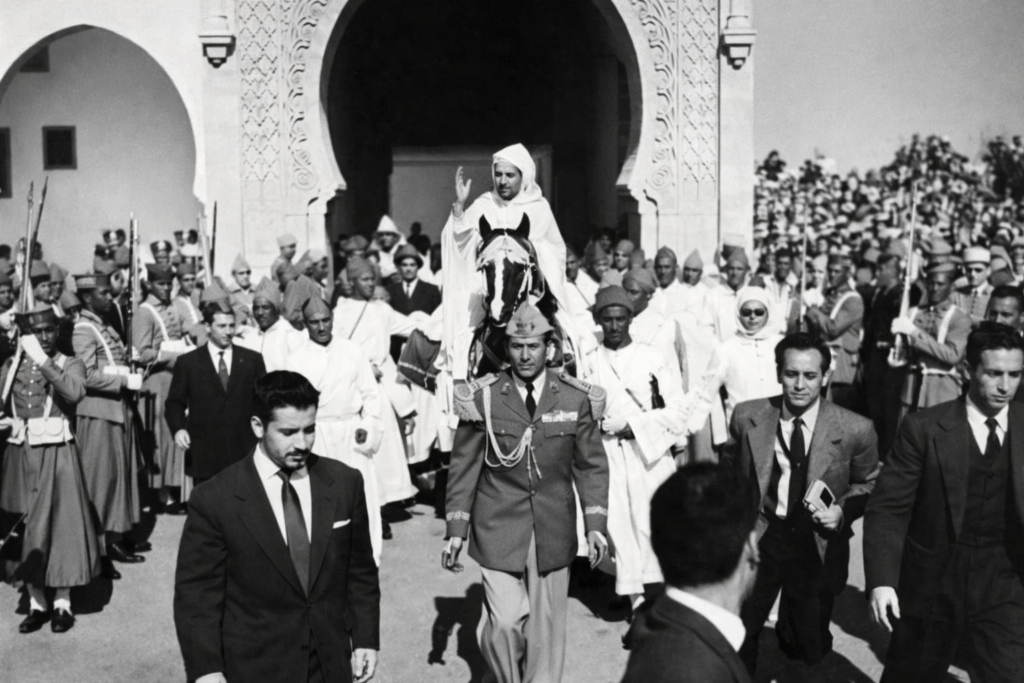
Among the central figures of the independence struggle, Mohammed V occupies a singular place. His role cannot be reduced to the constitutional language of monarchy. Over time, he came to embody a deeper national meaning. In him, many Moroccans saw continuity, legitimacy, and quiet courage. He was not merely a ruler within a political system constrained by colonial authority. He gradually became the moral face of a country that still recognized itself beneath foreign domination.
This symbolic position proved decisive. Colonial authorities could manage institutions, censor activists, and repress demonstrations, yet they struggled to neutralize the emotional and political force of a monarch who increasingly stood near the aspirations of his people. Mohammed V became, in a sense, the meeting point between historical Morocco and the Morocco that wished to recover its future.
When he was exiled in 1953, the colonial administration believed it could break the movement. The effect was the opposite. His removal shocked the country and transformed nationalist sentiment into something more intense and more widely shared. His exile did not weaken the cause. It deepened it. It touched the population not only politically, but intimately. Many Moroccans experienced it as a profound injustice and an insult to national dignity.
What followed was a sharpening of resistance. Protests multiplied. Defiance spread. The struggle gained new emotional force because it now fused the political demand for independence with the symbolic defense of legitimate national authority.
The cost of dignity
Independence narratives often risk becoming too smooth in retrospect. They can give the impression that history naturally moved toward liberation, as though the outcome had always been waiting just beyond the next negotiation. In truth, the road was hard, uncertain, and costly.
Colonial power responded with repression. Arrests, censorship, intimidation, and imprisonment formed part of everyday political reality. Nationalist leaders and activists were watched, silenced, exiled, or jailed. Families bore the fear of disappearance, retaliation, and social pressure. Those who chose resistance often did so without any guarantee that they would see victory in their lifetime.
Read more
- modern Moroccan identity
- Arab Spring in North Africa
- French colonialism in Africa