
The Changing Role of Bilateral Investment Treaties in Global Economics
Bilateral Investment Treaties, commonly known as BITs, emerged as practical legal instruments in the second half of the twentieth century, at a time when many countries were looking for ways to encourage cross-border investment while reducing uncertainty for foreign businesses. Their basic promise was simple yet powerful: if an investor committed capital, technology, or expertise in another country, that investment would receive a minimum level of protection under international law.
This mattered enormously in a world where political instability, sudden nationalizations, legal unpredictability, and administrative arbitrariness could discourage foreign direct investment. Investors wanted reassurance. States, especially developing economies seeking capital inflows, wanted to show that they were open for business. BITs became one of the main bridges between those two needs. They were meant to build confidence where trust alone was not enough.
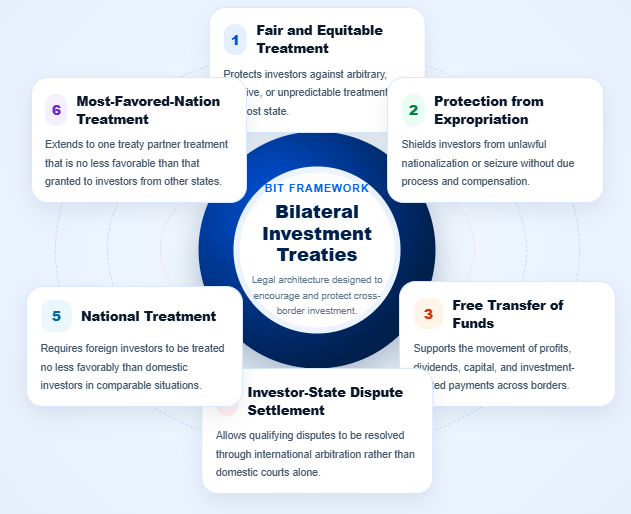
At their core, these treaties usually offered a set of protections that became familiar across many agreements: fair and equitable treatment, protection against unlawful expropriation, non-discrimination, free transfer of funds, and access to dispute settlement mechanisms. These rules gave investors a legal safety net. For host countries, the message was equally strategic: signing a BIT could signal seriousness, credibility, and commitment to a stable investment environment.
Over time, the use of BITs expanded dramatically. Thousands of treaties were signed across continents, turning them into one of the most visible pillars of the international investment system. For many years, the model seemed straightforward. If legal protections improved, investor confidence would grow. If confidence grew, foreign direct investment would follow. For governments competing to attract capital, jobs, infrastructure, and industrial development, that logic proved very appealing.
Yet the story of BITs has never been only about legal clauses. It has also been about political priorities, economic asymmetries, and changing ideas of what development should look like. That is precisely why their role in global economics has changed so much.
Why BITs Became So Important
The popularity of BITs did not happen by accident. They rose in a period marked by expanding globalization, financial liberalization, and the growing mobility of capital. Countries increasingly understood that domestic growth could be supported by external investment, especially in sectors such as energy, transport, telecommunications, manufacturing, mining, and services.
For investors, entering a foreign market always involves a degree of uncertainty. Laws may change. Tax policies may shift. Permits may be delayed. Contracts may be challenged. Political transitions may alter the business climate in ways that are hard to predict. BITs were designed to reduce these fears by creating a framework that stood above day-to-day political fluctuations.
This legal reassurance became especially significant for investments in countries where institutions were perceived as weak or where domestic courts were not always seen as fully independent, efficient, or predictable. A treaty, particularly one backed by international arbitration, created another layer of protection. Investors could believe that if something went wrong, they would not be entirely dependent on the host state’s own legal system.
Host states also had strong incentives to sign such treaties. Many governments hoped BITs would serve as a form of economic diplomacy. A treaty with a capital-exporting country could send a positive signal to global markets. It could suggest openness, legal modernization, and willingness to cooperate within the rules of international commerce.
For decades, that model carried real influence. BITs were often treated as a nearly automatic part of investment policy. Signing more of them came to be seen, in many circles, as a marker of integration into the global economy.
A Global Economy That No Longer Looks the Same
The difficulty today is that the world in which many BITs were written no longer exists in the same form. The global economy has become more interconnected, more politically sensitive, and more contested. Capital still moves across borders, of course, but the conditions surrounding that movement have changed dramatically.
Multinational corporations have grown in size, reach, and bargaining power. Global supply chains have become more complex. Strategic sectors such as digital infrastructure, energy transition, rare minerals, food systems, and pharmaceuticals are now linked not only to commerce, but also to sovereignty and national security. Governments no longer approach foreign investment with the same innocence that sometimes characterized earlier decades.
Public expectations have also changed. Citizens, civil society, and policymakers now scrutinize investment far more closely, especially its social and environmental effects. They want to know whether a project creates lasting value for the host country, upholds labor standards, protects ecosystems, and improves local lives rather than simply extracting profit. These concerns no longer sit at the margins of the conversation. They now shape the core debate over the legitimacy of the investment regime.
That shift has exposed the limitations of many older BITs. A large number of treaties were drafted in language that strongly emphasized investor protection while giving limited attention to other public interests. Environmental sustainability, public health, indigenous rights, climate obligations, responsible business conduct, and policy space for regulation often received little or no meaningful treatment. In a different era, that might have seemed acceptable or at least politically manageable. Today, it looks incomplete.
The role of BITs, therefore, is changing because the priorities of the global economy are changing. Investment remains essential, yet the terms on which it is welcomed are being reconsidered.
The Pressure to Modernize
Modern BIT reform is driven by a growing sense that balance matters more than ever. States still want to attract investment, but they also want room to govern. They want to preserve the ability to regulate in the public interest without facing constant exposure to legal claims. That includes the right to act on climate change, public health emergencies, financial stability, labor protections, human rights concerns, and industrial policy objectives.
Newer treaty models reflect this more cautious and more mature approach. Some now contain clearer definitions of what qualifies as an investment. Others limit vague standards that previously allowed broad interpretation. Some treaties explicitly affirm the state’s right to regulate for legitimate public purposes. Others include references to sustainable development, corporate responsibility, anti-corruption principles, or procedural transparency in dispute resolution.
This evolution marks an important change in tone. Earlier BITs often reflected a world in which capital protection was treated as the central priority and state regulation was viewed, at least implicitly, as a possible threat to that goal. Newer frameworks try to move beyond that binary. They acknowledge that investment protection and public policy do not have to be enemies, but they also accept that the balance between them must be drafted more carefully.
This is not only a legal adjustment. It is also a reflection of political reality. Governments today face domestic pressure from voters, activists, courts, and media in ways that make purely investor-centered frameworks harder to defend. A treaty that appears to protect foreign capital while weakening environmental regulation or public welfare is likely to meet greater skepticism than it might have twenty or thirty years ago.
The Main Criticisms of BITs
The criticisms directed at BITs are serious and have shaped much of the current reform agenda. One of the most frequent concerns is that these treaties can give foreign investors extraordinary leverage compared with local businesses or even with the host state itself. When a treaty allows corporations to challenge state measures through international arbitration, critics argue that a troubling imbalance can emerge.
The issue is not simply theoretical. Governments have sometimes faced costly claims over regulatory decisions taken in areas such as energy policy, environmental protection, taxation, mining controls, or public health. Even when a state ultimately prevails, the process can be expensive, lengthy, and politically draining. For lower-income countries in particular, the financial and administrative burden of defending such cases can be significant.
This has led many observers to worry about what is sometimes called regulatory chill. In other words, states may hesitate to adopt legitimate policies because they fear triggering investor claims. Whether this effect is always easy to prove is another matter, but the concern itself has become central to the debate. A treaty designed to promote stability begins to look problematic if it discourages governments from protecting public welfare.
Transparency is another major criticism. Traditional investor-state arbitration has often been faulted for operating with limited openness. Proceedings may be complex, costly, and difficult for the broader public to follow, even when the underlying dispute concerns matters of clear social importance. That raises questions about legitimacy. If public policy choices are being challenged through systems that citizens barely understand, confidence in the fairness of the process may erode.
There is also a broader criticism that BITs emerged from an unequal global context. Many early agreements were signed between capital-exporting developed countries and capital-importing developing countries. The distribution of bargaining power was rarely neutral. In some cases, host states accepted treaty language that strongly favored investors because they felt they had little room to negotiate better terms. As development strategies evolve, many of those states now reassess whether the legal commitments they made decades ago still align with their long-term interests.
Arbitration, Sovereignty, and the Question of Fairness
No discussion of BITs is complete without addressing the sovereignty question. States do not sign treaties lightly. When they enter a BIT, they accept constraints in exchange for expected benefits. That is normal in international law. The controversy arises when those constraints seem to cut too deeply into democratic or regulatory autonomy.
Supporters of BITs argue that such protections are necessary. Without enforceable rights, investors may be unwilling to commit long-term capital, especially in politically volatile environments. They also point out that states remain free to regulate, provided they do so lawfully and without discriminatory or arbitrary treatment. From this perspective, BITs do not destroy sovereignty. They discipline it in order to create trust.
Critics respond that the line between discipline and intrusion is sometimes too thin. When international tribunals review domestic policy choices with major economic consequences, the legitimacy of that oversight becomes contested. Who ultimately decides what counts as fair treatment? How much interpretive discretion should arbitrators hold? Should a foreign investor be able to bypass local courts entirely? These are no longer marginal technical questions. They sit at the heart of the debate over the future of international investment law.
The truth is that BITs have forced the international community to confront an uncomfortable but necessary dilemma. Economic integration requires rules. Yet rules that protect investment too rigidly can provoke backlash if they appear disconnected from social justice, environmental necessity, or democratic accountability.
The Future of Bilateral Investment Treaties
The future of BITs will likely be defined by adaptation rather than disappearance. These treaties still serve important functions. Investors continue to seek predictability. States continue to compete for capital, technology, and productive partnerships. Legal certainty remains valuable. For that reason, BITs are unlikely to vanish from the international economic landscape anytime soon.
What is changing is their design, their tone, and their place within a wider legal architecture. Reform efforts increasingly focus on drafting agreements that preserve investor confidence while better recognizing public-interest regulation. More treaties now include safeguards, clarifications, and language aimed at preventing overreach. Transparency rules are expanding in some contexts. Discussion of appellate mechanisms, permanent investment courts, or revised arbitration systems also reflects a desire to improve legitimacy and coherence.
At the same time, regional and multilateral frameworks are becoming more influential. Some trade agreements now include investment chapters that go beyond the bilateral model and attempt to harmonize more modern standards. These broader arrangements may serve as laboratories for a new generation of rules, especially where states want more integrated solutions.
This suggests that the future may not belong exclusively to the classic BIT model. Instead, we may see a coexistence of traditional bilateral agreements, reformed treaty templates, regional instruments, and broader investment governance structures. The shift is less about abandoning investment protection than about redefining what responsible protection should look like in the twenty-first century.
From Investor Protection to Broader Legitimacy
Bilateral Investment Treaties began as instruments of reassurance in an uncertain global economy. They promised protection, predictability, and confidence at a time when cross-border investment was expanding and many countries were eager to attract external capital. For years, they played that role with remarkable influence.
Yet the world around them has changed. Economic globalization is now intertwined with climate concerns, social expectations, geopolitical rivalry, regulatory debates, and demands for greater fairness. In that new landscape, BITs can no longer operate as though investor protection alone were enough. Their legitimacy increasingly depends on their ability to recognize a wider set of interests.
That is why the changing role of BITs matters so much. They remain important, but they are no longer untouchable templates from another era. They are being questioned, revised, and in some cases reimagined. Their future rests on balance: protecting investors without weakening the state’s duty to govern, encouraging capital without ignoring communities, and supporting economic cooperation without separating it from environmental and social responsibility.
That evolution does not weaken the international investment system. On the contrary, it may be the very condition for making it more durable, more credible, and more acceptable in a global economy that has become far more demanding than the one in which BITs were first conceived.
Bilateral Investment Treaties
A visual map of the main legal protections commonly associated with BITs. Instead of a conventional wheel, this layout presents investment protection as an interconnected orbit of guarantees surrounding the treaty core.
Why this layout works
This original orbit-style diagram presents BITs as a legal core surrounded by six major protections. The visual logic suggests that investor confidence does not rely on a single clause, but on a wider treaty ecosystem where legal certainty, capital protection, and dispute resolution work together.
Read more
- global economic policy
- trade relations evolution
- international arbitration