Moroccan Architecture: Where History Still Lives in Stone, Tile and Light
To speak of Moroccan architecture is to speak of far more than buildings. It is to speak of memory, ceremony, climate, power and craftsmanship, all meeting in spaces that still shape daily life. In Morocco, architecture does not sit quietly in the background. It frames the way people gather, pray, rest, negotiate, celebrate and remember. A courtyard is rarely just a courtyard. A carved door is rarely only decorative. Even the play of shade across a wall often carries the intelligence of centuries.
This is part of what makes Moroccan architecture so compelling to visitors and so meaningful to Moroccans themselves. It offers beauty at first glance, certainly, yet its deeper value lies in how naturally it binds function to culture. The same house that cools the air in summer may also preserve family privacy. The same mosque that commands the skyline may also tell the story of a dynasty’s ambition. The same mosaic that catches the eye may quietly reflect an entire worldview built on order, rhythm and proportion.
Across the kingdom, one finds an architectural language shaped by encounter. Amazigh building traditions, Islamic forms, Andalusian refinement, Saharan resilience and Mediterranean influences all leave their mark. What emerges from that long conversation is a style that feels unmistakably Moroccan: richly ornamental without losing discipline, monumental without surrendering intimacy, and deeply rooted in place.
A country written through its buildings
Morocco is one of those rare places where architecture still gives a clear sense of historical continuity. One can walk through the medina of Fez, pass into a quiet riad, stand before an Almohad minaret, travel south towards an earthen kasbah, then arrive in Casablanca and see how contemporary architects continue to borrow from inherited forms. The result is a living archive rather than a frozen one.
That distinction matters. In many countries, historic architecture is admired from a distance, protected, photographed and detached from ordinary life. In Morocco, much of it remains active. Markets continue to function inside ancient medinas. Houses still organise themselves around interior patios. Mosques continue to anchor neighbourhoods. Traditional craftsmanship survives, not only as heritage, but as practice. The architecture breathes because the society around it continues to use it.
This is why Moroccan architecture deserves to be read with patience. Its most impressive monuments often attract immediate attention, yet the kingdom’s true architectural genius also reveals itself in quieter places: in the geometry of a tiled fountain, in the way a passage turns to create privacy, in the thickness of a wall designed to resist heat, in the wooden ceiling of a room built to soften both sound and light.

The logic of landscape
Before Moroccan architecture became admired around the world for its elegance, it had to answer a simpler question: how should people build in a land of mountains, plains, coasts, deserts and intense seasonal contrasts?
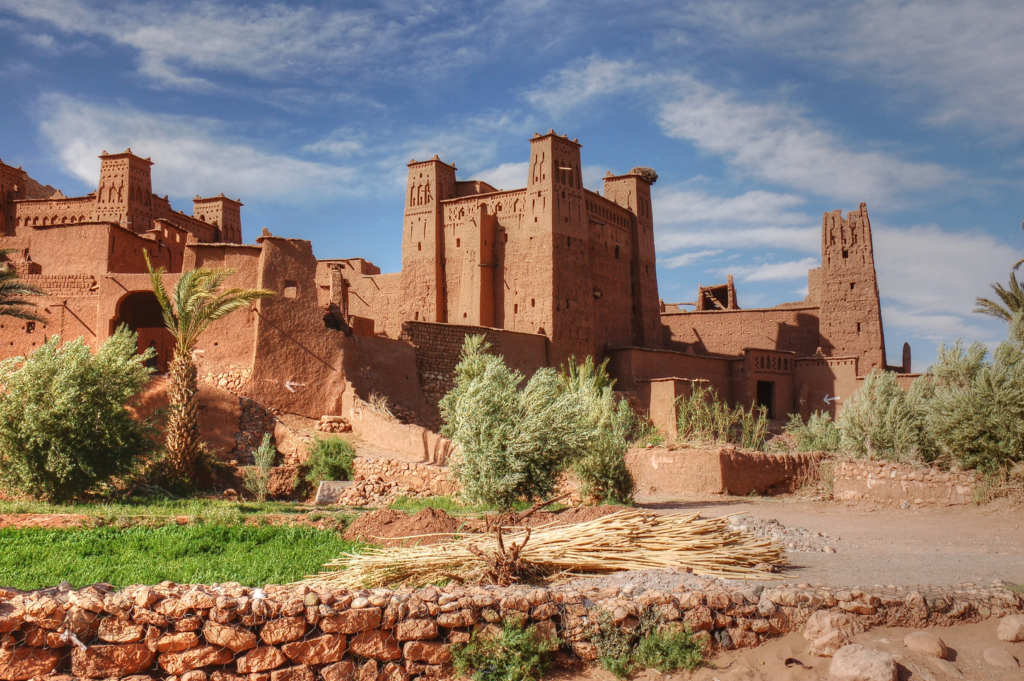
The answer was never singular. In the south and along caravan routes, builders worked with earth, creating fortified kasbahs and ksour that rose almost organically from the landscape. Their walls were thick, their openings measured, their colour nearly identical to the land around them. These structures were practical, certainly, though they also possessed a quiet grandeur. They knew how to endure.
In the mountains, building traditions responded to altitude, isolation and available materials. In urban centres, architecture grew denser and more inward-looking. Along the coast, the dialogue with trade, diplomacy and foreign influence became more visible. In every case, climate and geography were not secondary considerations. They were foundational.
That remains one of the most impressive features of Moroccan architecture. It rarely feels imposed on the land. It belongs to it. Even in the imperial cities, where dynasties projected prestige through monumental buildings, there is usually a strong sense that architecture responds to sun, wind, privacy, water and topography with remarkable intelligence.
The inward beauty of the riad

No discussion of Moroccan architecture feels complete without the riad, perhaps the clearest example of the kingdom’s ability to turn domestic space into an art form.
From the street, a traditional house may appear restrained, almost secretive. Its exterior does not announce the richness within. Then the door opens, and the spatial experience changes completely. At the centre lies the courtyard: tiled, planted, often arranged around a fountain, open to the sky yet enclosed by the house itself. Light descends gently. Air circulates. Sound softens. The city feels close and far away at once.
There is something profoundly humane about this design. It places calm at the centre of the home. It protects privacy without producing darkness. It makes room for family life, hospitality and reflection. The riad is beautiful, of course, though its beauty comes partly from how well it understands living.
Many outsiders first encounter riads as restored guesthouses in Marrakech or Fez, and they often remember them for their romance: the patterned walls, the scent of orange blossom, the stillness of the courtyard at dusk. Yet the riad is not merely picturesque. It reflects a long cultural and environmental logic. It is architecture that shelters, cools, orders and dignifies domestic life all at once.
Ornament with discipline
Moroccan architecture is often praised for its decoration, and rightly so. The zellige tilework, carved cedar, sculpted stucco and calligraphic detail found across the country can be astonishing in their refinement. Yet to focus on surface alone would be to miss the point.

Moroccan ornament is rarely excessive in the careless sense. It obeys rules. It works through repetition, balance and geometry. It creates rhythm across walls, floors, fountains, arches and ceilings. Even when a room appears richly adorned, the decoration is usually held together by proportion and structure.
Take zellige, for instance. At first glance, it seems exuberant, even dazzling. Look more closely, and one sees extraordinary discipline. Every fragment has its place. Every form contributes to a wider harmony. The eye may enjoy the colour, though the mind also senses order. That combination gives Moroccan decoration its authority. It is expressive without becoming chaotic.
The same can be said of carved plaster and woodwork. In a madrasa, a palace or a finely made house, decoration does not simply fill empty space. It guides attention. It marks thresholds. It elevates the atmosphere of a room. It reminds the viewer that craft, in Morocco, has long been treated as a serious cultural language.
The imperial cities and the architecture of power
If domestic architecture reveals Morocco’s sense of intimacy, the imperial cities reveal its sense of grandeur. Fez, Marrakech, Meknes and Rabat each offer a distinct chapter in the architectural history of the kingdom, and each reflects a particular relationship between power and place.
Fez is perhaps the most intricate of them all. Its medina unfolds like a dense manuscript, full of turns, layers and hidden revelations. Here, architecture feels learned and devotional. Madrasas, mosques, fondouks and houses all contribute to a cityscape shaped by scholarship, trade and piety. Fez does not overwhelm through scale alone. It impresses through depth. It rewards slow attention.
Marrakech, by contrast, makes a more immediate statement. It carries a monumental energy tied to dynastic ambition and southern geography. The Koutoubia Mosque, visible from afar, remains one of the great markers of Moroccan architectural identity. Elsewhere in the city, gardens, palaces and tombs reveal how power in Morocco has often been staged not only through military force or political ceremony, but through built form.
Meknes bears the imprint of Sultan Moulay Ismail, whose architectural vision aimed at authority on an imperial scale. Gates, walls, granaries and royal precincts communicate strength with unmistakable confidence. Architecture here becomes political theatre in stone and tile.
Rabat, the present capital, offers a different balance. It is both historical and administrative, ceremonial and modern. The Hassan Tower stands as a powerful reminder of unfinished ambition, while the broader city shows how Morocco continues to negotiate continuity and renewal in its urban identity.
Earth architecture and the genius of the south
To many travellers, the architecture of southern Morocco leaves one of the deepest impressions. There, kasbahs and ksour rise from the landscape in tones of ochre and red, as though shaped from the desert itself. These structures have become iconic, though their power lies in more than visual drama.
They reveal a profound understanding of material. Earth is often dismissed elsewhere as poor or provisional, yet in Morocco it becomes architecture of dignity, resilience and beauty. The walls regulate temperature. The towers command the horizon. The ensemble protects community life and trade. In places such as Aït Ben Haddou, one sees clearly how settlement, defence and environment were once woven together with remarkable coherence.
There is also something emotionally striking about these landscapes. A kasbah at sunset, its edges softened by dust and evening light, can feel almost cinematic. Yet the real achievement is practical before it is poetic. These buildings were made to last in difficult conditions, and many still carry the memory of the routes, exchanges and struggles that shaped Morocco’s southern regions.
Andalusian refinement and Moroccan transformation
One of the most important influences on Moroccan architecture came from Al-Andalus, especially after waves of migration from Muslim Spain brought artisans, scholars and families across the Strait. Their arrival enriched urban life in northern Morocco and left a lasting imprint on architecture, music, gardens and craft.
This influence is visible in the elegance of courtyards, the use of water, the refinement of stucco, the balance of ornament and the cultivation of enclosed beauty. Yet Morocco did not merely receive Andalusian forms passively. It transformed them. Imported traditions were adapted to local materials, climates and social customs. What emerged was not a copy of Andalusia, but a Moroccan synthesis with its own strength and vocabulary.
That capacity for assimilation without loss of identity is one of the kingdom’s enduring cultural traits. Moroccan architecture absorbs influences, yet it rarely disappears into them. It remains itself.

Sacred architecture and the urban skyline
In many Moroccan cities, the skyline still belongs to the mosque. The minaret, whether slender or monumental, does more than punctuate the urban horizon. It gives orientation, rhythm and meaning to the city. It reminds residents that architecture in Morocco has long served spiritual as well as civic life.
Mosques are, of course, places of worship, though they also shape the visual and social organisation of neighbourhoods. Around them, markets, houses, schools and public movement often take form. A great mosque can define an entire city’s architectural identity, as the Koutoubia does in Marrakech or the Hassan II Mosque does in Casablanca in a much more contemporary register.
Religious architecture in Morocco often carries a composure that feels distinct. Even at its most ornate, it tends to preserve clarity. Proportion matters. Light matters. The progression from exterior to ablution space to prayer hall matters. Sacred space is designed to prepare the body and quiet the mind.
Modern Morocco and the persistence of tradition
It would be easy, though mistaken, to imagine Moroccan architecture as something fully anchored in the past. In reality, the conversation between tradition and modernity remains very active.
Contemporary architects across the country continue to draw on inherited forms, sometimes explicitly, sometimes with great subtlety. Courtyards reappear in modern villas and hotels. Screens and mashrabiya-inspired facades help filter light. Earth construction is being re-evaluated through the lens of sustainability. Geometric patterns return in contemporary materials. In some of the best examples, tradition is not pasted onto a building as decoration. It informs the building’s logic.
Casablanca offers perhaps the clearest stage for this dialogue. As Morocco’s economic capital, it contains art deco heritage, large-scale urban development and major modern landmarks. The Hassan II Mosque, completed in the late 20th century, stands as a dramatic example of how contemporary engineering can work alongside traditional craftsmanship on a monumental scale. It is modern in execution, historical in language and unmistakably national in symbolism.
Why Moroccan architecture speaks so widely
There is a reason Moroccan architecture continues to fascinate people far beyond the kingdom. Part of the appeal is visual. The colours, textures and patterns are memorable. Part of it is atmospheric. Moroccan spaces know how to create intimacy, shade, stillness and surprise. Yet the lasting fascination comes from something deeper.
This architecture suggests that beauty and use do not have to be separated. It shows that ornament can still possess seriousness. It proves that local materials can produce grandeur. It reminds modern observers that privacy, climate, spirituality and communal life all deserve architectural expression.
In an age when so many cities increasingly resemble one another, Moroccan architecture remains grounded in identity. It does not apologise for continuity. It does not treat craftsmanship as an afterthought. It still believes that a wall, a gate, a courtyard or a minaret can carry meaning.
A living inheritance
The finest way to understand Moroccan architecture is to stop seeing it as a sequence of postcard images. It is not only the famous riad, the photogenic alley, the tiled fountain or the desert kasbah. It is an entire civilisational habit of building: one that takes climate seriously, honours craft, values enclosure as much as openness, and gives cultural memory a physical home.
That is why Moroccan architecture remains so powerful. It belongs to history, yet it has not been abandoned to history. It survives in monuments, certainly, though also in habits of space, in artisanal techniques, in urban rhythms and in the national imagination. It still speaks. It still shelters. It still teaches.
And perhaps that is its greatest achievement. In Morocco, architecture does more than preserve the past. It keeps the past in conversation with the present, through stone, plaster, cedar, earth, water and light.
Riad, Dar and Kasbah: Understanding Moroccan Architectural Forms
Moroccan architecture includes several types of traditional structures that often appear similar to outsiders but serve different purposes. Understanding the distinction helps reveal how Moroccan cities and landscapes developed over centuries.
- Riad – A traditional urban house built around a central garden courtyard with fountains and trees.
- Dar – A traditional Moroccan house organized around a courtyard, usually without a garden.
- Kasbah – A fortified structure or citadel, often found in southern Morocco and built from rammed earth.
Each form reflects a different relationship between architecture, climate, and social life. Riads express urban privacy, while kasbahs express protection and territorial control.
How Moroccan Architecture Adapts to Climate
Traditional Moroccan buildings were designed long before modern air conditioning. Architects relied on thick walls, interior courtyards, shaded arcades and fountains to regulate temperature naturally.
- Central courtyards create natural air circulation.
- Fountains and vegetation cool the surrounding air.
- Thick adobe or stone walls protect interiors from heat.
- Minimal exterior windows preserve privacy and reduce sunlight.
These strategies allowed Moroccan homes to remain comfortable even during intense summer heat.
Water and Gardens in Moroccan Architecture
Water plays a symbolic and practical role in Moroccan architecture. Courtyard fountains and reflecting pools create cool microclimates while adding serenity to living spaces.
Inspired by Islamic garden traditions, many riads feature symmetrical gardens divided into four sections, often centered on a fountain that becomes the visual and spiritual heart of the home.
Cultural Influences Behind Moroccan Architecture
Moroccan architecture emerged from centuries of cultural exchange. Its distinctive appearance reflects multiple historical influences.
- Amazigh (Berber) traditions visible in kasbahs and earthen desert architecture.
- Islamic architecture expressed through geometric decoration and courtyard planning.
- Andalusian craftsmanship introduced refined tilework and ornamental plaster.
- Mediterranean influences shaping urban planning and materials.
Together these traditions produced one of the most recognizable architectural identities in the world.
Famous Examples of Moroccan Architecture
Across Morocco, historic buildings reveal the refinement of traditional architecture. Several landmarks illustrate the richness of this heritage.
- Bahia Palace in Marrakech
- Al-Quaraouiyine Mosque in Fez
- Aït Ben Haddou fortified ksar
- Ben Youssef Madrasa
- Kasbah of Tangier
These sites combine geometric ornament, courtyards, carved cedar wood and intricate zellige tilework.
Modern Architecture Inspired by Morocco
Contemporary architects increasingly reinterpret Moroccan architectural traditions. Modern villas, hotels and cultural centers often integrate classic elements such as interior patios, geometric patterns and natural materials.
This approach allows designers to preserve cultural identity while adapting buildings to modern lifestyles.
Frequently Asked Questions About Moroccan Architecture
What defines Moroccan architecture?
Moroccan architecture is defined by courtyards, geometric ornament, zellige tilework, carved wood, and the careful use of light and shade.
Why are Moroccan houses built around courtyards?
Courtyards regulate temperature, create privacy and bring natural light into the home.
What is zellige in Moroccan architecture?
Zellige is handcrafted mosaic tilework made from individually cut glazed tiles arranged in geometric patterns.
Where can you see the best Moroccan architecture?
Cities such as Marrakech, Fez and Essaouira preserve some of the most impressive examples of Moroccan architectural heritage.
The Evolution of Moroccan Architecture
Travel across centuries of stone, earth, cedar, tile and light—from Roman Volubilis to the medinas, kasbahs, imperial cities and the modern capital.
Volubilis and the ancient urban layer
Before the great Islamic capitals, Morocco already held a sophisticated architectural landscape shaped by Roman urban planning and masonry.
Idrisid foundations and the rise of Fez
The early Islamic city established enduring principles: compact streets, courtyard homes, mosques and a deeply urban architectural rhythm.
Almoravid Marrakesh and the imperial turn
The founding of Marrakesh marked a decisive moment: architecture became the language of empire, prestige and urban ambition.
Almohad grandeur
Power took vertical form through minarets, gates and a disciplined monumental style that still defines the skyline of Moroccan memory.
Marinid refinement and the age of ornament
This was the era in which Moroccan decoration became inseparable from architecture itself: tile, plaster and wood formed one coherent art.
Saadian splendour and courtly display
Architecture became theatrical in the noblest sense: spaces of memory, ceremony and royal presence acquired a richer decorative force.
Kasbahs, ksour and earthen architecture
Here, Morocco’s architecture speaks in rammed earth and shadow, with forms shaped as much by landscape as by history.
Alaouite continuity and the imperial cities
Rather than breaking with the past, this era extended it—maintaining the ceremonial and urban grammar that still defines historic Morocco.
Protectorate urbanism and new city planning
Modern boulevards and administrative buildings entered the story, creating a dual city in which colonial planning stood beside inherited urban worlds.
Contemporary Morocco
The story remains alive: heritage is preserved, adapted and translated into new forms that still honour light, craft and proportion.