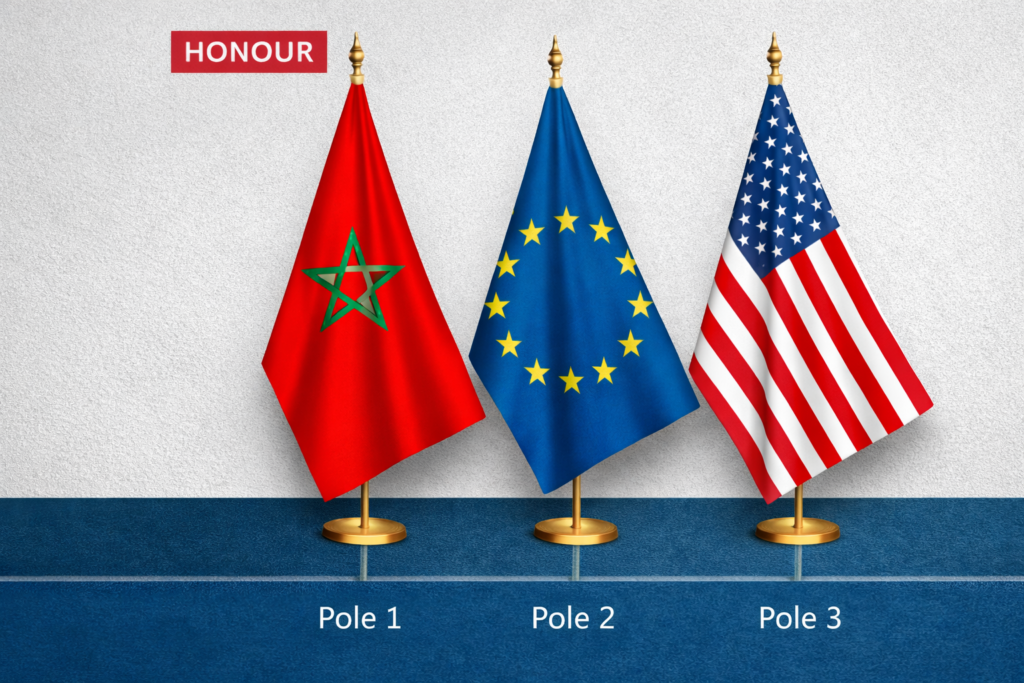
Flag Order Protocol Register (A4) — Placement Sheet & Precedence Log
Flag Order Protocol is the quiet architecture behind a ceremony that feels effortless. When flags are placed with precision, the audience reads the scene instantly: who hosts, who is honoured, which institutions are present, and how the relationship between parties is framed. The protocol is not decoration; it is a language of rank, respect, and representation, expressed through cloth, colour, and position.
A strong protocol also prevents misunderstandings. In diplomatic and institutional settings, a flag misplaced by a few centimetres can look like a deliberate statement. The aim is therefore clarity: every flag appears exactly where it should, in the right order, at the right height, with the right proportion, and under the right conditions.
What Flag Order Protocol governs
At its core, the protocol answers five questions.
It determines precedence, meaning which flag takes priority when several appear together. It defines placement, meaning where each flag stands in a line, on a stage, behind a lectern, or at an entrance. It controls height and proportion, so that no flag visually dominates another without a legitimate reason. It sets rules of use, such as raising, lowering, half-staff, lighting, and weather constraints. It also frames context, because indoor displays, maritime settings, funerals, national days, and international conferences each impose their own logic.
Because practices vary by country and institution, a good protocol is both principled and adaptable. The best results come from applying widely accepted etiquette rules, then aligning them with the host country’s official guidance and the event’s diplomatic intent.
The guiding idea of precedence
Precedence is the hierarchy that decides order. The host nation almost always holds a privileged position, because hosting is itself a form of authority over the space. Visiting heads of state, guest countries, and supranational organisations may then follow, depending on the nature of the event.
A useful mental model is this: the flag arrangement should read like the seating plan of the ceremony. If a VIP would be seated closest to the host, that VIP’s flag should also be placed closest to the host flag, with comparable prominence.
When multiple countries are treated as equals, protocol seeks neutral ordering methods to avoid signalling preference. Alphabetical order in the host language is common, as is ordering by the official names of states used in invitations. For federations, unions, or international bodies, the organisation’s own conventions can apply, especially in its headquarters or official events.
The position of honour
In flag protocol, the position of honour is typically the right side of the display from the flag’s own perspective. To an audience facing the flags, this often appears on the viewer’s left. This single idea explains many placements on stages and podiums.
If one flag must be highlighted, it goes to the position of honour. In national settings, that is usually the national flag. In a hosted international setting, the host national flag commonly holds that place, with guest flags placed in respectful proximity.
This is also why symmetry matters. A balanced arrangement communicates equality; an imbalanced one communicates hierarchy. Protocol uses symmetry deliberately, never by accident.
Equal height, equal dignity
When flags of different entities are displayed together, the default standard is equality of height and size. Poles should match, finials should match, and flags should be in comparable condition, so that the visual field does not imply rank beyond what the event intends.
There are exceptions. A national flag may receive elevation in specifically national contexts, such as national holidays or state buildings governed by domestic rules. Military or ceremonial standards may also have prescribed heights. Outside such exceptions, equality is the safest and most diplomatically sound baseline.
A practical detail often overlooked is spacing. Flags need room to move. When they are too close, they tangle and obscure one another, creating a messy image that reads as carelessness. Clean separation, straight poles, and consistent angles are not aesthetics; they are protocol discipline.
Common display scenarios
Two flags, host and guest
A bilateral setup should feel straightforward and fair. The host flag typically occupies the position of honour, with the guest flag beside it at equal height and size. From the audience viewpoint, the host flag is commonly placed on the left side of the display, and the guest on the right, creating a stable reading of host-first without diminishing the visitor.
This arrangement becomes particularly important in press photos, where the flags act as captions behind leaders. A correct bilateral display produces an image that requires no explanation.
Three flags, host, guest, and organisation
When a supranational organisation is part of the event, the arrangement should reflect why it is there. If the organisation is the convenor, its flag may take the central position, with participating states to either side. If the host state convenes and the organisation is represented as a partner, the host flag usually keeps precedence, with the organisation and guest flags placed according to the agreed diplomatic framing.
The key is consistency with the event narrative. A partnership summit looks different from a national visit, and the flags should say so immediately.
Multiple national flags at a conference
Large conferences often display many flags on stage or in a foyer. In such cases, neutral ordering becomes critical. Alphabetical order is common, but it must be executed with rigor: the same language rule, the same official country names, and a clear start point.
One reliable approach is to place the host flag in the position of honour, then arrange the remaining flags symmetrically outward in alphabetical order. Another approach is a full alphabetical line with no special position, used when the host wants to emphasise equality among participants. Both can be correct, provided the choice matches the diplomatic message and is communicated internally to avoid last-minute improvisation.
Indoor versus outdoor protocol
Indoor displays typically involve stand-mounted flags, controlled lighting, and limited movement. This environment rewards precision: straight poles, aligned finials, and consistent drape. Indoors, flags should never touch the floor, and they should be positioned so they are fully visible behind speakers without obstructing cameras or creating visual clutter.
Outdoor displays add wind, weather, and crowd flow. Outdoors, durability becomes part of protocol. A flag that is faded, torn, or too small for its pole undermines the dignity of the display. Outdoor flags also require attention to raising and lowering times, and to lighting when displayed at night.
In both cases, protocol is inseparable from logistics. The best ceremonial team treats flags as critical equipment, inspected and prepared with the same seriousness as sound systems and security checkpoints.
Half-staff and moments of mourning
Half-staff is one of the most sensitive areas of flag protocol, because it conveys grief, respect, and state message. When half-staff is required, it must be done correctly: the flag is typically raised briskly to the top first, then lowered to the half-staff position. When lowered at the end of the period, it is raised again to the top before being brought down.
In international settings, half-staff can be complex. A host may order half-staff nationally while guests may not have the same observance. The protocol decision should be made early, communicated formally, and executed uniformly. Inconsistency is what creates confusion, and confusion in mourning reads as indifference.
Correct handling and condition
A flag is not a prop. Handling rules exist because flags symbolise authority and identity. The basics are simple and non-negotiable: do not let the flag touch the ground, do not use it as a cover for objects unless explicitly authorised by specific ceremonial traditions, and do not display it if it is damaged or dirty.
Folding, storage, and transport matter as well. A creased, wrinkled flag looks careless in high-resolution photography, and those images live longer than the event itself. Professional teams steam or press flags when appropriate, store them in protective cases, and maintain an inventory with sizes, pole types, and mounting hardware.
Podiums, stages, and photo lines
Flags behind a lectern are more than background. They frame the speaker’s authority. A clean setup usually keeps flags slightly behind and to the sides, not directly behind the head where they create visual clutter. If two flags are used, they should mirror each other in distance and angle.
For seated meetings with a photo moment, flags placed behind each leader should be balanced, with equal spacing. For walking arrivals, flags along a carpet should be evenly spaced, identical in height, and oriented so that the most recognisable face of each flag is presented to cameras.
Table flags require special care. Small flags can feel informal if poorly chosen. Their bases should match, their sizes should be consistent, and they should never block sightlines. When table flags represent the parties at the table, their ordering should mirror the seating plan.
A practical protocol method for event teams
A reliable process avoids last-minute corrections.
Start by identifying entities: host state, visiting delegations, organisations, regions, military units, or institutions. Confirm official names and whether any entity has prescribed precedence rules. Decide the message of the event: equality, hosted honour, partnership, or institutional authority. Choose an ordering method that matches that message, then document it in a short protocol note shared with security, venue, and communications teams.
Next, map the locations: entrance, stage, meeting room, press wall, and dining spaces. For each location, specify number of flags, pole type, heights, and exact left-to-right order as seen by the audience and by the camera. Finally, do a physical rehearsal. Protocol is one of those domains where the real mistakes happen in the last two metres.
The difference between being correct and being effective
A flag display can be technically correct and still fail visually. Effectiveness is about readability: the audience should understand the hierarchy and the partnerships at a glance. That requires clean alignment, proportional sizing, strong fabric condition, and a layout that anticipates photography.
The best Flag Order Protocol is therefore a blend of rule and judgement. It honours precedence without creating unnecessary emphasis, it communicates respect without theatricality, and it builds a setting where the ceremony feels inevitable, as though it could not have been arranged any other way.
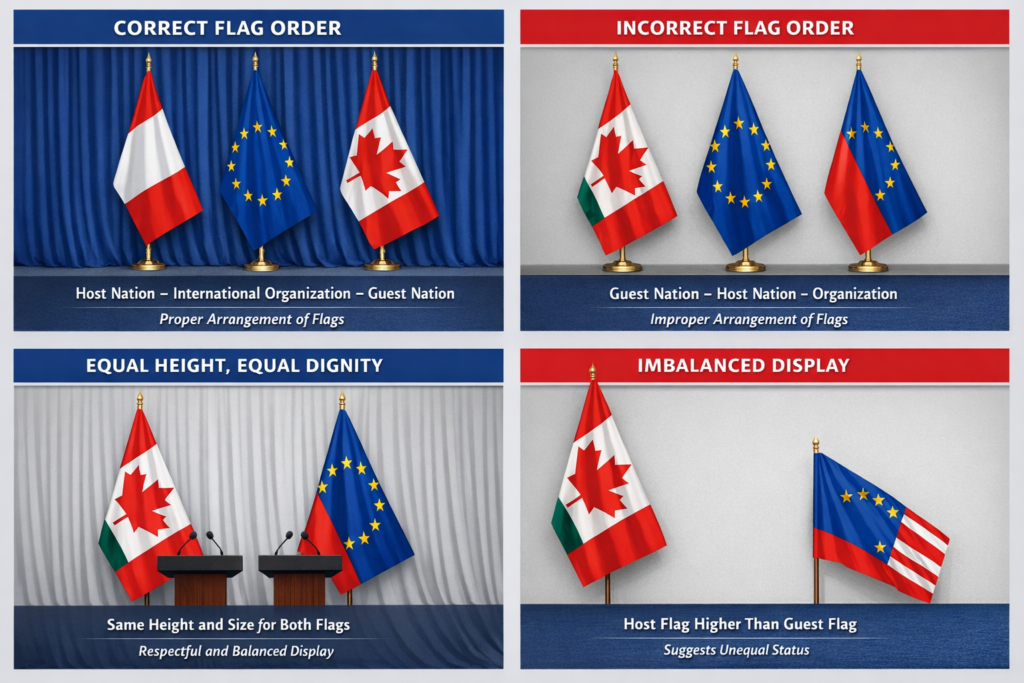
Word-based Flag Order Protocol (registry style) resolves that risk in a very practical way—by turning an “interpretation problem” into a controlled, printable instruction
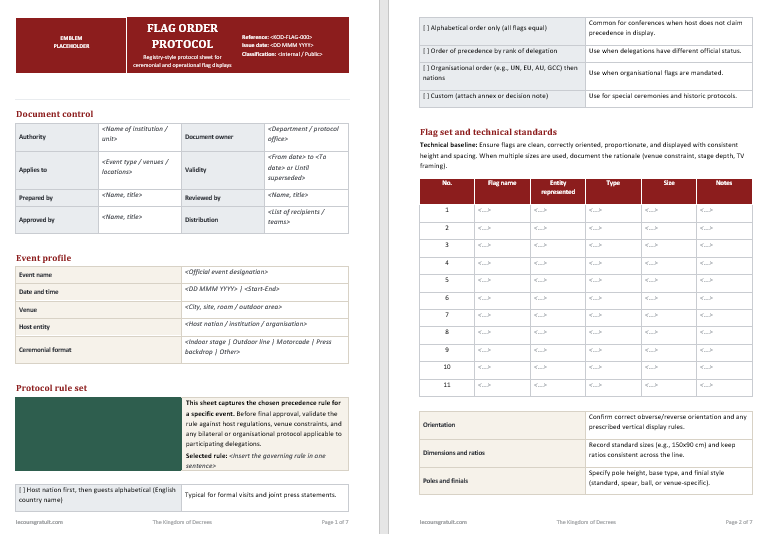
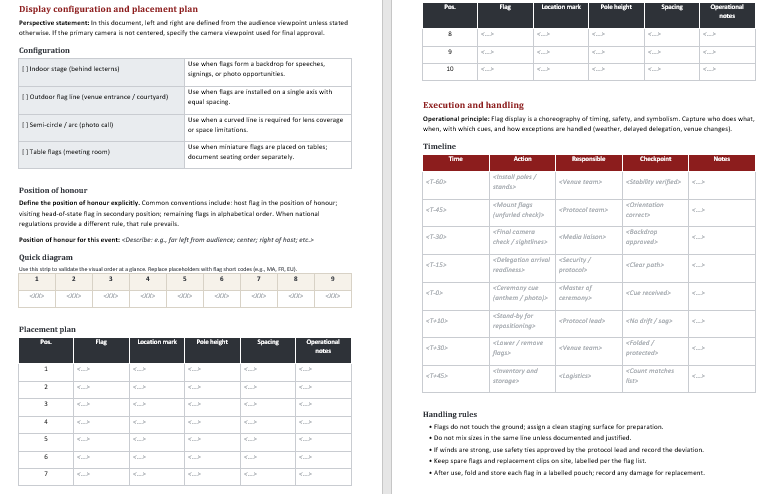
How the Word document prevents the “incorrect flag order” scenario
1) It fixes the reference point (no more confusion about left/right)
Most mistakes come from one question: left of whom? (audience vs speaker vs camera).
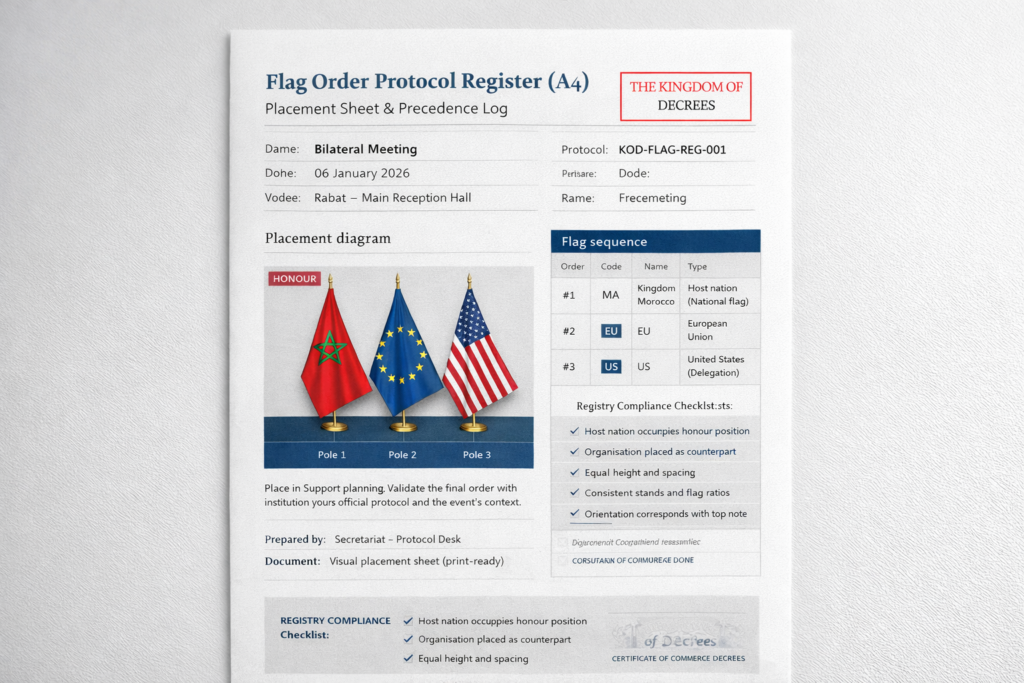
The template forces an explicit choice in the header (example fields you filled):
- Place of Honour (Audience-left or Audience-right)
- Orientation (front-facing / stage-facing)
Once that is written, the order becomes unambiguous for everyone on site.
2) It formalizes precedence into a clear sequence
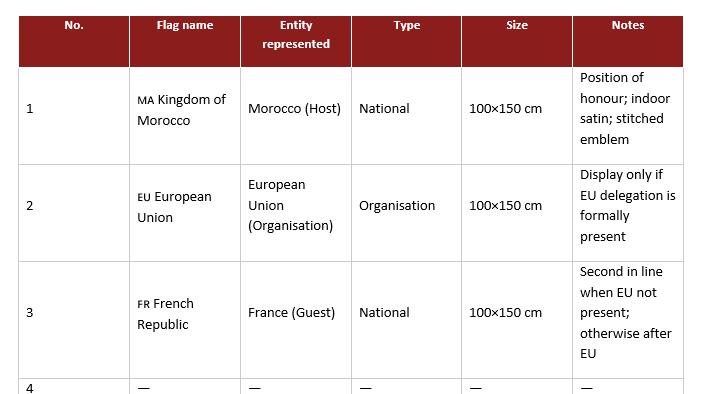
The document turns precedence into a numbered registry list:
- Order #1, #2, #3…
- Type: Host / Guest / Organisation / Other
- Notes: “Host nation”, “International organisation”, “Guest nation”, etc.
This prevents the exact error shown in your image (e.g., Guest – Host – Organisation) because the list is validated before installation.
3) It provides a visual placement map (so installers don’t improvise)
Your Word model includes a placement diagram (poles/stands with numbered positions).
That diagram makes the “correct vs incorrect” difference visible instantly:
- the host is locked into the honour position
- the organisation flag is placed where your protocol says it belongs
- the rest follows the numbered order—no guesswork
4) It enforces “equal height, equal dignity”
Another major failure shown in the image is “imbalanced display.”
The template includes guidance fields/checks that standardize:
- same pole height
- same flag size ratio
- consistent spacing
- same stand style (when possible)
So the display communicates respect and neutrality, not hierarchy-by-accident.
5) It creates a single source of truth (registry logic)
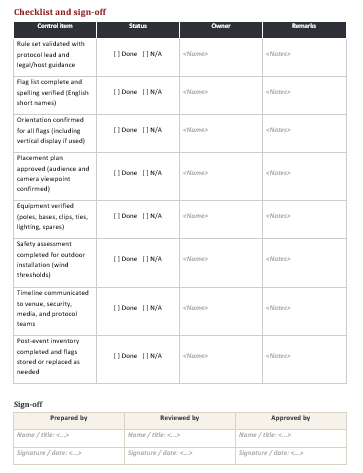
Instead of multiple people “knowing the rule,” you get one signed sheet:
- prepared by / validated by
- date, venue, event reference
- final sequence table + diagram
That prevents last-minute changes and “someone moved a flag because it looked better.”
In one sentence
The Word template solves the issue because it converts protocol into an operational, print-ready instruction: defined viewpoint → validated precedence list → numbered placement diagram → equal-display checks.