
Music in Morocco : A reference guide for international readers, listeners, and cultural researchers
Morocco’s music is often introduced as a “crossroads” between Africa, the Arab world, the Mediterranean, and the Sahara. The image is true, yet it can mislead: it suggests a single blended sound when Morocco actually holds a plural musical order, where distinct traditions live side by side, each with its own social purpose, etiquette, and transmission.
For an international audience, the fastest way to understand Moroccan music is not to chase labels, but to read it as a landscape. A wedding repertoire is not built like a ritual night. A poetic cycle does not behave like a dance circle. Even in the same city, music can change meaning depending on whether it is performed for celebration, devotion, healing, memory, or public spectacle.
This page is built as a stable reference. It clarifies the major pillars, teaches a listening method, provides a concrete planning example, and names the limits that most often create misunderstandings when Moroccan music is approached from outside.
How to read the Moroccan musical map
Moroccan music is best understood through three coordinates that reveal what a label often hides: function, place and language, and lineage. These three elements help locate almost any performance, whether it is heard in a courtyard, a festival stage, a family celebration, or a recording studio.
Function comes first because in Morocco music is frequently defined by what it is for. Some traditions are built to accompany rites, others to elevate poetry, others to carry collective joy, and others to sustain a long night where repetition and sequence matter as much as melody. The same instrument can appear in different contexts, yet the intention changes everything.
Place and language are equally decisive. Morocco is a multilingual country, and language is not a simple overlay; it shapes rhythm, vocal approach, and poetic structure. Regional identities also matter. Cities with long urban repertoires develop different aesthetic standards from rural circuits where voice, endurance, and social memory can dominate.
Lineage and transmission complete the map. Some traditions are taught with formal repertoires and curated suites. Others are transmitted through apprenticeship, performance circuits, and community recognition. In practice, “traditional” can mean two very different realities: a canon protected through institutions, or a living craft protected through social authority.
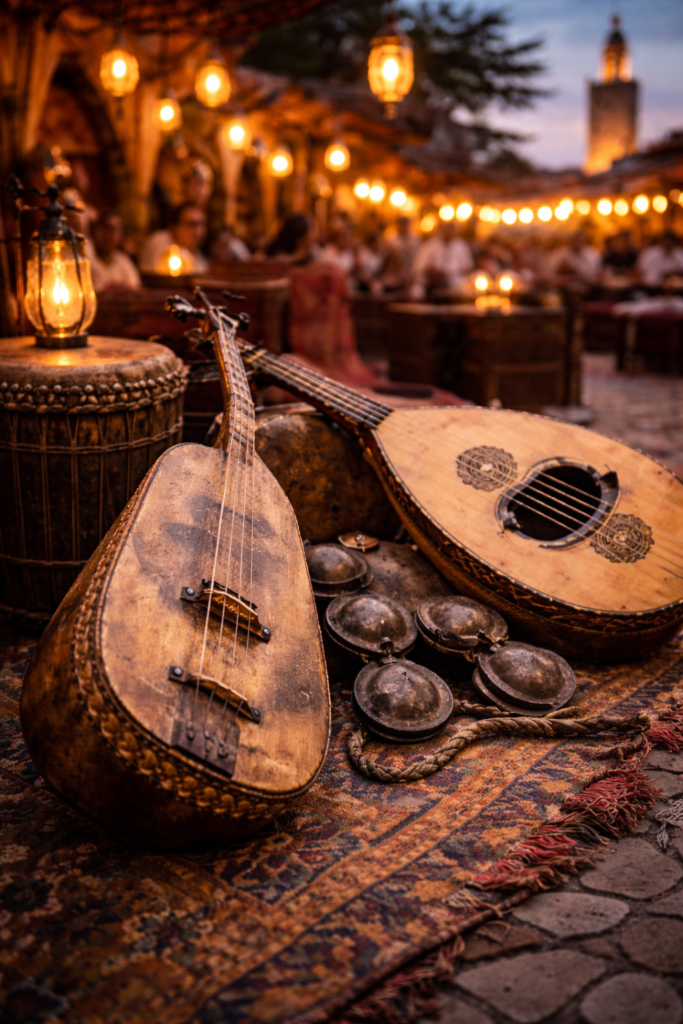
The classical and courtly pillar
Morocco holds a prestigious urban tradition of art music often connected to Andalusian heritage and to the long memory of poetry, modes, and formal suites. For international listeners, the essential point is not the origin story alone, but the architecture of performance: this repertoire values continuity, discipline, and learned sequences that are meant to be reproduced with care.
Listening here rewards patience. The beauty is rarely a single hook; it is a slow unfolding where melody, rhythmic cycles, and poetic phrasing form a coherent order. The ensemble is not simply accompanying a singer. It is shaping a structured experience that has its own internal rules, closer to a curated library than to a spontaneous jam.
A useful cue is to notice how time is organized. In this pillar, time is often measured by formal progression, not by urgency. It is music that assumes attentive listening, whether the setting is a concert hall, a cultural gathering, or a curated public performance.
The poetic pillar
Another major Moroccan pillar is music built around text, where the craft of verse remains central and melody serves as its vessel. In these traditions, the listener is invited into a world where meaning is produced through rhetorical pacing, vocal nuance, and the interplay between the solo line and the ensemble’s response.
For international readers, the right approach is to treat these forms as sung literature. Translation can carry the topic and the storyline, yet a large part of the artistry sits in what translation cannot fully reproduce: cadence, emphasis, breath, and the way a line lands in a room. Even without full linguistic access, it is possible to follow structure by listening for repeated refrains, shifts in intensity, and moments where the ensemble amplifies a concluding phrase.
This pillar is also a reminder that Moroccan music does not always begin with instruments. It often begins with the authority of words.
The ritual pillar
Morocco also holds traditions where music is linked to ritual frameworks, night ceremonies, and therapeutic or devotional intentions. These practices can be highly visible on international stages today, but their original logic is not designed for quick sampling. Sequence matters. Repetition is not a decorative loop; it is the engine of the experience. The community roles around the music can be as meaningful as the music itself.
International audiences often meet this pillar through festival programming and collaborations, where excerpts are shaped to fit stage durations and global expectations. That visibility can be valuable, yet it should not be confused with the total tradition. A stage version may translate sound effectively while translating context only partially.
A respectful way to listen is to pay attention to how the performance seems to carry time rather than “finish” it. Where other music aims at closure, ritual-linked performance can aim at continuity, gradual intensification, and carefully shaped transitions.
The rural and oral pillar
Morocco’s musical landscape would be incomplete without the traditions rooted in rural circuits and oral transmission, where voice, memory, and social presence carry immense weight. In these repertoires, performance often functions as a form of collective archive, preserving emotions, local narratives, and community codes that are rarely written down.
Here, the event setting matters sharply. A tradition can sound one way in a family celebration and another way in a public festival. The same song may shift depending on the audience composition, the moment of the night, and the social purpose of the gathering. This pillar also illustrates a Moroccan constant: music is not only entertainment; it can be a social instrument for cohesion, remembrance, and identity.
International listeners sometimes underestimate this pillar because it does not always fit the “concert format.” Yet it is often closer to the lived heart of Moroccan musical life than the most visible global stages.
Amazigh pillars and collective performance worlds
Morocco’s Amazigh performance worlds add further depth, notably through collective forms that combine singing, percussion, poetic exchange, and choreographed movement. These traditions are not a single category. They are plural, regionally grounded, and shaped by local etiquette.
The most reliable way to approach Amazigh music is to resist simplification. Instead of searching for one representative sound, follow how region and occasion reshape the performance. Listen for the dialogue between group and solo voice, the communal pulse of percussion, and the way movement and sound operate as one system rather than separate arts.
For international audiences, this pillar also clarifies an important point: Morocco’s musical identity is not only urban and not only Arabic. It is a layered national landscape where multiple languages and regional forms remain active in the present.
Contemporary Morocco where the pillars meet the present
Modern Moroccan music develops at the intersection of heritage, city life, digital production, diaspora circulation, and festival infrastructure. Pop, rap, electronic projects, and cross-genre collaborations often draw selectively from older pillars, sometimes by borrowing rhythms, sometimes by sampling timbres, and sometimes by reworking poetic sensibilities for new audiences.
This process is not automatically dilution. It can be a mode of continuity, especially when artists treat tradition as a living source rather than a costume. It can also create misunderstandings when fragments are extracted without respect for function and context, particularly in ritual-linked traditions.
A useful lens is to ask what a contemporary track is doing with its references. Is it quoting a sound for atmosphere, or does it preserve the structural logic and cultural meaning of the source? The answer varies widely, and that variation is part of Morocco’s current musical story.
A clear procedure for exploring Moroccan music with method
This procedure is designed for international listeners who want more than a list of names.
Step 1 Choose one entry door
Select a single pillar to begin. Morocco’s musical diversity is real, and starting everywhere at once often produces confusion. One pillar is enough to build the first map.
Step 2 Identify the setting before you judge the sound
Ask what kind of setting the performance belongs to: a formal concert, a family celebration, a community gathering, a ritual night, or a festival stage. The same tradition can change meaning depending on the setting, and “quality” is often judged differently within each context.
Step 3 Listen for structure rather than novelty
Focus on what repeats, what gradually intensifies, and how the performance manages time. Notice where leadership sits: with a solo voice, with the ensemble, or with collective call-and-response. This reveals the internal grammar of the tradition.
Step 4 Add context in small, reliable layers
Do not overload the first session with encyclopedic detail. Add one layer at a time: purpose, region, language, and transmission mode. These are the most stable anchors and the least likely to distort.
Step 5 Compare responsibly
Compare a community-context performance with a stage or studio version. This comparison is one of the most effective ways to understand what is essential and what is adapted for visibility.
Step 6 Keep a listening notebook
Write down the pillar, region, language, setting, and the moments that felt structurally central. After five sessions, the Moroccan map becomes readable in a way that playlists alone rarely achieve.
A visible numeric example 7 days of listening with a realistic budget frame
This example is a planning model, not a universal rule. Prices vary by season, city, and travel style.
Goal Experience three dimensions of Moroccan music: a large public stage, an urban curated context, and a coastal city known for musical visibility and collaborations.
Suggested sequence
- Days 1–2 Rabat for contemporary visibility and large public programming when in season
- Days 3–4 Fez for a city where cultural programming often highlights refined traditions and spiritual or scholarly atmospheres
- Days 5–7 Essaouira for a coastal setting closely associated with high-profile musical exchange and international audiences
Budget frame mid-range, 7 days, per person
- Accommodation 7 nights × 55–90 USD = 385–630 USD
- Local transport and intercity = 60–140 USD
- Meals 7 days × 15–30 USD = 105–210 USD
- Tickets and paid events = 0–120 USD
Estimated total 550–1,100 USD
This numeric frame is useful because it turns cultural curiosity into a concrete plan. It also clarifies a key truth: Moroccan music is profoundly shaped by place, and hearing it in context can change understanding more than weeks of online listening.
Limits and special cases international audiences often miss
Ritual contexts are not performance themes
Ritual-linked music is sometimes presented as a genre for stages and content platforms. That presentation can be attractive, yet it risks removing the intention, sequence, and social roles that create meaning. When the framework is reduced to sound alone, the listener hears less than what is actually happening.
Labels travel badly
International categories such as “folk,” “world,” or “trance” can be convenient, but they often flatten Morocco’s distinctions. A label may describe a feeling while ignoring function, language, and transmission.
Festivals amplify one layer of reality
Festivals can be powerful windows. They also compress traditions into stage formats and highlight what travels well internationally. They should be read as gateways, not as complete representations.
Language is not secondary in poetic traditions
Where verse is central, meaning lives in cadence, emphasis, and the social intelligence of delivery. Even partial access through a short glossary and a brief contextual note can change the entire listening experience.
Music in Morocco
A structured guide for international readers to understand Morocco’s musical landscape through its major pillars, listening method, cultural settings, and planning logic.
A neutral, high-trust reference intended for readers, travelers, and cultural researchers.
How to read the Moroccan musical map
In Morocco, musical “genre” is often less informative than function, setting, and lineage. The same city can host several musical languages that rarely overlap except through festivals or modern projects.
Three coordinates
- Function: devotional, therapeutic-ritual, celebratory, poetic-literary, entertainment.
- Place and language: regional identity and language shape rhythm, instruments, and etiquette.
- Lineage and transmission: conservatory repertories vs oral master-apprentice circuits.
The classical and courtly pillar
Morocco’s Andalusian art music is organized around disciplined repertories and suite-like architecture. It is designed to be learned, curated, and reproduced with fidelity, functioning as a musical library of continuity.
Approach it as structured listening rather than ambiance: follow how poetry, mode, and rhythmic cycles organize time.
The poetic pillar: Malhun
Malhun places verse at the center. Music carries the text, the rhetorical pacing, and the ensemble response. Translation helps, but delivery and cadence are part of the meaning.
The ritual pillar: Gnawa
Gnawa is often simplified abroad as “trance music,” yet it also belongs to brotherhood practice and night-ceremony logic. Modern festival stages increase visibility without replacing the internal framework of sequence and symbolism.
Ritual-linked music can be filmed and marketed, but meaning depends on intent, sequence, and community roles. A stage excerpt may not represent the full tradition.
The rural and oral pillar: Aita
Aita operates as a social archive carried by voice, memory, and event-circuit performance. It is often associated with women performers and regional repertoires shaped by gatherings and ceremonies.
Amazigh pillars: collective performance arts
Amazigh performance worlds include collective dance-singing-percussion forms and poet-singers. Treat them as plural traditions: region, language, and local etiquette determine sound and structure.
Contemporary Morocco: where the pillars meet the present
Modern Moroccan music often draws selectively from older pillars while adapting them for new audiences. Festivals, collaborations, and studio production create meeting points, sometimes respectfully, sometimes reductively.
A clear procedure for exploration
Follow these steps to avoid the common international mistake of treating Morocco’s musical landscape as a single playlist.
- Choose one entry door (one pillar) before expanding.
- Identify the social setting (concert, wedding circuit, ritual night, festival stage).
- Listen for structure: repetition, leadership (voice vs ensemble), time-carrying logic.
- Add context in small layers: function, region, language, performance sequence.
- Compare two versions responsibly: community-context vs stage/festival excerpt.
- Keep a listening notebook to build a readable map over five sessions.
A visible numeric example: 7-day listening itinerary
A planning model that forces realistic choices. Costs vary by season and accommodation level.
| Line | Assumption | Range |
|---|---|---|
| Accommodation | 7 nights, mid-range | 385–630 USD |
| Transport | Local + intercity | 60–140 USD |
| Meals | 15–30 USD/day | 105–210 USD |
| Tickets / paid events | Some stages free; some concerts ticketed | 0–120 USD |
| Total | 7-day estimate | 550–1,100 USD |
Limits and special cases
- Sacred and therapeutic contexts are not “themes”; they are frameworks with rules.
- Genre labels travel badly; they can flatten regional distinctions and functions.
- Festivals amplify visibility but never represent the full musical ecosystem.
- Language is not secondary in poetic traditions; meaning is partly in cadence and delivery.
Related guides and deep dives
For readers who want a focused lens on each tradition, these dedicated pages extend the reference:
- Gnawa in Morocco: ritual logic, instruments, and modern stages
- Malhun: Moroccan sung poetry, themes, and performance etiquette
- Aita: voice, memory, and contemporary revivals
- Andalusian music in Morocco: structure and listening keys
- Amazigh performance arts: regional forms and etiquette
- Morocco’s major music festivals: how to attend with cultural literacy