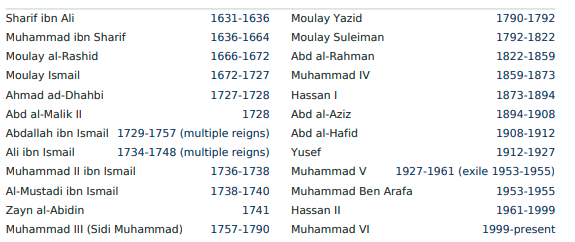
Origins of the Alaouite Dynasty : Tafilalt, Sijilmassa, and the Caravan-State Logic of Moroccan Sovereignty
Some dynasties begin in palaces, already surrounded by banners, ritual, and the confident choreography of court. The Alaouite dynasty begins elsewhere—in the disciplined world of the oasis, where life is negotiated with nature, and authority is tested not by applause but by outcomes. To understand the Alaouite origins, one must set aside the modern habit of imagining power as something that descends from a capital to a countryside. In the Moroccan southeast, power historically rose along routes, around wells, through markets, and within communities whose survival depended on mediation as much as on strength.
The early Alaouite story is therefore not only genealogical. It is geographic and economic, social and moral. It is shaped by Tafilalt, by the memory and gravitational pull of Sijilmassa, and by the long, patient intelligence of caravan corridors—those moving arteries that connected Morocco to the Sahara and beyond. These were not peripheral spaces. They were strategic environments where Morocco learned, in early form, the essentials of sovereignty: protection, arbitration, legitimacy, and the art of holding diverse interests together.
Tafilalt: The Oasis as a School of Authority
Tafilalt is often described in simple terms—an oasis region in Morocco’s southeast, a place of palms and water, of seasonal rhythms and earthen architecture. Yet for the historian of power, an oasis is never merely scenery. It is a political environment of unusual clarity. Water creates hierarchy; access creates obligation; scarcity creates a strict ethic of rule. When resources are finite and survival is shared, leadership cannot remain theatrical for long. It must be practical, it must be credible, and it must be seen to deliver.
In such a setting, authority tends to grow from service. The leader who can secure irrigation rights, arbitrate disputes between families, protect harvests, and settle conflicts before they become feuds will acquire a legitimacy that is felt, not merely declared. This is a legitimacy produced by proximity to real life. It is the kind that people remember when storm and drought arrive, and it is the kind that endures when the fashionable language of politics changes.
Tafilalt also taught a deeper political lesson: the southeast was never isolated. Its life depended on movement—of merchants, scholars, pilgrims, and caravans. Authority had to be compatible with circulation. A ruler who strangles routes strangles prosperity; a ruler who secures them earns loyalty in a currency stronger than coin: trust.
Sijilmassa: The Memory of a Gateway City
If Tafilalt is the school, Sijilmassa is the symbol—an echoing name that still carries the prestige of the caravan age. Historically celebrated as a great trading center, Sijilmassa functioned as a gateway between the Maghreb and the Sahara. It was a place where goods and reputations changed hands, where distant worlds became tangible through markets, contracts, and correspondence.
The importance of Sijilmassa for Alaouite origins lies not only in what it was at its height, but in what it represented afterward: a memory of Morocco as a connector. In the political imagination of the region, Sijilmassa signaled that prosperity and security were historically linked to the control of routes and the management of exchange. Even as cities rise and fall, their political meaning can persist. Sijilmassa remained a reference point—a reminder that the southeast held keys to Morocco’s broader economic and strategic horizons.
Gateway cities also teach rulers that power is rarely singular. Markets are plural spaces: merchants demand predictability, religious scholars demand moral order, local notables demand recognition, and caravans demand safety. A leader who thrives in such an environment is trained to balance. The art is not to dominate every actor at once, but to orchestrate coexistence—allowing multiple interests to function under an umbrella of authority that feels legitimate.
Caravan Corridors: The State in Motion
Modern states often think in terms of borders—lines on maps, customs checkpoints, fixed administrations. The pre-modern political logic that shaped the Alaouite beginnings was less about lines and more about corridors. Caravan routes were not only commercial channels; they were instruments of political formation. Along them flowed wealth, yes, but also information, alliances, and the authority that comes from being recognized across distance.
In the caravan world, sovereignty is measured by whether people can move. A route that is safe becomes a public good; a route plagued by predation becomes a political indictment. The ability to protect travelers, to regulate markets, and to discipline those who prey on circulation—this is governance in its most immediate form. It is, in a sense, the state at its most visible: not a distant institution, but the difference between fear and stability on a road.
This is the essence of what might be called caravan-state logic. Authority begins as a promise: “Pass through; you will not be harmed.” It becomes a reputation: “Trade here; contracts will be honored.” And it matures into legitimacy: “Allegiance is owed because order is maintained.” Where corridors matter, the state is not merely a territory; it is a system of protections and obligations that travels with people and goods.
The Alaouite emergence within this environment meant that the dynasty’s early political instincts were shaped by motion and negotiation. It learned to treat security not as spectacle but as infrastructure, and to understand that the credibility of rule can be measured in the ordinary experiences of merchants and communities.
Legitimacy with a Moral Horizon: Sharifian Descent in Context
Alaouite identity has also been historically associated with sharifian lineage, a claim to descent from the Prophet’s family. In Moroccan political culture, sharifian legitimacy is not merely decorative; it is a moral claim that shapes how authority is perceived. It connects sovereignty to the language of religion, honor, and responsibility—an inheritance that can strengthen rule, but also imposes a standard.
In the southeast, where communities were knit by both local custom and religious life, such a claim resonated within existing structures of respect. Yet it would be misleading to present lineage as a magical key that opened every door. In the real politics of the oasis and the caravan, lineage becomes meaningful when it aligns with conduct. Moral legitimacy must be made plausible by action—by dispute resolution, protection, and restraint.
The significance of sharifian descent in the Alaouite origin story is therefore best understood as a framework. It offered a language of legitimacy that could travel: across regions, across communities, and eventually toward the centers of power. It also positioned the dynasty within a Moroccan tradition in which the ruler is expected to be not only a commander, but a guardian of religious and social order.
From Regional Authority to National Ambition: The Logic of Consolidation
When a dynasty rooted in the southeast begins to expand its authority, it does not simply “conquer” Morocco in a modern sense. It enters a complex field of powers: tribes and confederations, urban elites, scholarly networks, commercial interests, and rival centers of coercion. Expansion, in such circumstances, is as much about recognition as it is about force.
The caravan-state logic provided the Alaouites with a practical advantage: they were accustomed to building authority through networks rather than through one-dimensional domination. They understood that allegiance could be negotiated, that order could be offered as a bargain, and that legitimacy could be staged as a relationship rather than proclaimed as an entitlement.
This is where the later language of Moroccan governance—the balancing role of the center, the negotiation between authority and autonomy—finds an early echo. The makhzen, often invoked in discussions of Moroccan statecraft, can be seen here in embryo: a system built on alliances, obligations, and calibrated enforcement. The seeds of that political temperament are visible in the southeast’s caravan world.
The Oasis Ethic and the Imperial Horizon
It is tempting to imagine a clean transition from “origin” to “empire,” from palm groves to palaces. History rarely offers such neatness. Yet there is a continuity worth noticing: the disciplines of the oasis—resource management, dispute resolution, security as public service—scale surprisingly well when a dynasty becomes national.
When the Alaouites later assert their rule across Morocco, they do so in a country where geography insists on pluralism: mountains and plains, Atlantic ports and Saharan fringes, Arab and Amazigh communities, city life and tribal landscapes. A dynasty trained in corridor logic has a mental advantage. It does not assume uniformity. It understands that unity must be crafted, not imposed as a fantasy.
In other words, the Alaouite origin story does not simply explain where the dynasty came from; it explains why it could endure. A dynasty born in a world of routes and bargaining tends to develop a patient, strategic approach to governance. It learns to govern through mediation, to speak to different social languages, and to treat order as a tangible product delivered to the public.
Sovereignty Before the Throne
Before the throne is erected, sovereignty begins as something more elemental: a promise that the road will be safe, that disputes will be judged, that the weak will not be abandoned, and that the community will not be left alone before the harshness of nature and the opportunism of violence. In the southeast of Morocco—between Tafilalt, the remembered grandeur of Sijilmassa, and the pulse of caravan corridors—the Alaouite dynasty learned this truth early.