
Who are the 300 men inside of the Roman Republic that advise the consuls?
Behind the consuls’ public imperium stands a quieter force often described as three hundred men: the senators of the Roman Senatus. Drawn from the Republic’s governing elite, they gather in the Curia to weigh precedent, steer diplomacy, secure funding for war, and confer the decisive weight of auctoritas—an authority that can turn counsel into the Republic’s practical direction, even when it remains, in form, only advice.
How the Roman Senate Shaped Consular Power in the Republic
In the Roman Republic, power rarely appeared where a modern eye expects to find it. The consul stood at the summit of the annual magistracies, invested with imperium, escorted by lictors, and entrusted with the conduct of war, the order of the city, and the dignity of the state. Yet even at the height of that public authority, a consul did not govern in solitude. He governed in a world thick with precedent, surrounded by men who claimed no imperium at that moment, yet possessed something more enduring than the power of command: the power of collective standing, the weight of remembrance, the authority of the established order.
The phrase that echoes through many summaries of Roman government—three hundred men advising the consuls—points to a political reality that was both simple and subtle. Simple, because it names the Senate, the Senatus, an elite council that, for long stretches of the Republic, hovered around that number. Subtle, because the Senate’s influence did not depend on a neat constitutional sentence that reads like a modern statute. It depended on a Roman art of persuasion: an institutional habit whereby counsel, when spoken by the right men in the right place, became almost indistinguishable from necessity.
The Senate as the Republic’s memory
Rome’s Republic was an annual regime in its executive offices. Consuls changed each year; their ambitions were urgent, their time brief. The Senate did not change with the same speed. Its benches gathered men who had already climbed the ladder of magistracies, men whose names carried the afterglow of commands, triumphs, missions, and crises survived. Where the consul represented the sharp edge of action, the Senate represented continuity. It was the state’s memory made present: not a library of documents, but a living archive of decisions, alliances, betrayals, disasters, recoveries, and the slow accumulation of what Romans called mos maiorum, the ancestral way.
This is why the Senate’s influence could feel paradoxical to outsiders. In strict form, the Senate advised. In practice, advice from that body was a force that shaped what could be done, what should be done, and what would later be defended as properly Roman. A consul might propose; the Senate could define the terms under which the proposal became acceptable, funded, reputable, and politically survivable.
Why three hundred mattered
The number three hundred is not best understood as an exact census frozen in time. Roman institutions moved; war and reform could swell or thin the ranks; deaths and disgrace could create gaps; censors could revise membership. Yet the figure endured because it communicated a social and political fact: the Senate was large enough to represent the leading class and yet limited enough to remain a governing circle.
In the middle Republic—an era of fierce external pressure and rapid expansion—Rome benefited from a body that could gather experience in one place. In those centuries, the Senate’s approximate size conveyed the image of a compact aristocratic engine, a council that could deliberate without dissolving into the shapelessness of a crowd. Three hundred sounded, and often was, the Republic’s ruling conversation.
Auctoritas and the Roman style of power
Roman political language distinguishes between power that commands and authority that compels assent. A consul held imperium: the legal and sacred power to lead armies, punish, and act in the name of the state. The Senate claimed auctoritas: the prestige and legitimacy that made its guidance hard to ignore without consequences.
This distinction is essential. Roman politics was not only a contest of votes and offices; it was a contest of standing. A decision made without the Senate’s backing could be legal and still be treated as reckless, isolated, or impious in spirit. A decision made with senatorial support could acquire a sense of inevitability, even when it remained, technically, “advice.” Rome’s greatness was partly forged in this separation of functions: executive energy held in tension with aristocratic continuity.
How the Senate spoke
The Senate’s collective judgment took form in resolutions known as senatus consulta. These were not, in the strictest sense, laws passed by the people. Their force lay in the political ecosystem that surrounded them. The Senate did not need to legislate like an assembly if it could shape the agenda, define the options, direct resources, and establish what counted as prudent.
A consul who desired success in war required more than a battlefield plan. He required soldiers supplied, allies reassured, funds allocated, mandates clarified, and rival ambitions contained. In these domains, the Senate’s voice was decisive. It governed the slow arteries of the Republic: finance, diplomacy, provincial oversight, and the wider management of Rome’s obligations. The consul’s year might be dramatic; the Senate’s seasons were long.
The censors and the making of senators
To understand who these three hundred men were, one must look to the gatekeepers of respectability in the Republic. Over time, membership in the Senate became increasingly tied to public office and to the judgment of the censors. The censors were not commanders; they were guardians of status. They conducted the census, but they also policed the moral and social boundaries of the ruling class.
When the censors revised the list of senators, they did something more than administrative housekeeping. They performed a ritual of political legitimacy. Enrollment signaled that a man belonged to the governing order; exclusion signaled that he had fallen below the standard of Roman dignity, whether through scandal, financial ruin, or perceived unworthiness. This censorial power helped transform the Senate from a loose gathering of prominent men into a more stable institution, one whose composition expressed the Republic’s ideals of service, reputation, and hierarchy.
The consul and the Curia
A consul did not merely “consult” the Senate as a courtesy. He convened it, spoke before it, listened, and often returned again. The Curia was not a neutral room; it was a political arena that rewarded certain styles of speech and punished others. Senators valued precedent, restraint, and the appearance of acting for the commonwealth rather than for a private faction. They could be moved by fear, ambition, and rivalry, but the language of debate demanded a public mask of civic virtue.
The consul who mastered this environment could convert senatorial support into momentum. The consul who treated it as a nuisance risked being branded reckless, arrogant, or dangerous. Roman politics was unforgiving toward men who looked like they wanted kingship, even by accident. The Senate’s benches were therefore not only advisers; they were sentries guarding the Republic’s self-image.
Collegiality and the architecture of restraint
The Republic’s genius for self-restraint appears most plainly in its insistence on two consuls. Collegiality was not decorative. It was a structural warning: no single magistrate should become the state. Two consuls, elected annually, sharing office, checking each other, competing and cooperating, were meant to prevent the rise of solitary rule.
The Senate fitted naturally into this architecture. It served as a third force: not an executive rival, but an anchor. Where consuls could be propelled by urgency, the Senate pulled toward continuity. Where consuls might gamble for glory, the Senate could demand the slower calculus of endurance. This constant balancing act did not eliminate ambition—it channeled it into a form that, for centuries, produced results.
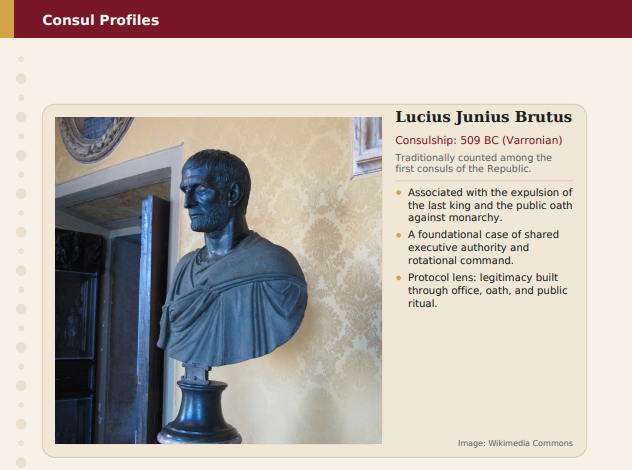
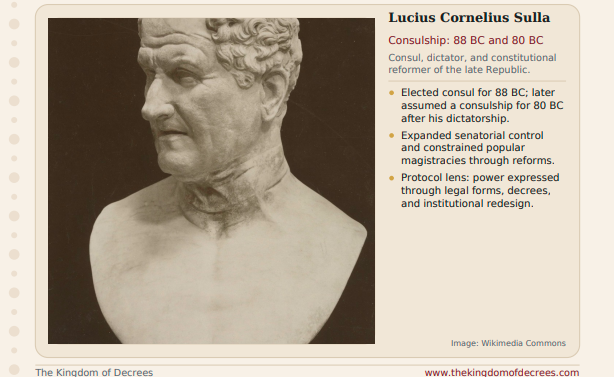
Download A visual registry of selected office-holders and republican authority — a concise, design-led guide to Rome’s key magistrates and power structure.📥
Why the roster is elusive
A modern request for the names of the three hundred is understandable, and yet the Republic itself did not preserve a single, comprehensive roster for every year in a way that has survived intact. Senators rose and fell; membership changed with each censorship; lists were revised, not engraved as permanent monuments for later readers. The Republic remembered offices more readily than benches. Magistracies left official traces; the Senate’s composition was a living order whose continuity mattered more than a fixed catalogue.
This does not mean the Senate was faceless. On the contrary, Roman political life was intensely personal: families, reputations, alliances, and rivalries shaped decisions. But the Senate’s power resided precisely in its capacity to outlast individuals. The institution mattered because it could absorb deaths, defeats, and scandals without collapsing. A roster could be rewritten; the Senate’s posture as the guardian of the commonwealth remained.
The Senate’s reach in war and peace
To say the Senate advised the consuls can sound timid. In practice, senatorial guidance reached into the most consequential theatres of Roman life.
In war, the Senate shaped strategy indirectly: by determining priorities, dispatching envoys, managing alliances, authorizing extraordinary measures, and negotiating the political meaning of victory or defeat. It could also determine the narrative of a campaign. A consul’s triumph was not merely a military fact; it was a political judgment about what counted as worthy, legitimate, and beneficial to Rome.
In peace, the Senate dominated continuity. Diplomacy depended on a long memory of treaties and hostilities. Finance depended on a stable class that understood the burdens of taxation and the cost of armies. Provincial oversight demanded a degree of coherence that annual magistrates alone could not provide. In these domains, the Senate did not merely advise. It orchestrated.
The elegance and the strain of the Republican system
The Republic’s system worked because it transformed competition into governance. Senators wanted honor; consuls wanted glory; families wanted lasting prestige. The state benefited when those desires were forced to pass through institutions that demanded public justification. Yet the same mechanism contained its own seeds of strain. As Rome’s empire expanded, the rewards grew larger, the stakes sharper, the tempo more violent. The Senate’s authority could become the object of factional warfare rather than the source of common direction. Consular ambition could harden into something more desperate than a search for reputation. The Republic’s architecture of restraint, magnificent in its balance, was tested by the scale of what Rome had become.
Even so, the historical impression remains clear. The “three hundred” were not a decorative council. They were the Republic’s stabilizing class, the men who translated precedent into policy, who made advice carry the weight of command, and who taught consuls that power in Rome was never only a matter of holding office. It was a matter of being recognized as acting within the Republic’s moral and political grammar.
The meaning of the three hundred
If one seeks the essence of the relationship between Senate and consuls, it lies in a simple tension. The consul embodied action. The Senate embodied endurance. The consul moved first; the Senate made the movement last.
In that partnership—sometimes harmonious, sometimes bitter—Rome found a form of government capable of extraordinary resilience. Its greatness did not come from a single sovereign voice, but from the constant negotiation between the power to command and the authority to persuade. The Republic’s most characteristic strength was not unanimity. It was the capacity to argue within an order, and to turn argument into decisions that could carry a world.
Signed,
The Kingdom of Decrees
Download A visual registry of selected office-holders and republican authority to explore the faces, titles, and functions that shaped Rome’s Republic—cleanly designed, historically framed, and ready to use for study, teaching, or protocol-inspired publishing 📥