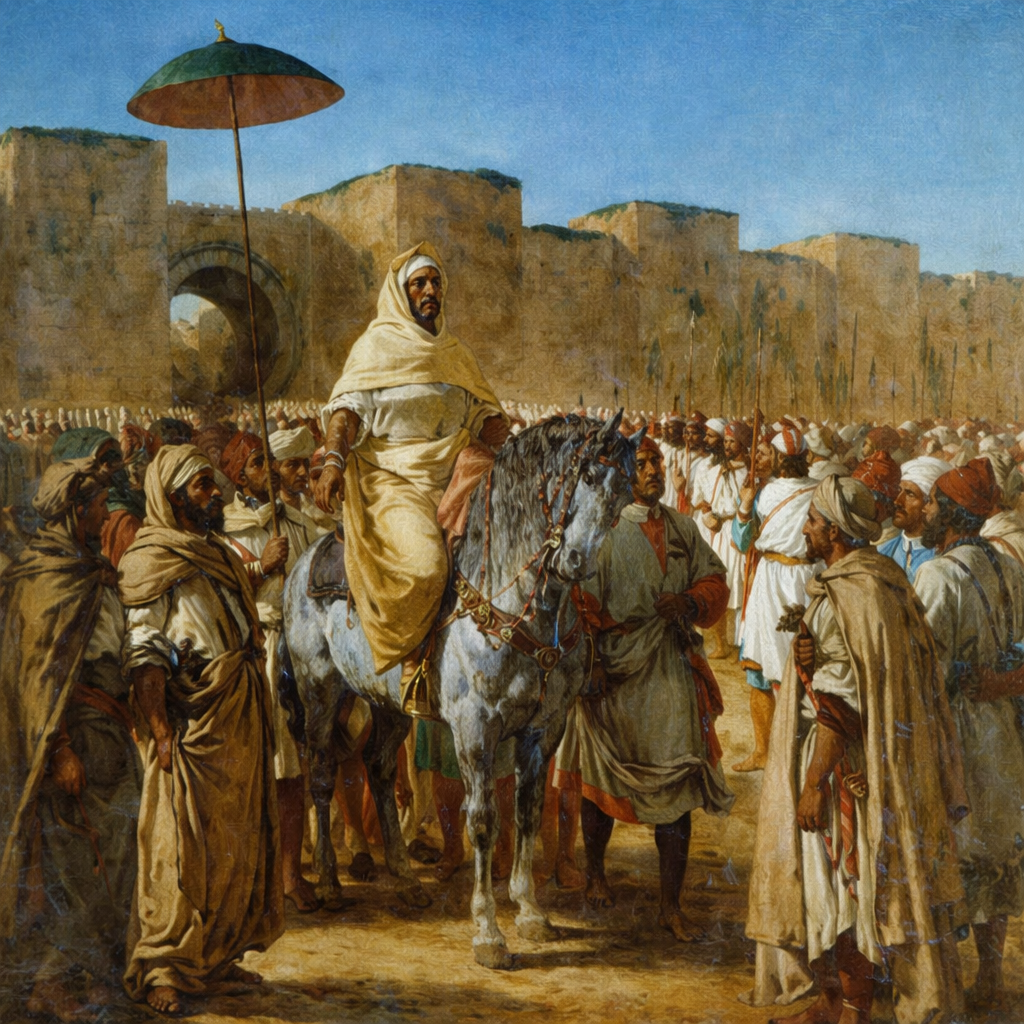
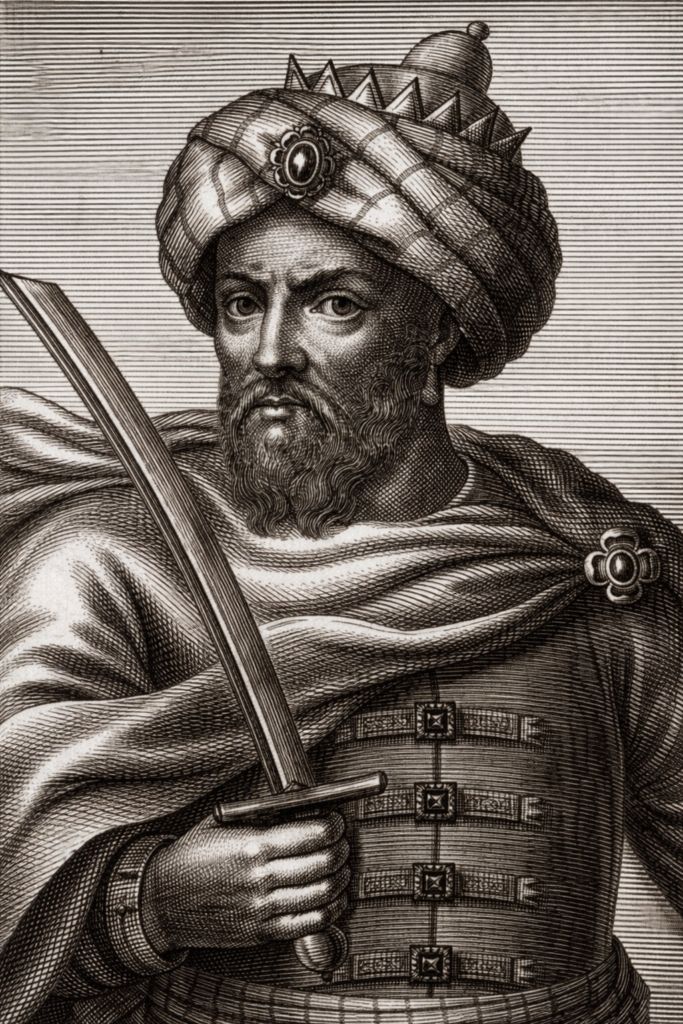
The Alaouite Dynasty of Morocco : Origins, Continuity, and the Craft of Sovereignty
There are dynasties that rule by accident of conquest, and there are dynasties that endure because they learn—patiently, often painfully—how to hold a country together. Morocco’s Alaouite dynasty belongs to the second category. Its story is not merely one of succession; it is a long apprenticeship in legitimacy, geography, diplomacy, and the quiet arts of statecraft. It begins far from courtly ceremony, in the disciplined logic of the oasis and the caravan road, where authority must be earned, protected, and renewed.
To speak of the Alaouites is therefore to speak of Morocco itself: a realm shaped by mountains and seas, desert horizons and imperial cities, tribal solidarities and scholarly lineages, local autonomy and central authority. Over centuries, the dynasty’s political vocabulary has evolved—sultanate, protectorate, independence, constitutional monarchy—yet the central challenge has remained constant: how to translate moral legitimacy into effective governance, and how to reconcile the many Moroccos within one sovereign framework.
A Southern Beginning: Tafilalt, Sijilmassa, and the Caravan World
The Alaouite origins are anchored in the southeast, in the region of Tafilalt, historically linked to Sijilmassa, the famed medieval entrepôt that flourished as a gateway between the Maghreb and the Sahara. This is not incidental background; it is the dynasty’s formative environment. The oasis is a school of politics. It teaches that water is power, that security is never abstract, and that alliances are built by necessity as much as by sentiment. In such settings, leadership tends to be practical—measured in protection offered, arbitration delivered, and obligations fulfilled.
The caravan corridors added another lesson: Morocco has always been connected. Before modern borders and ministries, commerce and pilgrimage routes carried goods, ideas, and reputations. An authority that could secure passage, mediate disputes, and maintain order along these arteries did more than enrich itself—it acquired a form of legitimacy rooted in service. In the long run, this kind of legitimacy outlasts the rhetoric of the moment, because it answers a real need.
The Alaouite family’s claim to sharifian descent—a lineage traced to the Prophet’s family through Hasan—also belongs to this early landscape. In Moroccan political culture, such descent has never functioned as a mere ornament. It signals a moral horizon: the expectation that power must be tempered by piety, justice, and public responsibility. Whether rulers meet that expectation is a separate question; what matters historically is that the claim sets a standard and gives the society a language for judging its sovereign.
From Fragmentation to Consolidation: The Seventeenth-Century Threshold
The seventeenth century was a time when Morocco’s political unity could not be taken for granted. Regional forces, local leaders, and competing centers of authority contested the boundaries of command. In such an atmosphere, the rise of a dynasty is rarely a smooth ascent; it is a painstaking work of consolidation, requiring both force and persuasion.
The early Alaouite rulers are often remembered, above all, for turning authority into a durable structure. The figure commonly associated with the dynasty’s decisive emergence is Moulay al-Rashid (r. 1666–1672). His reign is brief, yet symbolically weighty: he stands as the consolidator, the one who begins to restore coherence after fragmentation. The achievement of such a ruler is not only military. It is institutional and psychological. He persuades key elites—tribal, urban, scholarly—that unity is preferable to perpetual contest, and that the center can again be trusted to arbitrate.
A l a o u i t e D y n a s t y o f M or o c c o
His successor, Moulay Ismail (r. 1672–1727), is among the dynasty’s most formidable sovereigns, and one of the great state-builders of Moroccan history. He is often associated with the strengthening of central authority, the shaping of a disciplined military apparatus, and the monumental imprint of his capital at Meknes. Yet his deeper legacy lies in the idea that Morocco could be governed as a coherent political entity with an assertive state presence—what later generations would call the makhzen in its most organized form. A long reign, in a pre-modern state, is a political instrument in itself: it creates routines, expectations, and a memory of order.
Still, consolidation brings its own trials. When power becomes more centralized, the succession becomes more contested; when authority becomes more effective, resistance becomes more strategic. The Alaouite history is therefore not a straight line of dominion, but an ongoing negotiation between sovereignty and society—sometimes harmonious, sometimes tense, always consequential.
The Makḥzen as Method: Authority by Mediation
One of the most distinctive features of Moroccan governance across centuries is the interplay between central authority and local autonomy. Morocco was never a blank canvas waiting for a state to paint itself upon it. It was a tapestry of regions with their own solidarities, economies, and political habits. The genius—and burden—of the monarchy has been to govern not by erasing this complexity, but by managing it.
This is where the makhzen is best understood not as a single institution, but as a method: a way of maintaining order through networks of loyalty, negotiated obligations, and calibrated enforcement. The monarchy’s legitimacy was strengthened when it was perceived as the ultimate guarantor of justice, religion, and stability. The bay‘ah—an oath of allegiance—illustrates this. It is not simply a ritual. It is a political contract in symbolic form: a public recognition of authority, and a public expectation of responsibility.
This mediation has often required flexibility. Moroccan monarchy learned, over generations, to speak multiple political dialects: the language of the city and the language of the tribe, the language of scholars and the language of soldiers, the language of diplomacy and the language of religious legitimacy. Such multilingual governance—culturally and institutionally—helps explain endurance more than any single battle or treaty.
Morocco and the World: Diplomacy, Pressure, and Adaptation
No dynasty survives on internal politics alone. Morocco’s geographical position—Atlantic and Mediterranean, African and Near-European—has always drawn it into global currents. The Alaouite era is rich with examples of diplomacy, correspondence, and negotiation with European powers, and later with the expanding influence of modern imperial states.
By the nineteenth and early twentieth centuries, external pressure intensified. Economic interests, military threats, and diplomatic coercion converged. The Moroccan state faced the difficult task of reforming without losing sovereignty, modernizing without surrendering its political vocabulary, and engaging foreign powers without being absorbed by them.
The Treaty of Fez (1912) marked the establishment of the French Protectorate (with Spain administering zones), a decisive transformation of Moroccan political life. Yet the monarchy did not disappear; it was constrained, reshaped, and placed at the center of a new political drama. In the long view, this period becomes a crucible: legitimacy is tested not only by domestic governance, but by the ability to represent the nation’s continuity under foreign domination.
Muhammad V: The Sovereign as National Figure
In the twentieth century, the dynasty’s narrative acquires a modern, deeply human dimension in the figure of Muhammad V. He is remembered not merely as a ruler, but as a symbol of national dignity. The protectorate era forced Moroccan leadership to navigate a world of administrative constraints and political surveillance. Within those limits, Muhammad V became a focal point of national aspiration.
What makes his story compelling is the moral architecture of his role: the sovereign as a figure who embodies continuity while the nation seeks political adulthood. His return from exile and the restoration of Moroccan independence in 1956 gave the monarchy a renewed historical mandate. In 1957, the title “King” replaced “Sultan,” reflecting Morocco’s modern state form while preserving the dynasty’s deep roots.
This is a moment where history becomes almost intimate: one can sense how the monarchy’s survival depended not only on institutions, but on a relationship with the people—an emotional legitimacy that cannot be fabricated by decree.
Hassan II: State, Constitution, and Strategic Continuity
The reign of Hassan II (1961–1999) occupies a complex place in Moroccan memory. It is a period of strong state authority, significant constitutional development, and intense political management. Morocco’s modern institutions—parliamentary forms, administrative structures, diplomatic posture—were shaped within the framework of a monarchy that asserted itself as the guarantor of stability.
Hassan II’s reign also illustrates a central truth about long-lived dynasties: survival requires strategy. The monarchy had to navigate ideological currents, regional conflicts, and domestic political pressures, while maintaining Morocco’s cohesion. The ability to preserve continuity without stagnation is never automatic; it is crafted.
Muhammad VI: Modernization, Social Horizon, and a Renewed Contract
Since 1999, Muhammad VI has presided over a Morocco defined by transformation: infrastructure, social policy, economic modernization, and a more explicit engagement with questions of rights and governance. His reign is often described in terms of development and reform, and the monarchy’s legitimacy has increasingly been tied to performance as well as symbolism.
The 2011 Constitution, adopted amid broader regional turbulence, further refined Morocco’s constitutional monarchy model and formalized aspects of governance and rights. Whether one reads this as a culmination or a new beginning, it represents the dynasty’s modern instinct: to adapt the form of sovereignty while maintaining its core role as the state’s anchor.
In this, one sees again the Alaouite continuity: a dynasty does not endure by refusing change; it endures by shaping change so it does not become rupture.
Milestones of a Dynasty: A Brief Anchor Timeline
- Tafilalt and the southeastern oasis world as the dynasty’s early base.
- 1666: Moulay al-Rashid consolidates power and marks the dynasty’s decisive rise.
- 1672–1727: Moulay Ismail’s long reign strengthens central authority and leaves an architectural and institutional imprint.
- 1912: Treaty of Fez establishes the protectorate system, reshaping the state.
- 1956: Independence restores full sovereignty.
- 1957: The modern title of “King” formalizes the new state era.
- 1999: Accession of Muhammad VI, a period characterized by modernization.
- 2011: Constitutional reform articulates updated governance principles.
Why the Alaouites Endure: Legitimacy, Geography, and Political Temperament
Many dynasties have possessed bloodlines. Few have cultivated, over centuries, a political temperament suited to Morocco’s realities. The Alaouite endurance rests on a triad.
First: legitimacy. The sharifian claim situates the monarchy within a moral horizon and a religious-political tradition that Moroccans recognize. It provides symbolic capital, but also demands—an expectation that sovereignty should protect the common order.
Second: geography. Morocco’s diversity demands a form of rule that can integrate multiple regions without flattening them. The monarchy has often functioned as the ultimate mediator, the institution capable of holding plural landscapes within a single state.
Third: adaptation. The dynasty has moved from pre-modern consolidation to modern constitutional forms, through colonization and independence, without relinquishing the idea that the monarchy is the state’s stabilizing spine.
This does not mean perfection. No long reign is free of controversy, and no state is built without tension. Yet the Alaouite history suggests something rare: a capacity to reframe authority in each era so that continuity remains credible.
A Closing Reflection: Sovereignty as Stewardship
In the end, the Alaouite dynasty is not only a sequence of rulers; it is a continuous argument about what sovereignty should be. It is the insistence that Morocco is not merely a territory to administer, but a civilization to steward—rooted in faith, history, and the dignity of a people who have endured the tests of empire, modernity, and global change.
To study this dynasty is to encounter a form of power that seeks to be more than power: a public institution wrapped in ceremony, yet judged, in every generation, by its ability to protect order, embody continuity, and honor the country’s plural soul.