Finding Morocco on the Map of History and Geography
Where is Morocco: A Geographic Enigma
The Land at the Crossroads of Continents
Morocco sits at the far northwest tip of the African continent, a country shaped by water on two sides and by distance on none. To the west—and curling up toward the north—the Atlantic opens wide, giving Morocco a long maritime face turned toward global routes. Along the northeastern edge, the Mediterranean draws a different shoreline: more compact, more enclosed, historically crowded with ports, rival powers, and shared markets. Few places are framed so clearly by two seas that do not feel the same, yet both have helped write Morocco’s outward-looking character.
Then there is the Strait of Gibraltar, the narrow passage that makes geography feel almost personal. Just across it lies Spain, close enough to turn “Europe” from an abstract idea into a visible reality—something you can measure in miles, in ferry schedules, in weather fronts, in centuries of contact. That closeness is not simply symbolic; it has made Morocco a constant point of passage, observation, and negotiation. When land is this near, borders are never only lines on paper. They become living systems—of movement, regulation, aspiration, and memory.
Morocco: Close enough to Europe to argue about it 😉
Find Morocco on the map
Interactive map
Find Morocco on the map
Zoom, drag, or switch to satellite view to see where Morocco sits between the Atlantic Ocean, the Mediterranean, and the Strait of Gibraltar.
Close enough to Europe to argue about it.
Historically, this position has turned Morocco into a threshold: a place where Africa and Europe meet without fully merging, where the Mediterranean and Atlantic worlds overlap, sometimes smoothly, sometimes sharply. Trade has flowed through this corridor for ages—goods, crafts, technologies, and ideas—carried by merchants, sailors, pilgrims, and diplomats. Cultural exchange has followed naturally, leaving traces in language, cuisine, music, architecture, and the quiet details of daily life. Yet the same strategic location has also invited competition. A crossroads is valuable, and value attracts power: alliances, rivalries, fortifications, and moments of friction that remind you how often geography becomes politics.
Seen from this angle, Morocco is not just “bordered” by seas; it is defined by them. Its coastline is a contact zone, its northern horizon a constant reminder of proximity, and its national story a long exercise in navigating openness without losing control of its own narrative. Morocco’s geography has made it a gateway for commerce and culture—but also a frontline at times—where exchange can be generous, and where tension can arrive with the tide.
Historical Context of Morocco’s Location
Morocco’s geography was never just a nice detail on a map—it has always been a kind of pressure, and sometimes a kind of invitation. Sitting between the Atlantic and the Mediterranean, with Europe just across the Strait of Gibraltar, the country has spent centuries in the path of travelers, traders, and empires. Phoenicians, Romans, Arab dynasties, and later European powers didn’t simply “arrive” and vanish; they left habits, words, routes, and traces that settled into everyday life.
Some places felt this more than others. Tangier, with one eye on the sea-lanes and the other on the continent, became a true crossroads: a port where commerce and power often traveled together. And further inland, Fez and Marrakech grew into more than big cities—they became places where learning, culture, craft, and authority could take root and radiate outward.
This is why Morocco’s position has been both a gift and a challenge. It made the country desirable, sometimes targeted, often watched. But it also forced Morocco to become skilled at balance—at taking in influence without losing its own spine, at turning proximity into leverage, and at staying itself while the tides around it kept changing
The Alaouite Dynasty and the Craft of Sovereignty
The current royal family, the Alaouite dynasty, traces its origins to the 17th century and has steered Morocco through centuries of change. By leveraging Morocco’s unique location and diverse heritage, the Alaouites have crafted a sustained sovereign state that balances tradition and modernity. Their legacy ties closely to how the nation fortified its identity amid regional and global shifts, proving the enduring power of geography intertwined with leadership.
Discover more about the Alaouite dynasty’s origins and their role in Morocco’s history.
Morocco’s Diverse Cultural Intersection
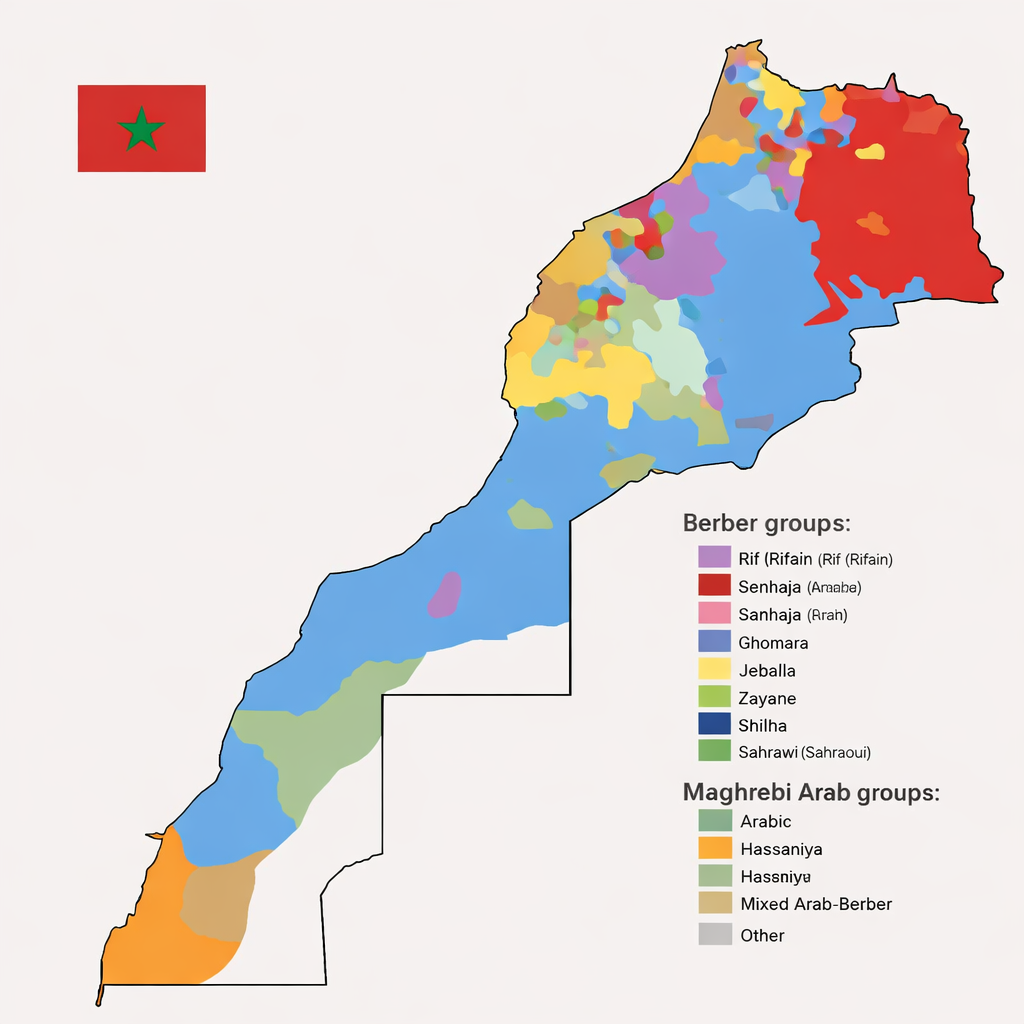
Morocco feels like a country built in layers, and that’s not an accident—it’s what happens when you live at a crossroads. Amazigh roots, Arab influence, African depth, and Europe close enough to be more than a distant idea: over time, these worlds didn’t line up neatly side by side. They blended, quietly and constantly, until the mix became part of the everyday—visible in the shapes of homes, the pace of traditions, and the way language shifts mid-sentence without anyone even noticing.
If you want to feel that fusion rather than just read about it, listen to the music. Moroccan sound carries history in its rhythm. Andalusian melodies can feel like an old memory drifting in from the north—elegant, disciplined, almost architectural. Gnawa, on the other hand, hits deeper: a spiritual pulse tied to African heritage, built for gathering, repetition, and release. Put them together—along with everything in between—and you don’t get a single “style.” You get a living soundtrack of Morocco’s cultural currents, still moving, still mixing, still unmistakably its own.
Learn how Moroccan music reflects its rich cultural tapestry and historical intersections.
Morocco’s Role in the Mediterranean and African History
Morocco has never had the option of being “far from everything.” It sits close enough to Europe for the other shore to feel real, and open enough toward sub-Saharan Africa to be tied—historically and culturally—to routes that carried goods, people, and ideas long before the modern world put labels on them. That geography didn’t just shape maps; it shaped behavior. Morocco learned early that being well-placed means being noticed.
So trade was never only business. It was contact, bargaining, and influence—ports and caravan paths, deals and rivalries, tides and seasons. Diplomacy followed the same logic: Morocco often had to speak across worlds, translating interests, managing pressure, and keeping doors open without giving away the keys.
But crossroads attract more than commerce. They attract ambition. Morocco’s position made it strategic, and that meant moments of tension—foreign designs, colonial appetite, and political contests where the stakes were control, access, and prestige. The country’s response was rarely one-note: sometimes firm resistance, sometimes careful negotiation, sometimes modernization used as a shield as much as a choice.
What lasts through all of it is a sense of participation. Morocco wasn’t a quiet spectator on the edge of events. Its location kept pulling it into the story—regional and global—and over time it developed a particular skill: staying open to exchange, while still protecting a clear sense of itself.
Modern Implications of Morocco’s Location
Today, Morocco still knows how to use its position—not in an abstract, geopolitical way, but in the practical sense of being a country that sits where routes naturally meet. It remains one of the clearest connectors between Africa and Europe: politically, through partnerships and regional dialogue; economically, through logistics and trade flows; culturally, through a constant back-and-forth of people, languages, and ideas that never really stops.
You can see it first in the ports. They are more than coastal infrastructure—they’re working crossroads. Cargo comes in, cargo goes out, and with it comes influence: the ability to move products, to shorten distances, to make Morocco feel like a near neighbor to multiple markets at once. This “near-ness” is part of the country’s modern identity: Morocco isn’t only a destination; it’s also a passage, a platform, a link in a larger chain.
Tourism tells a parallel story, but with a different vocabulary. Morocco’s landscapes don’t offer a single image—they offer range. Atlantic coastlines, Mediterranean light, mountain towns, palm-lined valleys, desert edges: the country attracts visitors precisely because it doesn’t feel like one fixed scene. It feels like a sequence of worlds placed surprisingly close together, each with its own tempo, colors, and traditions.
And that’s the key point: when you understand where Morocco sits—geographically and historically—you stop seeing it as a “faraway” place and start seeing it as a country that actively shapes its neighborhood. Not just by being between Africa and Europe, but by turning that in-between position into presence: in trade, in culture, and in the ongoing conversations that define the region.
Read more
To go further, here are a few relevant internal links.