
The First Day Journey: A New Hire’s Perspective on Employee Onboarding
Emma paused, briefly, before pushing the door open. The gesture was slight, almost imperceptible, yet telling. A first day at work carries a particular tension—anticipation tempered by restraint. What appears ordinary to others presents itself, to the newcomer, as a space to be deciphered.
The contrast emerges at once. Outside, the city moves according to a familiar rhythm. Inside, everything appears already calibrated—movements efficient, interactions purposeful, attention sharply focused. Emma is not merely entering a building; she is stepping into a system in motion.
From the outset, the challenge extends beyond logistics. It lies in reading implicit codes, detecting subtle signals, and anticipating expectations not yet articulated. Onboarding frameworks, in principle, are designed to ease this transition. In practice, their effectiveness depends less on their completeness than on their capacity to orient.
At reception, the exchange is concise: an identity confirmed, a badge issued, directions provided. Yet beneath this procedural simplicity lies a more delicate balance. Does the organisation signal attentiveness, or does it merely process an arrival?
Within minutes, an impression takes shape—not definitive, but formative. Emma is not seeking full understanding. She is gauging whether this environment might, in time, accommodate her presence.
Employee Onboarding Process
A condensed overview of onboarding, designed to show how a new hire moves from arrival to integration. The process combines structure, clarity and human connection, since successful onboarding is never only administrative.
What onboarding really does
Onboarding introduces more than tasks and tools. It helps a newcomer understand the organisation’s rhythm, expectations, culture and working logic. In practical terms, it reduces uncertainty, accelerates adaptation and creates the conditions for confident contribution.
Condensed view
At display level, the journey should remain clear, elegant and easy to scan.
- Before Day One: preparation, access, agenda, welcome message.
- First Day: reception, introductions, orientation, first tools.
- First Week: training, team contact, practical guidance.
- First Month: role clarity, feedback, early contribution.
- First 90 Days: autonomy, alignment, measurable integration.
The onboarding timeline
A clean sequence, suitable for a premium and compact presentation.
Preboarding
Before the first day, the organisation prepares access, documents, communication and logistics.
Preparation phaseArrival
Reception, welcome, first orientation and the initial emotional impression of the workplace.
First contactOrientation
Introduction to the company, its values, policies, reporting lines and expected standards.
Corporate frameworkTraining
Practical exposure to tools, systems, workflows and role-specific responsibilities.
Capability buildingIntegration
Feedback, mentoring, first deliverables and gradual movement towards autonomy.
Longer-term alignmentDetailed process
Expandable blocks keep the page visually condensed while preserving substance.
01
Preboarding
Before the employee arrives
+
02
First Day Welcome
Arrival and first impression
+
03
Organisational Orientation
Understanding the institution
+
04
Role Training
Operational adaptation
+
05
Integration and Follow-up
From presence to contribution
+
Key principles of effective onboarding
The strongest onboarding systems remain clear, human and progressive. They do not overwhelm. They orient. They do not merely inform. They help a new hire understand where they are, how the organisation works, what is expected and how confidence can grow through guided integration.
- Clarity before complexity
- Human contact alongside formal process
- Practical learning rather than passive information overload
- Follow-up beyond the first day
- Steady transition from newcomer to contributor
Meeting the Team: Reading the Invisible Structure
The team meeting introduces a more intricate dimension. Formalities unfold predictably: names, roles, responsibilities. Yet beneath this surface, a subtler architecture becomes visible.
Emma listens closely, yet her attention extends beyond words. She notes who speaks with ease, who quietly gives shape to the discussion, and who stays reserved while still carrying influence. From these details, she builds an informal map of the room — seldom written down, but essential for moving through it with judgment.
It becomes clear that onboarding is not confined to absorbing information. It involves understanding a social dynamic and positioning oneself within it, gradually and without disruption.
Institutional content—history, values, procedures—provides a necessary framework. It offers coherence. Yet it does not, in itself, generate a sense of belonging. That emerges elsewhere, in the margins.
A name remembered. A quiet clarification offered unprompted. A gesture of inclusion that feels unforced. Such details, modest but cumulative, begin to transform abstraction into familiarity.
Emma does not leave the room fully integrated. That would be unrealistic. What she acquires instead is a first point of anchorage—an initial alignment that makes progression possible.
The First Training Sessions: From Information to Understanding
The afternoon introduces operational demands. Training sessions follow in structured succession—dense, at times brisk. Systems, tools and protocols accumulate, each adding a layer of complexity.
Initially, the effect can be disorienting. Attention fragments; information outpaces assimilation. This phenomenon is common, though seldom acknowledged.
A shift occurs, however, when the format allows for interaction. When the trainer pauses, invites questions, and engages with uncertainty, the dynamic changes. Learning ceases to be a one-way transmission; it becomes an exchange.
Emma hesitates, then asks a question. The response is clear, measured, without impatience. Its impact extends beyond the answer itself. It establishes a condition: uncertainty is permissible.
From that point, progress becomes incremental rather than absolute. Partial understanding is acceptable; refinement follows. Confidence does not emerge through immediate mastery, but through successive validations.
Effective onboarding, therefore, does not seek to exhaust knowledge at once. It structures a pathway towards it. It offers orientation rather than completion.
Finding the Workspace: A Concrete Point of Stability
The allocation of a workspace introduces a tangible dimension. At last, the environment acquires a fixed point.
At first glance, the moment appears minor. In practice, it is consequential. A designated space signals recognition. It anchors presence within the broader organisational structure.
The desk is prepared; the equipment functional. Yet the significance lies elsewhere—in the interactions that accompany the moment. A colleague offers practical guidance. Another highlights small but useful details. These gestures reduce uncertainty and facilitate adjustment.
Emma settles in. She makes small adjustments, observes her surroundings, establishes initial bearings. The space, while not yet familiar, becomes less abstract.
Integration, in this sense, does not occur abruptly. It proceeds through successive calibrations. Each step, however modest, stabilises the next.
Reflecting on the Day: From Dispersion to Coherence
By evening, distance allows for reflection. What had seemed fragmented begins to align. The day’s elements—presentations, exchanges, observations—start to cohere.
Clarity remains partial. Some aspects are still indistinct. Yet a structure emerges. Complexity has not been removed; it has become intelligible.
This transition is decisive. Onboarding does not eliminate difficulty. It renders it navigable.
Emma recognises that full comprehension was never the immediate objective. Orientation was. A starting point sufficiently stable to allow progression without disorientation.
Case Study
Strategic Onboarding in a Geopolitical PR Environment


In certain contexts, onboarding acquires a sharper edge. Consider the practices of Edelman within its geopolitical advisory work.
Here, new hires enter an environment defined by velocity and consequence. The organisation operates at the intersection of media, policy and global risk. The stakes extend well beyond internal performance.
Accordingly, onboarding becomes a process of strategic alignment. New consultants are introduced not only to systems and workflows, but to interpretative frameworks: how to read geopolitical signals, anticipate reputational exposure, and construct narratives across diverse cultural and political contexts.
Training frequently takes the form of simulation. A diplomatic dispute escalates. A corporate client faces coordinated media scrutiny. Regulatory pressure intensifies across jurisdictions. Each scenario demands rapid analysis, calibrated judgement and coordinated response.
In such settings, formal instruction proves insufficient. What is required is the cultivation of judgement—an ability shaped through exposure, mentorship and reflection.
Senior practitioners guide newcomers through past cases, not as fixed templates but as structured reasoning. Why a course of action was chosen. What alternatives were weighed. Which risks were accepted.
Onboarding, therefore, evolves into a form of strategic apprenticeship. Integration must occur swiftly, without sacrificing depth.
Emma’s experience unfolds at a more measured pace. Yet the underlying principles remain consistent: clarity, interaction and continuity.
The Ongoing Journey: Extending the First Day
Leaving the office does not conclude the process; it extends it. The first day establishes reference points. The following weeks refine them.
Gradually, questions become more precise. Tasks gain fluidity. Interactions deepen. Without a clearly defined moment, the status of “new hire” recedes.
This evolution resists rigid timelines. It depends on experience, feedback and repeated adjustment.
Onboarding, when approached with care, functions as a continuum. It accompanies the transition towards autonomy rather than marking its beginning and end.
Final Perspective: Beyond Structure, Toward Alignment
Ultimately, onboarding exceeds its procedural dimension. It constitutes an initial negotiation between an individual and an organisation.
On one side: expectations, methods, culture. On the other: experience, capability, adaptability.
The objective lies in their alignment.
Emma does not leave her first day with complete certainty. She leaves with direction. That shift—subtle yet decisive—conditions what follows.
For organisations, the implication is clear. The aim is not to multiply processes, but to create conditions in which individuals can move, steadily and without rupture, from observation to contribution.
Everything else follows.
Read more
To go further, here are a few relevant internal links.
- employee engagement strategies
- workplace culture development
- career path planning
- training program design
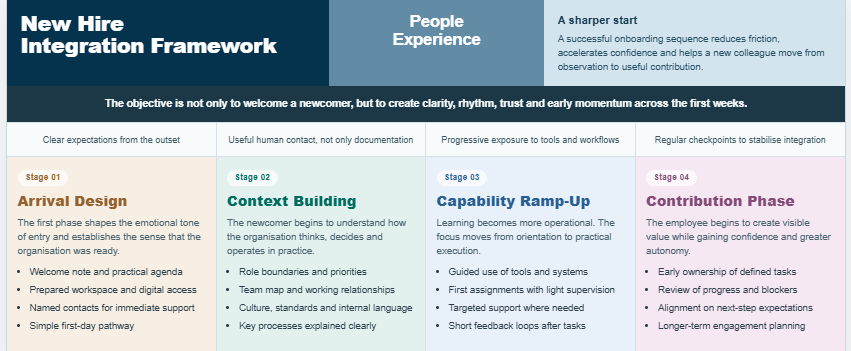
New Hire
Integration Framework
People
Experience
A sharper start A successful onboarding sequence reduces friction, accelerates confidence and helps a new colleague move from observation to useful contribution.
Arrival Design
The first phase shapes the emotional tone of entry and establishes the sense that the organisation was ready.
- Welcome note and practical agenda
- Prepared workspace and digital access
- Named contacts for immediate support
- Simple first-day pathway
Context Building
The newcomer begins to understand how the organisation thinks, decides and operates in practice.
- Role boundaries and priorities
- Team map and working relationships
- Culture, standards and internal language
- Key processes explained clearly
Capability Ramp-Up
Learning becomes more operational. The focus moves from orientation to practical execution.
- Guided use of tools and systems
- First assignments with light supervision
- Targeted support where needed
- Short feedback loops after tasks
Contribution Phase
The employee begins to create visible value while gaining confidence and greater autonomy.
- Early ownership of defined tasks
- Review of progress and blockers
- Alignment on next-step expectations
- Longer-term engagement planning