
Aita, Morocco’s Rough-Edged Songcraft of Witness and Wit
In the markets and wedding tents of Morocco, some songs are built to flatter; aita is built to speak. The word itself carries the sense of a call, a cry, an address thrown outward to be answered. Over decades, aita has moved between countryside and city, between the intimacy of a family celebration and the public arena of a recorded hit, while keeping a distinctive authority: it narrates, teases, mourns, and remembers with a directness that feels social as much as musical.
What aita is and what it does
Aita is a Moroccan vocal tradition, widely associated with chaabi performance worlds and with a repertoire that can be regional in dialect, imagery, and melodic habits. It is often delivered in a charged, speech-like style where the voice leads and the ensemble answers, creating a push-and-pull between solo assertion and communal grounding.
More than a genre label, aita functions like a cultural tool. It can carry coded commentary, local history, and a very Moroccan sense of humor that toggles between tenderness and provocation. In performance settings, its power is partly structural: it invites response, whether in the form of a chorus, a handclap pattern, a dance phrase, or the audience’s shouted interjections.
Listeners new to Morocco sometimes look for a single musical signature and miss the point. Aita is less one sound than a family of practices: narrative singing tied to social occasions, anchored in recognizable rhythmic cycles, and shaped by a performer’s ability to turn everyday language into memorable, singable lines.
Roots and regional flavors
When Moroccans speak of aita, they often speak of place. The tradition is associated with several regional styles that carry their own reputations and aesthetics. Some are linked to plains and coastal zones, others to inland routes of trade and migration. The vocabulary of the songs can shift accordingly: references to agricultural life, coastal winds, saints’ festivals, or urban neighborhoods appear and recede depending on where the repertoire has been nurtured.
Rather than treating these variants as rigid categories, it helps to see them as local accents within a shared approach to song. The same story can travel, picking up new lines, new rhythmic emphases, and new performance expectations. That mobility is one reason aita has endured: it adapts without dissolving into generic entertainment.
Voice, ensemble, and the social contract of performance
Aita typically places the voice at the center, not as a polished instrument but as a carrier of intention. A singer’s phrasing can lean into speech, stretch into melisma, then snap back into crisp consonants. The music often grows in intensity through repetition and escalation: a line is delivered, answered, varied, and returned to with fresh emphasis.
Instrumentation varies by context and era, but the underlying logic is consistent: rhythmic propulsion supports a vocal line that must remain intelligible. This intelligibility matters because aita is not merely sound; it is address. The audience is not an abstract consumer but a participant expected to recognize allusions, catch double meanings, and respond to the singer’s cues.
That expectation creates a social contract. The performer offers a narrative, a complaint, a flirtation, or a moral jab; the public gives back attention, chorus, and sometimes corrective feedback. In aita, the crowd is part of the arrangement.
The sheikhat and the contested prestige of aita
Any serious discussion of aita must reckon with the figure of the sheikha (plural sheikhat): women performers historically central to transmitting repertoire and performance technique. Their visibility in celebrations and public festivities has made them cultural touchstones, and also targets of moral anxiety.
In many Moroccan contexts, the sheikhat have been admired for artistry while simultaneously facing stigma tied to gendered ideas of respectability and public presence. This tension is not incidental; it shapes how aita has been documented, who has been credited, and how repertoires have moved into commercial circuits.
To understand aita’s cultural weight, one has to see this contradiction clearly. The tradition’s endurance owes much to women who carried songs across generations, yet the very spaces that made their work possible have often been treated as socially ambiguous. Aita therefore offers a window into Morocco’s negotiations between public joy and private judgment.
Two concrete examples of how aita lives today
Example 1: A wedding set that turns into a public conversation
At a Moroccan wedding, aita can begin as a recognizable opening call that gathers attention across a noisy room. The singer’s first lines establish the mode: celebratory, nostalgic, teasing, or sharp. As the tempo tightens, guests start to contribute—clapping becomes synchronized, relatives drift closer, and women in the front may echo refrains or add ululations at moments of emphasis.
What makes this more than entertainment is the way lyrics can slip between praise and commentary. A line that seems to honor a family can also contain a joking reminder about obligations, generosity, or reputation. Everyone understands the double function: aita blesses the occasion while keeping social truth within earshot.
Example 2: A recorded track that carries rural aesthetics into urban listening
In the era of cassettes and, later, streaming, aita has been rearranged for broader audiences. Producers may tighten the structure, highlight a punchy rhythmic pattern, or foreground a hook that plays well on the radio. Yet the best recordings keep an audible trace of the live setting: call-and-response, a sense of gathering momentum, and lyrics that still feel addressed to someone, not merely performed at them.
This shift changes the relationship between singer and audience. The listener is no longer physically present, but the track can still feel interactive because aita’s core gesture is communicative. Even in headphones, it retains the texture of public life.
Language, metaphor, and the art of saying without saying
Aita’s lyrical craft often depends on what is left implicit. Everyday vocabulary can be arranged so that an apparently simple phrase carries layered meaning—romantic, moral, political, or comic—depending on context. This is not mere vagueness; it is a sophisticated social technique in a culture where indirectness can be a form of tact, safety, or wit.
Metaphors tied to landscape and movement appear frequently: roads, horses, rivers, winds, seasons, and the changing distance between people. Such imagery does more than decorate the song. It allows the singer to speak about desire, disappointment, or loyalty while maintaining plausible deniability, especially in mixed company.
For international readers, this can be the hardest feature to translate. Aita’s meaning often lives in cadence, in local idiom, and in the shared knowledge of an audience that knows who is being teased, who is being warned, and which social line is being tested.
Aita in the wider Moroccan soundscape
Morocco’s musical landscape is plural by design, with urban art musics, devotional repertoires, Amazigh traditions, Saharan styles, and popular hybrids coexisting and influencing one another. Aita occupies an important corridor between rural memory and national popular culture: it has fed into chaabi performance circuits and been reshaped by them in return.
Its relationship to other genres is not a matter of competition so much as shared infrastructure. Weddings, seasonal festivals, and neighborhood celebrations are ecosystems where musicians borrow gestures, rhythms, and audience-management strategies. Aita’s signature contribution is its rhetorical stance: it insists on address, on being heard as speech with stakes.
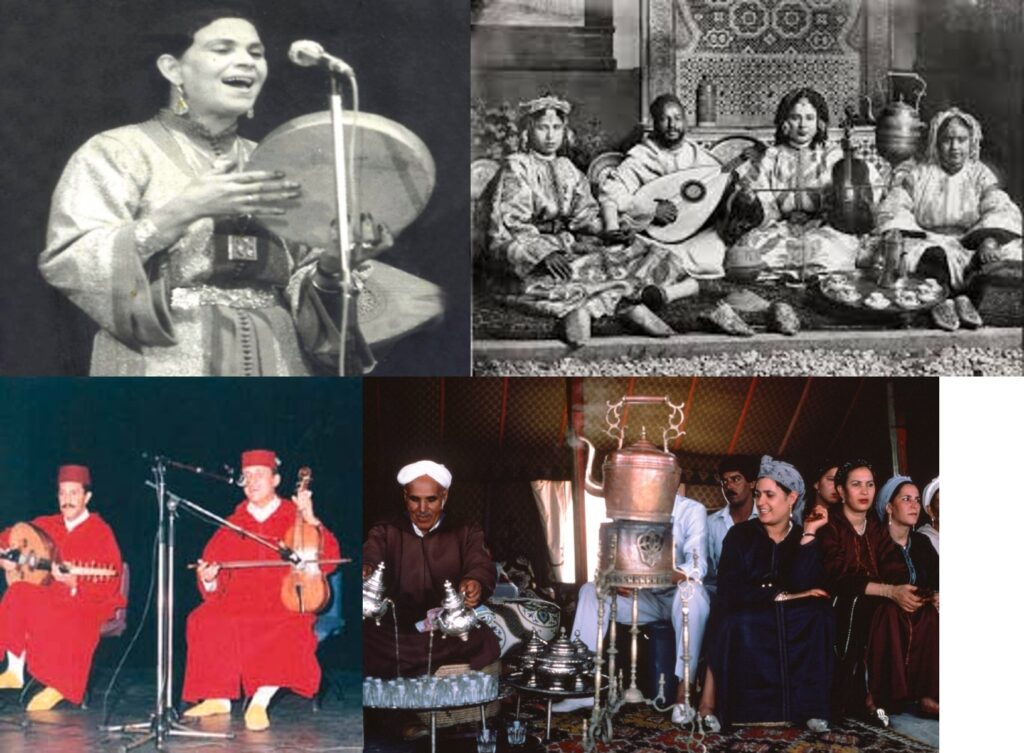
Listening with attention: what to notice
For readers encountering aita for the first time, a few listening habits can sharpen appreciation:
- Follow the build: many performances intensify through cycles, returning to a line with fresh urgency.
- Listen for response: chorus, handclaps, and audience noises are not background; they are part of the form.
- Track the diction: consonants and rhythmic speech patterns often carry as much expression as melody.
- Respect the context: some lines are playful, some are socially pointed; meaning shifts with the occasion.
Aita rewards patience. Its pleasures are rarely instant virtuosity alone; they are the pleasures of recognition, escalation, and social intelligence.
Why aita matters as cultural history
Aita is sometimes filed away as folk entertainment, but its deeper value is archival. It holds traces of migration between countryside and city, of changing gender norms, of how communities narrate their own conflicts and aspirations. It also shows how art can remain grounded in everyday life without becoming static.
In a time when global music circulation often pressures traditions to standardize, aita’s most compelling performances keep their edges: the grain of the voice, the quick turns of phrase, the charged relationship to an audience that is expected to understand. That insistence on local intelligence is precisely what makes aita legible as culture, not just content.
If you want to go further, approach aita as both music and social practice: listen across regions, pay attention to performance settings, and notice how the same refrain can land differently in a wedding tent, a concert hall, or a recording designed for travel. Bloc prêt à copier-coller : titres, slugs, meta, chapos, angles, FAQ, tags, liens internes.
Structured cultural reference
Aita, Morocco’s Rough-Edged Songcraft of Witness and Wit
Aita is not polished by design. It is sung close to the ground—where people work, celebrate, argue, endure. Its lyrics can praise, tease, warn, or expose. In a few lines, a whole social scene can be captured.
What Aita is
Aita is a Moroccan vocal tradition shaped by storytelling, sharp phrasing, and communal energy. It is often carried by call-and-response patterns and a performance style where meaning is delivered with both seriousness and humor.
If you want a one-line definition for readers: Aita can be described as sung social commentary with bite.
Why it matters
- Daily life is documented through metaphor, irony, and direct address.
- Community memory is kept alive through repeated lines and shared refrains.
- Authority is questioned through wit rather than confrontation.
- Emotion is balanced: grief can sit beside laughter without contradiction.
Aita often feels “rough” because it refuses to be ornamental. That refusal is its strength.
FAQ
Is Aita a “genre” or a “style”?
Aita is usually treated as a tradition with multiple regional expressions.
Is Aita performed for audiences today?
Aita is still performed, and it is frequently reinterpreted in modern contexts.
Is humor used in Aita?
Humor is often used to sharpen meaning and reduce fear of speaking plainly.